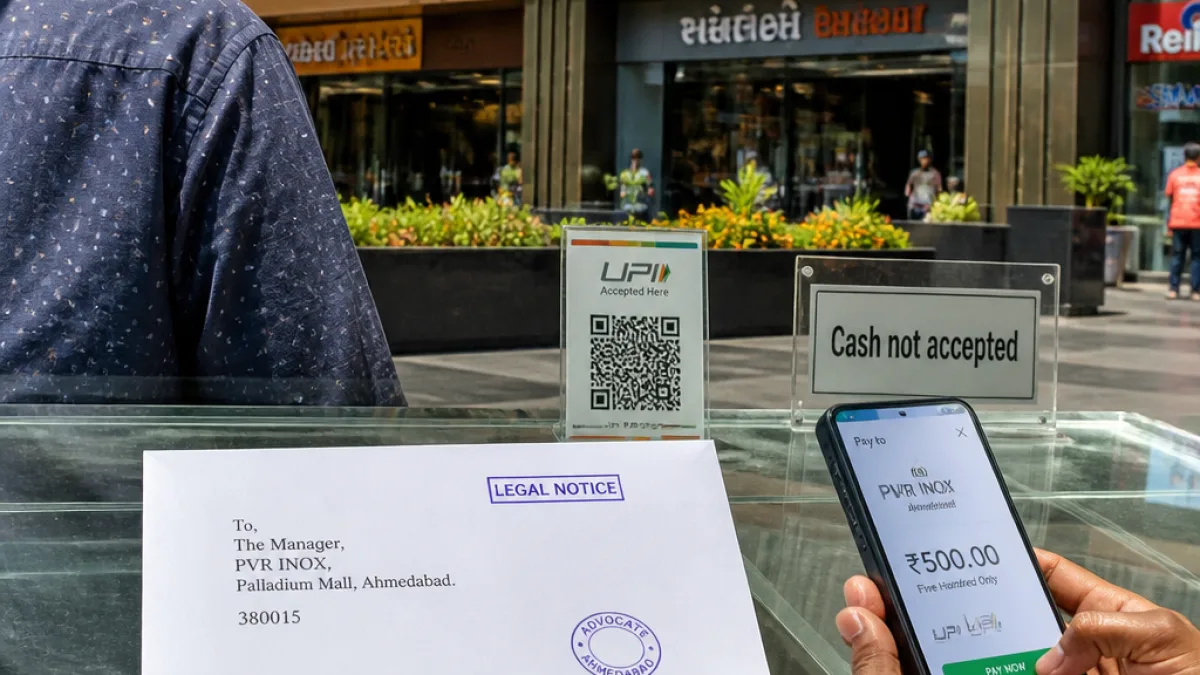
An advocate practising in the Gujarat High Court has served a legal notice on multiplex operator PVR INOX Ltd, alleging that staff at its Palladium Mall outlet in Ahmedabad refused to accept cash payments and compelled him to pay via UPI for tickets and refreshments.
Allegation: cash refused, UPI compelled
Advocate Utkarsh Dave said he attended a screening of 'Mirzapur: The Movie' at the Palladium Mall multiplex on September 13 and was informed at the box office that cash would not be accepted. According to the legal notice, Dave paid ₹475 by UPI for his ticket and, later, when buying food and beverages, was again told cash was not accepted and paid ₹420 by UPI.
The notice, served on PVR INOX on September 16, requests the company to confirm whether employees at the Palladium Mall outlet were acting under any written company policy, circular or internal instruction prohibiting cash payments.
Legal basis cited
In the notice, Dave invokes Section 26(1) of the Reserve Bank of India Act, 1934, which recognises RBI-issued banknotes as legal tender throughout India. He said his grievance is not with the provision of digital payment options such as UPI or cards, but with a purported blanket exclusion of cash that, he argues, denies a willing customer the choice of payment instrument.
“Cash is not refused at any time,” a senior PVR INOX official told reporters when sought for comment, according to the reporting.
Company response and next steps
The Indian Express reported that it had sought a formal response from PVR INOX; at the time of filing, a formal corporate reply was awaited. The company official quoted by the paper denied refusing cash.
The legal notice includes copies of the two UPI transactions cited by the advocate. It asks PVR INOX to state whether the alleged refusal amounts to a company directive and to produce any written policy or instruction on payment modes applicable at the Palladium Mall outlet.
Broader implications for businesses and consumers
The case highlights a tension between private establishments’ operational preferences for digital payments and consumers’ entitlement to pay in legal tender. While many merchants and service providers encourage cashless transactions for convenience and efficiency, an absolute prohibition on cash raises legal and consumer-protection questions.
Consumer advocates say businesses may offer digital payment options but cannot effectively deny a customer the right to use currency recognised as legal tender without a lawful basis. The legal notice frames the issue as one of transparency and fairness in consumer-facing transactions.
- Transactions cited: ₹475 (ticket), ₹420 (food & beverages).
- Location: Palladium Mall multiplex, Ahmedabad.
- Legal provision referenced: Section 26(1), Reserve Bank of India Act, 1934.
Data from the complaint
| Item | Amount | Payment method (alleged) |
|---|---|---|
| Movie ticket | ₹475 | UPI |
| Food & beverages | ₹420 | UPI |
If PVR INOX confirms the existence of an internal directive, the matter could prompt both regulatory scrutiny and consumer complaints. Conversely, if the company maintains that cash was accepted and the incident was an isolated staff-level misunderstanding, retailers may still use the episode to review staff training and point-of-sale practices.
The episode comes amid a broader shift in urban retail and services towards digital payments, spurred by UPI’s mass adoption, merchant incentives, lower transaction friction and pandemic-era preferences. Yet the legal-tender status of banknotes means courts and regulators may be called on to clarify how far private establishments can limit cash acceptance in practice.
The advocate has asked PVR INOX to respond to the notice within a stipulated timeframe; further legal steps were not detailed in the public report. The company’s formal position and any evidence it provides — such as a written policy or denial of the claim — will be central to whether the matter advances to consumer fora or court.
The incident is directly relevant to Ahmedabad consumers who prefer or rely on cash payments, and to businesses weighing operational convenience against legal and reputational risk when adopting cashless practices.