
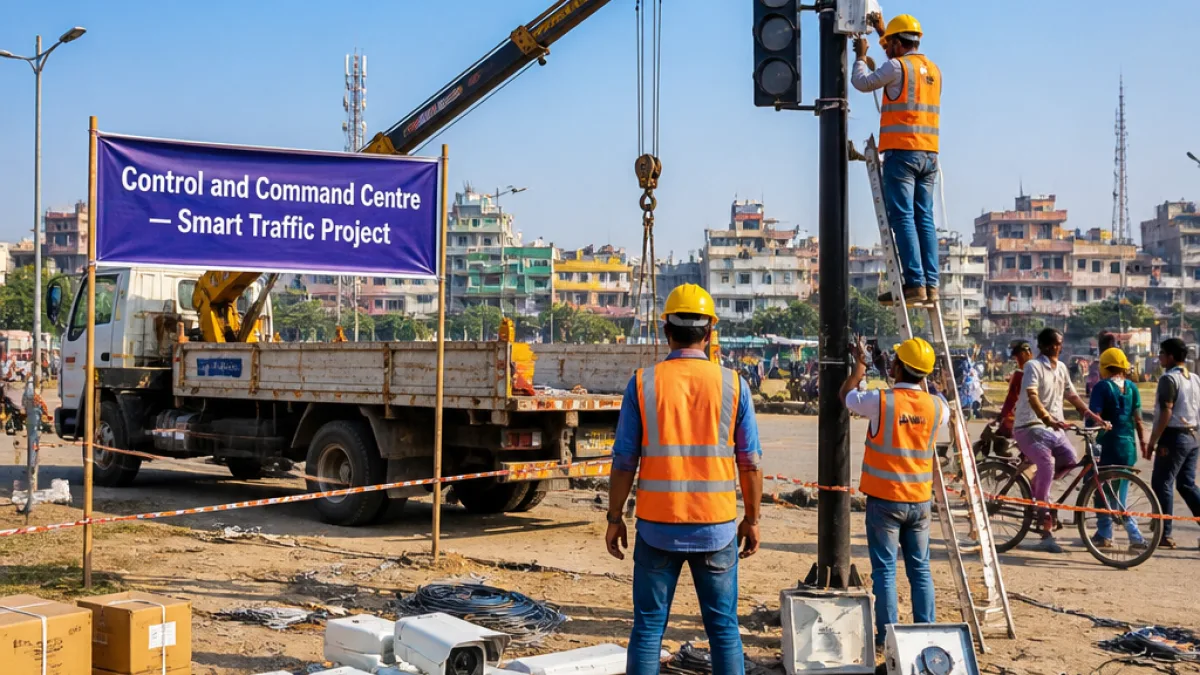
Project restarted after site dispute; Gandhi Maidan chosen for control hub
Work has resumed on Gaya’s long-awaited smart traffic management project after a six-month impasse over the location of the city’s Control and Command Centre (CCC), according to media reports. The implementation agency has started installing modern traffic signals, sensors and high-resolution cameras at 75 locations inside the Gaya Municipal Corporation area, with officials targeting completion before Chhath.
The project, which missed an initial deadline of June 30, was delayed after municipal councillors, led by Mayor Birendra Kumar, objected to Beltron’s proposed site on vacant land within municipal corporation premises. Deputy Commissioner Shashank Shubhankar issued a stay on construction at that location and the Corporation later withheld a no-objection certificate, records show. The dispute has now been resolved and the CCC will be constructed at Gandhi Maidan, the municipality has decided.
Work on signals and high-resolution CCTV cameras has begun; the agency has promised to complete the work before Chhath, according to local reporting.
What the system will include
- Installation of modern traffic signals at 75 junctions, including Rai Kashinath Mod, MG College intersection and Bata Mor.
- Deployment of 668 high-resolution CCTV cameras and 294 poles across the municipal area.
- Adaptive traffic control capable of adjusting signal timings to actual traffic demand using sensors, cameras and AI algorithms.
- Automatic Number Plate Recognition (ANPR), face recognition capability and a public address system for real-time management and enforcement.
Gaya Town MLA and Assembly Speaker Prem Kumar, who has been pursuing the project, visited the chosen site at Gandhi Maidan on Friday morning, local reports stated. Municipal Commissioner Gagan Kumar provided the timeline details and confirmed the decision to move the CCC to Gandhi Maidan, according to the reporting.
Expected benefits and local implications
Officials say the integrated system will provide real-time traffic management and is expected to improve traffic flow, reduce congestion and shorten waiting times by using adaptive signal control rather than fixed schedules. High-resolution cameras and ANPR capability are intended to assist in incident detection, traffic rule enforcement and quicker response by enforcement agencies.
For commuters, the project promises smoother movement on key arteries such as the MG College intersection and Bata Mor, which experience routine peak-hour congestion. The administration’s public commitment to complete the work before Chhath underlines the political sensitivity: the festival draws large numbers of visitors and increased local movement in early November.
| Component | Planned number |
|---|---|
| Traffic signal locations | 75 |
| High-resolution CCTV cameras | 668 |
| Poles | 294 |
Process and remaining steps
Beltron, the executing agency, had begun preliminary earthwork at the initially proposed site before objections led to a stoppage. The stay order from the Deputy Commissioner and the lack of an NOC from the Municipal Corporation were the immediate causes of delay, according to official records cited in reports. With the site issue settled, the agency has resumed installation of poles, signals and cameras and is setting up the CCC infrastructure at Gandhi Maidan.
Authorities will need to complete integration of sensors, AI-based control algorithms and the communication backbone linking field hardware to the CCC before the system becomes fully operational. The project will also require testing phases to calibrate adaptive signal timings and to ensure accurate functioning of ANPR and other camera-based features.
The restart removes a principal administrative hurdle, but residents and civic groups will watch implementation closely for timeline adherence, the effectiveness of adaptive controls at peak hours, and the governance of surveillance technologies once the system is live.