
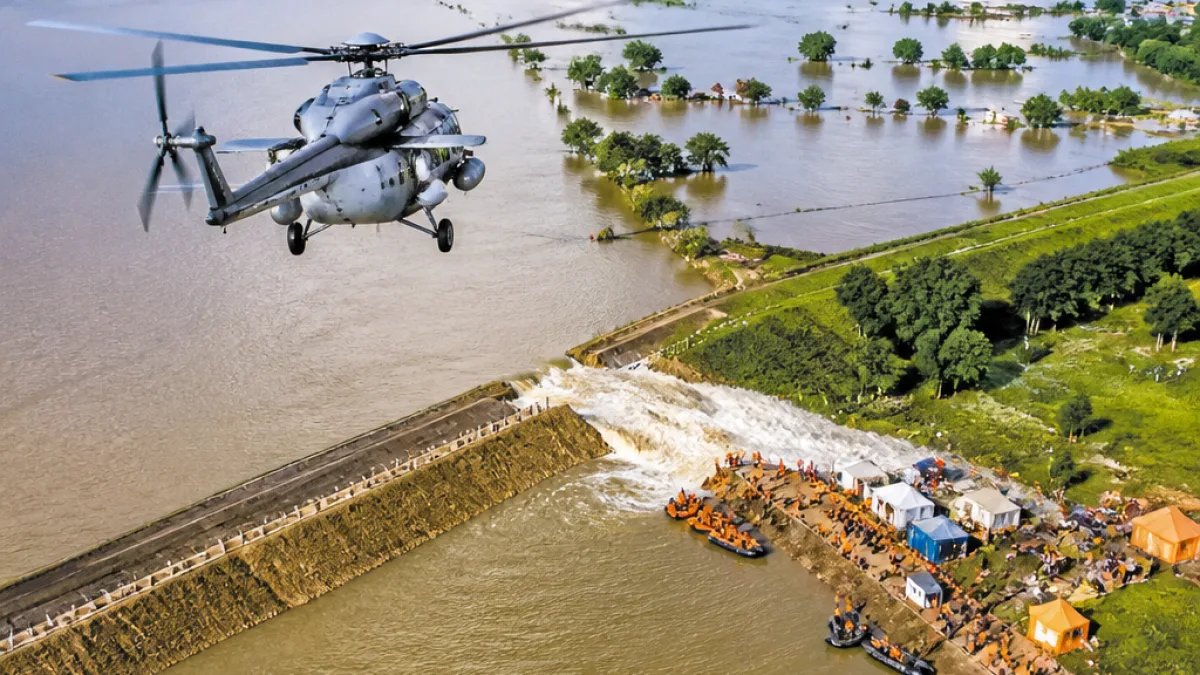
PATNA: Bihar Chief Minister Samrat Choudhary carried out an aerial survey of flood-hit areas in north Bihar on Monday as record water released from Nepal pushed up river levels, affecting several districts including West Champaran, East Champaran and Gopalganj.
Survey, inspections and an urgent review
Choudhary, accompanied by Deputy Chief Minister and Water Resources Minister Vijay Kumar Chaudhary, reviewed the situation from the air over East Champaran, Gopalganj, Vaishali and Saran districts. He later chaired a meeting with senior officials to assess water levels, discharge from barrages, the condition of embankments and night patrolling arrangements.
Present at the review were Union MP Radha Mohan Singh, Chief Secretary Pratyaya Amrit, Gopalganj District Magistrate Saurav Samir and Superintendent of Police Vinay Tiwari, according to a statement issued by the Chief Minister’s Office (CMO).
Relief measures ordered
The chief minister directed officials to remain on high alert and to be fully prepared for rescue and relief operations. He instructed the administration to immediately open relief camps in affected areas and said community kitchens should be set up where needed to provide food to displaced residents.
“Chief Minister directed officials to continuously monitor vulnerable and low-lying areas, ensure prompt assistance to affected people and maintain full preparedness for rescue operations,” the CMO said.
District teams were told to coordinate closely with State Disaster Response Force (SDRF) and National Disaster Response Force (NDRF) contingents for evacuations and search-and-rescue, the statement added.
What triggered the surge
The immediate trigger was heavy discharge from Nepal. Officials reported that Nepal released a record 6.52 lakh cusecs of water at the Devghat gauge station, a volume higher than the previous recorded peak of 5.26 lakh cusecs on 27 August 1999. The Gandak recorded a peak discharge of 5,43,500 cusecs at the Gandak Barrage in Valmikinagar, West Champaran, at 5.00 am.
Local impact and infrastructure checks
Officials inspected embankments and checked the status of bridges and barrages. In Gopalganj district, officers also examined the Dhumariaghat bridge as part of the assessment. Rising water levels in the Gandak have caused alarm among residents of low-lying and riverside communities, officials said.
The administration emphasised night patrolling of vulnerable reaches of the river and directed immediate remedial measures where embankment stress or seepage was observed. Continuous monitoring from the Water Resources Department (WRD) command centre in Patna was reported; Choudhary is said to have kept track of the situation through the night.
Practical information for affected residents
- Relief camps are being established in affected blocks; district administrations will announce specific locations locally.
- Community kitchens have begun functioning at some sites to provide cooked food to evacuees.
- Evacuation and rescue operations will be coordinated with SDRF and NDRF teams; local district control rooms will direct movement.
Officials urged residents in low-lying and flood-prone areas to follow directions from district authorities and to move to designated relief centres when asked. The CMO statement stressed prompt assistance and full preparedness for rescue operations.
Wider context
Northern Bihar is periodically vulnerable to floods originating in upstream catchments in Nepal. Sudden releases from transboundary reservoirs and heavy monsoon rains often swell rivers like the Gandak, Koshi and Mahananda, testing embankments and local disaster-response capacity. The recent discharge from Devghat, larger than earlier records, has strained the system and prompted swift administrative action.
Authorities in the affected districts will continue to monitor river gauges, manage embankment patrolling and co-ordinate relief measures until water levels recede. Further updates are expected from the Chief Minister’s Office and respective district administrations as the situation evolves.
| Metric | Reported value |
|---|---|
| Devghat gauge discharge (Nepal) | 6.52 lakh cusecs |
| Previous highest Devghat discharge | 5.26 lakh cusecs (27 Aug 1999) |
| Gandak peak at Valmikinagar | 5,43,500 cusecs |
As relief measures roll out, the immediate priorities remain evacuation of vulnerable populations, protection of embankments, and uninterrupted coordination between state and district agencies with SDRF/NDRF support.