
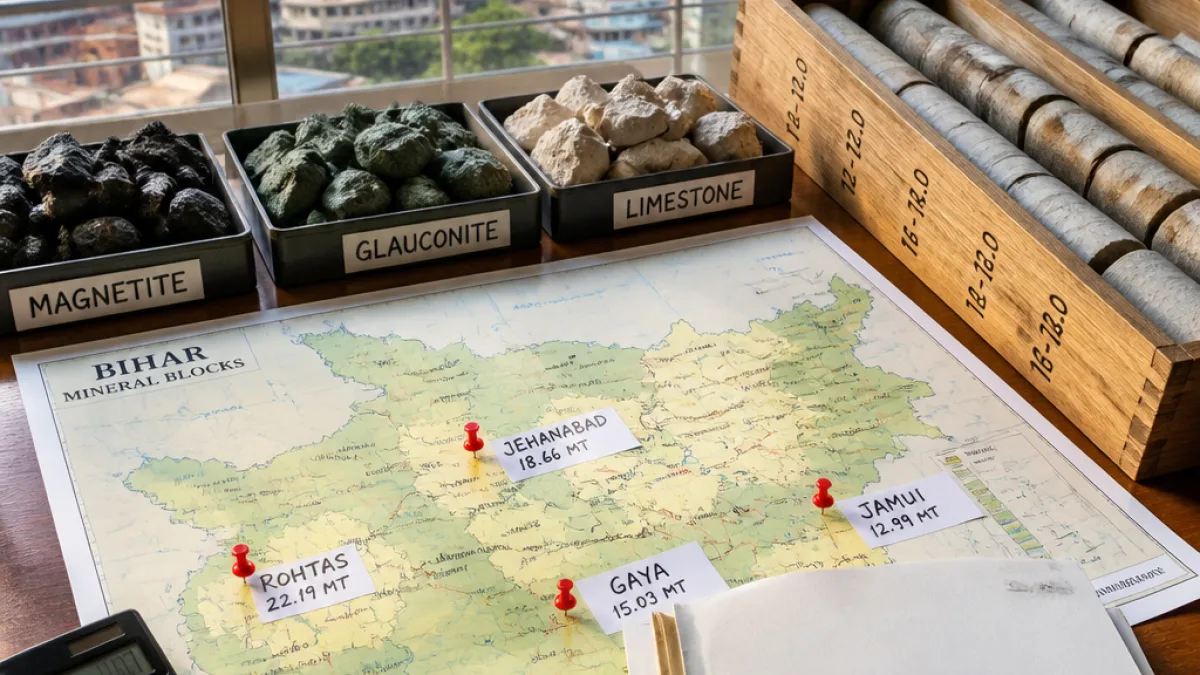
Bihar is aiming to revive a mineral economy that was left diminished after the state split in 2000, after geological surveys between 2021 and 2024 identified mineral resources estimated at more than ₹21,000 crore across Rohtas, Jamui, Gaya and Jehanabad, according to a report in The Indian Express cited by state officials.
Potential revenue and timeline
State authorities say the newly recorded resources could generate upwards of ₹5,000 crore per year in mining revenue once deposits are converted into working mines. That would outstrip Bihar's present record mining collection of ₹3,592 crore, which is largely derived from minor minerals such as sand and stone.
"The discoveries could potentially generate more than ₹5,000 crore in annual mining revenue once the identified resources are converted into operational mines," state officials said.
Officials have set a broad target window for bringing projects into extraction between 2026 and 2031. However, work remains at early stages: exploration, auctions, environmental and forest clearances and grant of mining leases must still be completed before commercial production can begin.
Where the minerals are and their value
Rohtas district accounts for a large share of the identified wealth. Geological teams have estimated substantial deposits of glauconite, limestone and pyrite in different blocks of the district, while Jamui has shown promise for magnetite and gold.
| District / Block | Mineral | Estimated quantity / value |
|---|---|---|
| Rohtas — Pipradih-Bhurwa, Chutia-Nauhatta | Glauconite | ~130.11 million tonnes; valued at ₹14,048 crore |
| Rohtas — Bhora-Kathra | Limestone (high-grade) | 33–39.68 million tonnes; valued at ₹1,761.42 crore |
| Rohtas — Amjhor | Pyrite | Holds nearly 95% of India’s known pyrite resources (no separate value provided) |
| Jamui — Majos, Bhanta | Magnetite; gold potential | Magnetite ~48.40 million tonnes; value range ₹3,817.60 crore–₹6,000 crore; additional deposits in Bhanta |
Economic and strategic implications
Glauconite is noteworthy because it can serve as a potassium source for fertiliser manufacture. India currently depends heavily on imported potash; indigenous glauconite could therefore have implications for the fertiliser supply chain if processing and beneficiation are established at scale.
Limestone deposits support the cement and quicklime industries, while large pyrite reserves are significant for sulphuric acid production and other chemical processes. Magnetite and any confirmed gold finds would add diversity to the state's mineral portfolio and could attract different kinds of investment.
- Value capture: Conversion of in-situ resources into operating mines will be needed for the state to realise royalties, lease rents and other collections.
- Supply chain: Local beneficiation, transport, power and water infrastructure will determine whether value-added industry sets up in Bihar or raw material moves out.
- Employment: Exploration and mining could generate local jobs if licences and contractors hire regionally and training is provided.
Challenges on the road to production
Officials and experts caution that survey figures are an initial step; several obstacles must be overcome before revenue projections materialise.
- Completion of detailed exploration and feasibility studies to firm up reserve estimates and mining plans.
- Conducting environmental impact assessments and securing statutory clearances, including forest and wildlife permissions where applicable.
- Designing transparent auction processes, issuing mining leases and ensuring regulatory oversight to prevent illegal extraction.
- Developing or upgrading transport, power and processing facilities to support commercial operations.
State planners are targeting staged extraction across multiple projects during the 2026–2031 period, but a precise schedule for auctions and lease grants has not been released. The conversion of geological wealth into fiscal receipts will therefore depend on the speed of clearances and the attractiveness of blocks to industry players.
For Bihar, rebuilding a mineral sector could be important not only for immediate revenue but for long-term industrial development. Effective policy design, investment in infrastructure and strong regulatory mechanisms will determine whether the state's newly recorded deposits translate into sustainable economic benefit.
Reporting here is based on a compilation of findings published by The Indian Express and statements attributed to state officials describing survey results from 2021–24.