
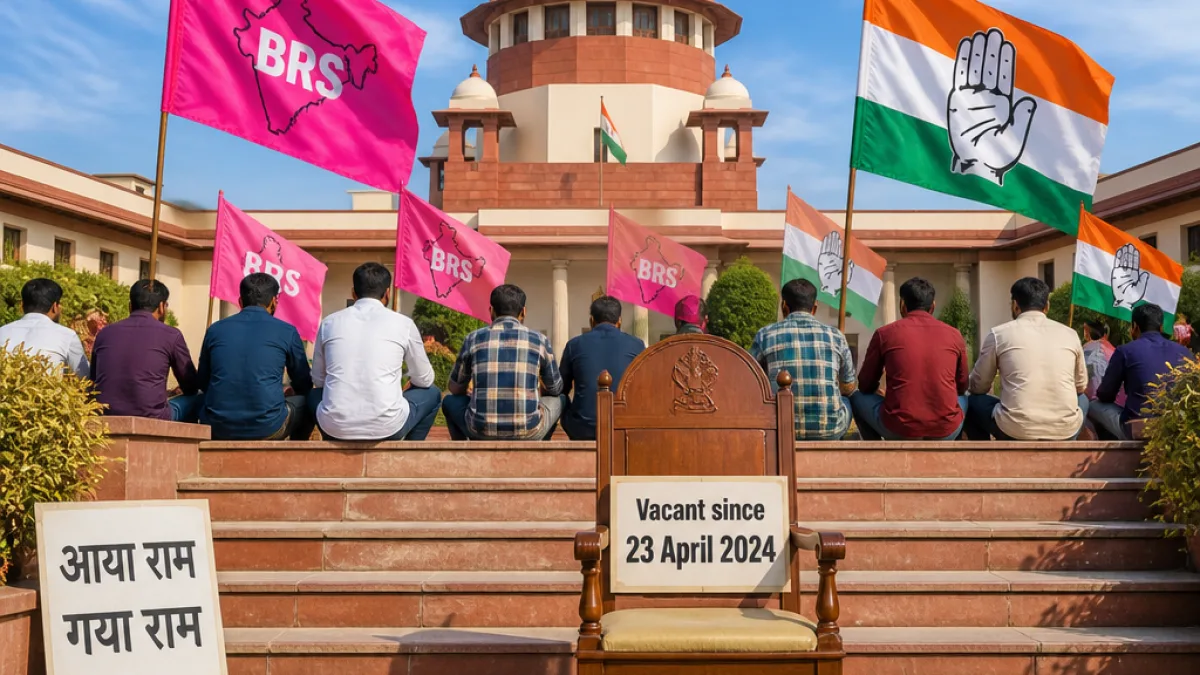
Supreme Court upholds disqualification; bench flags repeated party-switching
The Supreme Court on Thursday dismissed a plea by Bharat Rashtra Samithi (BRS) legislator Danam Nagender challenging a Telangana High Court order that declared him disqualified for contesting the 2024 Lok Sabha election on a Congress ticket while he was a BRS member of the Assembly. The apex court observed the facts as illustrative of frequent party-switching, using the colloquial expression "Aaya Ram, Gaya Ram".
A bench comprising Chief Justice Surya Kant and Justices Joymalya Bagchi and V Mohana said there was no ground to interfere with the high court’s order, reported PTI. Justice Bagchi orally asked:
"Your case is ‘Aaya Ram, Gaya Ram, phir aaya Ram’?"
The Telangana High Court had declared Nagender, MLA from Khairatabad, disqualified with effect from 23 April 2024, after finding that he had contested the Secunderabad Lok Sabha seat on a Congress ticket while holding the BRS Assembly seat. The high court’s decision came on petitions filed by BJP floor leader in the Assembly Alleti Maheshwar Reddy and P Kaushik Reddy of the BRS, which sought to set aside the Speaker’s order and declare the MLA disqualified under Paragraph 2(1)(a) of the Tenth Schedule of the Constitution.
Timeline of key events
| Event | Date |
|---|---|
| Nagender declared disqualified by Telangana High Court | 23 April 2024 |
| Speaker dismissed petitions seeking disqualification | 11 March 2026 (Speaker's order reported) |
| Supreme Court dismissed Nagender's plea | 24 September 2026 |
Senior advocate Mukul Rohatgi appeared for Nagender before the Supreme Court, the PTI report said. The high court had set aside an order of the Assembly Speaker in March this year that had dismissed petitions seeking Nagender’s disqualification.
Legal ground and arguments
The case turned on the Tenth Schedule, which governs disqualification of legislators for voluntarily giving up party membership or contravening party directives on voting. Petitioners argued that Nagender’s filing of a nomination affidavit and contesting the Lok Sabha election as a Congress candidate while being a BRS MLA amounted to voluntarily abandoning his party membership and therefore attracted disqualification.
Nagender, according to court records reported by PTI, contested the Secunderabad Lok Sabha seat on a Congress ticket in 2024 and later sought to continue as an MLA for Khairatabad — a seat he had won on a BRS ticket in the 2023 Assembly elections. The high court found that formal contesting on another party’s ticket while remaining a member of the Assembly amounted to disqualification.
Implications and local context
Although the litigation involves a Telangana legislator, the judgment underscores how courts interpret the anti-defection law and its application where elected representatives contest elections on another party's ticket. For Gaya and Bihar politics — where defections and party-switching are part of the electoral landscape — the case reinforces judicial scrutiny of actions that may amount to giving up party membership.
- The Supreme Court declined to interfere with the Telangana High Court order that declared the Khairatabad seat vacant effective 23 April 2024.
- Key legal focus was on Paragraph 2(1)(a) of the Tenth Schedule of the Constitution and whether nomination on another party’s ticket constitutes voluntary relinquishment of membership.
- The bench’s remark popularised the well-known phrase used to describe frequent turncoat politics.
The PTI report noted that Nagender was among a group of BRS legislators alleged to have moved to the Congress after the 2024 Lok Sabha elections, though the high court’s disqualification order relied specifically on his formal candidature for the Secunderabad seat. The Supreme Court’s dismissal of his plea leaves the high court order intact and the Khairatabad Assembly seat vacant as per the earlier declaration.
No further orders or directions were reported by the apex court on Thursday. The matter remains a reference point for legislators, party organisations and election authorities on the boundary between electoral contestation and the anti-defection law.