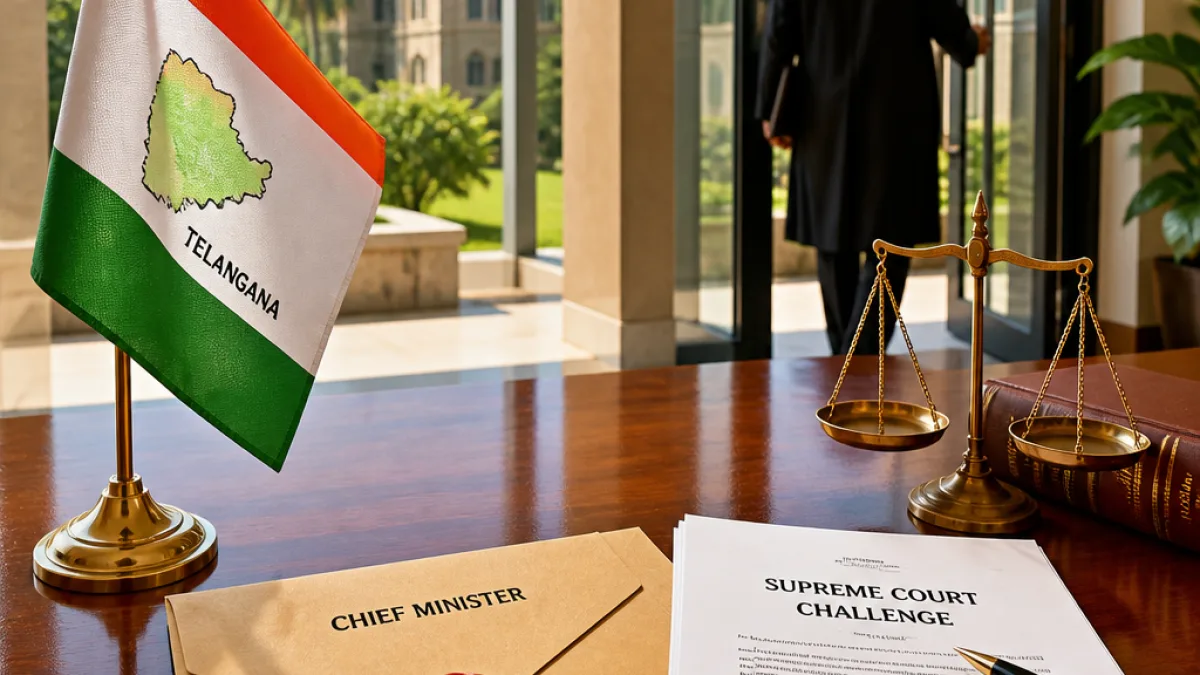
Congress MP Renuka Chowdhury has requested the Telangana government to assist the Supreme Court proceedings challenging recent amendments to the Transgender Rights law that removed the right to self-identification and introduced mandatory medical certification, according to a letter addressed to Chief Minister Revanth Reddy.
The letter, sent by the Rajya Sabha MP from Telangana, sought the state’s intervention through the office of the Learned Additional Advocate General, Shri Rajnikanth Reddy, to "assist the court in defence of the constitutional rights and dignity of transgender persons," and to examine the administrative and financial implications of the amended Act for the State.
"I would earnestly request the Government of Telangana to extend its support to these proceedings through the office of the Learned Additional Advocate General, Shri Rajnikanth Reddy, by assisting the court in defence of the constitutional rights and dignity of transgender persons," the letter said.
Legal and administrative concerns flagged
In her communication, Ms. Chowdhury underlined that the State should "carefully examine the administrative, financial and implementation implications of the new Act" to identify where the amendments might conflict with Telangana’s existing welfare architecture and commitments to protecting transgender rights. She noted that such an examination would be important to flag any state-level barriers to implementation and to safeguard existing schemes and entitlements for transgender persons.
The amendments to the Transgender Rights law, passed by Parliament in March, have generated widespread protests from transgender activists nationally and prompted resignations from members of the Government’s National Council for Transgender Persons. Central to the controversy is the removal of the provision allowing self-identification of gender identity, replaced by a system that requires medical certification—an issue opponents say undermines bodily autonomy and dignity.
Political and moral stakes for Telangana
Ms. Chowdhury told the Chief Minister that Telangana has "consistently stood for inclusion, social justice, and constitutional morality," and that the State’s intervention in the Supreme Court would carry both legal and moral significance. She urged the ruling Congress administration in Telangana to take a clear position in support of the challenges to the amended law.
The request places the Telangana government at a crossroads: whether to intervene in a matter that primarily concerns central legislation and the Supreme Court, but which also has direct implications for state-run welfare schemes and administrative processes affecting transgender persons within the State.
What the intervention would mean
If the State decides to assist the petitioners in the Supreme Court, its role could range from filing a statement of support or an affidavit to active participation by the Additional Advocate General in court hearings. Such state-level backing would augment legal arguments already put forward by civil society and affected individuals, and could influence judicial appreciation of the law’s impact on governance and rights at the federal and state levels.
- Request made to: Chief Minister Revanth Reddy
- Requested action: State support in Supreme Court via Additional Advocate General
- Core legal issue: Removal of self-identification; requirement of medical certification
- Follow-up asked: Administrative, financial and implementation review by the State
| Item | Detail |
|---|---|
| Sender | Renuka Chowdhury, Rajya Sabha MP (Congress) |
| Recipient | Chief Minister Revanth Reddy |
| Legal forum | Supreme Court of India (ongoing challenges) |
Telangana’s response will be closely watched by activists and government agencies alike. State-level involvement could shape the way welfare mechanisms for transgender persons are adjusted or preserved, and may influence broader national debate over rights, dignity and the role of medical certification in gender recognition.
The letter reiterates earlier criticisms by opponents of the amendment that the change from self-identification to medical certification substantially alters the guarantees intended by earlier legislation and may create barriers for marginalised persons seeking legal recognition and access to entitlements.
How quickly the State government responds, and whether it opts to place its weight behind the constitutional challenge, will determine the next phase of legal advocacy in which Telangana could play a direct role.
Reporting indicates the letter also asked the State to review provisions to ensure there is no conflict between the amended central law and Telangana’s existing policies and schemes for transgender welfare. The matter remains under active consideration among legal and political actors in the capital, Hyderabad, and beyond.