Agartala: Tripura’s potential as a hub for cultivated agarwood (agar) received fresh attention in Parliament on Thursday when Lok Sabha MP Kriti Singh Debbarma asked the Union government to simplify rules for transit, certification and export and to extend technical and market support to growers.
Centre sets quotas, promises digital certification and technical help
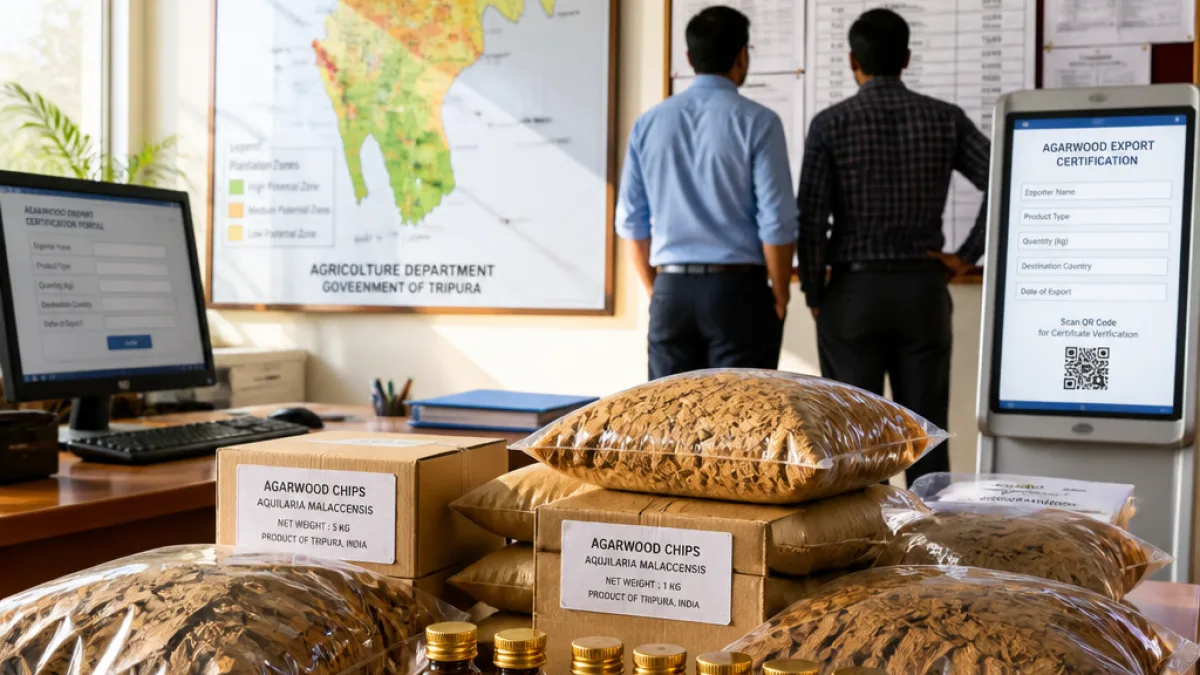
Replying to the MP, the Union Environment Ministry said it has notified an annual export quota for Tripura covering the period 2024-25 to 2026-27. The quota includes 22,500 kg of agarwood chips/powder/sawdust and 1,047 kg of agarwood oil. The ministry also said steps are being taken to modernise and streamline certification and export procedures via a digital system, and that technical assistance is being provided for scientific inoculation and sustainable cultivation.
Debbarma had emphasised agarwood’s capacity to generate employment in rural areas, expand exports from the Northeast and contribute to sustainable economic growth in Tripura and neighbouring states. She urged greater support for scientific cultivation methods, inoculation techniques, processes for value addition and improved market access for small and marginal growers.
"I will continue raising issues aimed at creating new opportunities and strengthening sustainable development in Tripura and the Northeast," Debbarma said.
What the notified quota means
For growers and traders in Tripura, the Centre’s notification provides a clear ceiling for legal exports for the three-year period. Officials said a notified quota can help channel produce through authorised routes and reduce illicit trade, provided the certification and transit procedures are practical and efficient.
| Item | Annual quota (2024-25 to 2026-27) |
|---|---|
| Agarwood chips / powder / sawdust | 22,500 kg |
| Agarwood oil | 1,047 kg |
Growers seek easier transit, better value chains
In Parliament, Debbarma sought simpler transit norms and a faster, more transparent certification mechanism to help farmers and nursery operators move stock across state and national borders. She also asked for assistance to build facilities for value addition — such as distillation units for oil extraction and small-scale processing for chips and powder — to retain a larger share of the final product value inside the state.
- Simplify transit and documentation for moving cultivated agarwood within and beyond the state.
- Digitise certification and export clearance to reduce delays and paperwork.
- Provide technical support for scientific inoculation and sustainable cultivation methods.
- Enable market access and value-addition infrastructure to boost returns for small growers.
Officials in Tripura noted that agarwood, when produced through cultivated and inoculated Aquilaria plantations, can fetch high prices in international markets for perfumery, incense and traditional medicines. They cautioned, however, that benefits will materialise only if growers are able to comply with regulations and access formal export channels.
Policy and practical challenges
Experts say a notified quota is only one element of a viable export regime. Practical challenges include establishing accredited testing laboratories, training farmers in inoculation techniques that reliably induce agar formation, ensuring traceability to meet international wildlife and CITES-related commitments, and building cold chains or processing units where required.
The Union ministry’s pledge to introduce a digital certification system aims to address traceability and paperwork, while the announced technical support seeks to improve cultivation outcomes. The effectiveness of these measures will depend on timely rollout, availability of local training and extension services, and coordination between state agencies and the central ministry.
For Tripura’s rural economy, a functional, regulated agarwood industry could mean new income streams for farmers and increased employment in nursery management, inoculation services, processing and logistics. Local stakeholders will be watching implementation closely as policy moves from notification to on-the-ground delivery.
Debbarma said she would continue to press the government for follow-through on the commitments made in Parliament to ensure growers in Tripura and the broader Northeast benefit from the emerging agarwood market.