Project Chetak celebrates four decades of infrastructure work from Bikaner
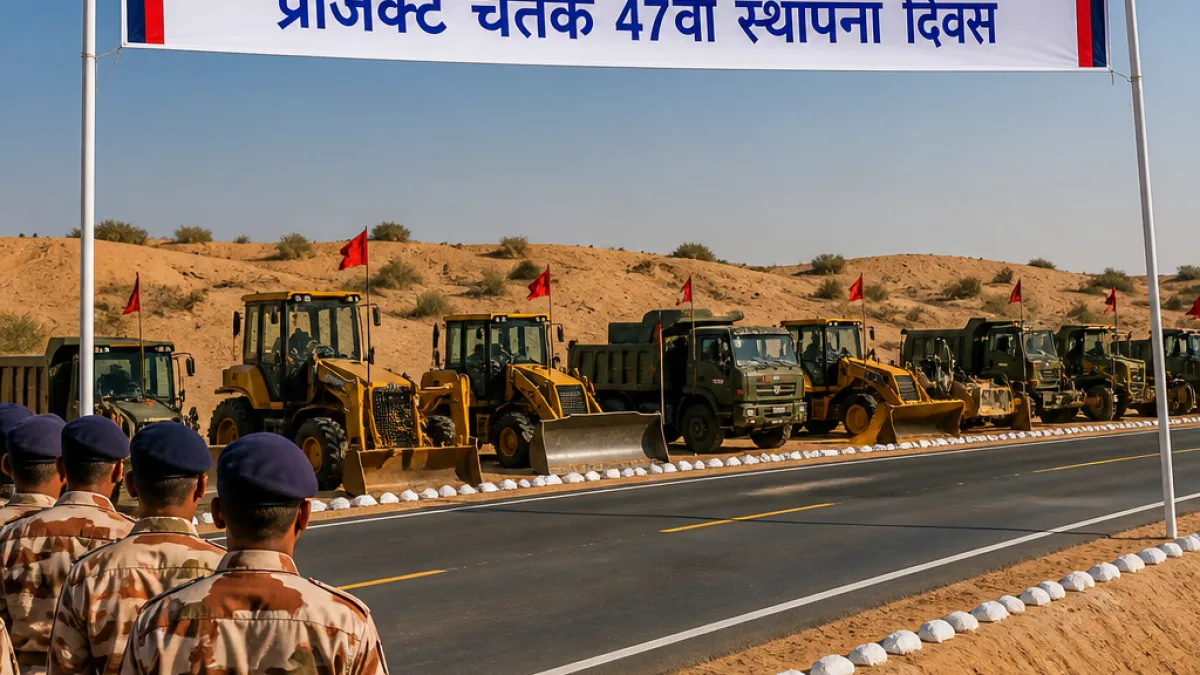
Bikaner, Rajasthan: Project Chetak of the Border Roads Organisation (BRO) celebrated its 47th Raising Day in Bikaner on Saturday, a ceremonial observance that underscored the unit’s long-running role in developing and maintaining strategic road and water-conservation infrastructure across the western sector.
The Ministry of Defence, in a statement reported on April 5, 2026, noted that Project Chetak was raised in 1980 and has since worked extensively across Rajasthan, Punjab and portions of northern Gujarat. The ministry said the project’s works are integral to connecting border areas and to supporting national security alongside regional socio-economic development.
Scope of works and strategic importance
According to the ministry’s statement, Project Chetak has covered more than 4,000 kilometres of road network and constructed 214 kilometres of Ditch Cum Bund — earthwork structures used for water conservation and drainage control. The BRO’s activity includes maintenance of feeder roads that lead to the International Border, with ongoing efforts to upgrade key stretches to National Highway double-lane specifications.
- Geographical reach: Western sector including Rajasthan, Punjab and parts of Gujarat.
- Road network: Over 4,000 km constructed or maintained by Project Chetak.
- Water-conservation works: 214 km of Ditch Cum Bund constructed to support local hydrology.
"Chetak ka Prayas, Desh ka Vikas," the ministry said, highlighting the dual aim of strategic mobility and regional development.
Local consequences and civilian interface
For Bikaner and surrounding districts, the BRO’s long-term activities have immediate implications: improved access to markets and services through upgraded highways, enhanced mobility for security forces, and initiatives that intersect with local water management. Ditch Cum Bunds, in particular, can influence groundwater recharge and soil conservation in arid and semi-arid tracts of Rajasthan where precipitation is highly variable.
The ministry’s release framed Project Chetak as “one of the largest projects of the BRO in terms of geographical area,” a description that signals continuing commitments to both hard infrastructure and landscape-sensitive works along strategic corridors. The statement also pointed to the BRO’s support role for the Defence Forces by maintaining feeder roads that feed into border approaches.
Numbers at a glance
| Indicator | Figure |
|---|---|
| Raising Day | 47th (observed in Bikaner) |
| Year of raising | 1980 |
| Road network covered | More than 4,000 km |
| Ditch Cum Bund constructed | 214 km |
Officials framed the celebration as both a commemoration and a reaffirmation of ongoing work: maintaining existing links and upgrading selected stretches to meet national highway standards. Such upgrades typically mean broader carriageways and enhanced load-bearing capacity — changes that affect commercial transport, emergency movement and troop mobility alike.
For residents of Bikaner district, the BRO’s work intersects with civic life in practical ways. Better roads reduce travel time to district markets and health facilities; upgraded approaches strengthen supply chains for local agriculture and trade. At the same time, water-management earthworks like Ditch Cum Bunds are relevant to farmers and grazing communities who contend with limited and often erratic rainfall.
The ministry’s statement placed Project Chetak’s efforts in the dual frame of national security and regional development. In Bikaner — a city marked by the Thar’s sand and a history of fortifications — the BRO’s infrastructure footprint is a contemporary instrument of connectivity and resilience in the borderland economy.