Bhavnagar shoppers reminded to check purity, making charges and tax on gold purchases
Bhavnagar — Jewellery shoppers and small investors in Bhavnagar should pay close attention to purity marks, making charges and the mandatory 3% Goods and Services Tax when buying gold, industry guidance said, outlining practical steps to protect value and ensure authenticity.
Local retailers and financial advisers say the everyday quoted gold rate operates as a benchmark. The actual amount a consumer pays at a showroom typically includes the base quoted price plus variable making charges and the statutory 3% GST on the finished product.
"Verify the BIS logo, the purity grade and the HUID code before purchase," industry advisories recommend.
Understanding karat differences is central to choice. The common standards and their typical uses are:
- 24K (99.9%) — Highest purity; preferred for coins and bars and less suitable for everyday jewellery because of softness.
- 22K (91.6%) — Standard for traditional Indian jewellery; alloyed for better durability and widely sold in Bhavnagar showrooms.
- 18K and 14K — Contain less gold but offer greater strength for intricate or durable designs.
Buyers should note that the colour of gold — yellow, white or rose — reflects the metals used in alloys (such as silver or copper) and does not indicate purity. The karat number determines the actual gold content.
Hallmarking, net weight and stone deductions
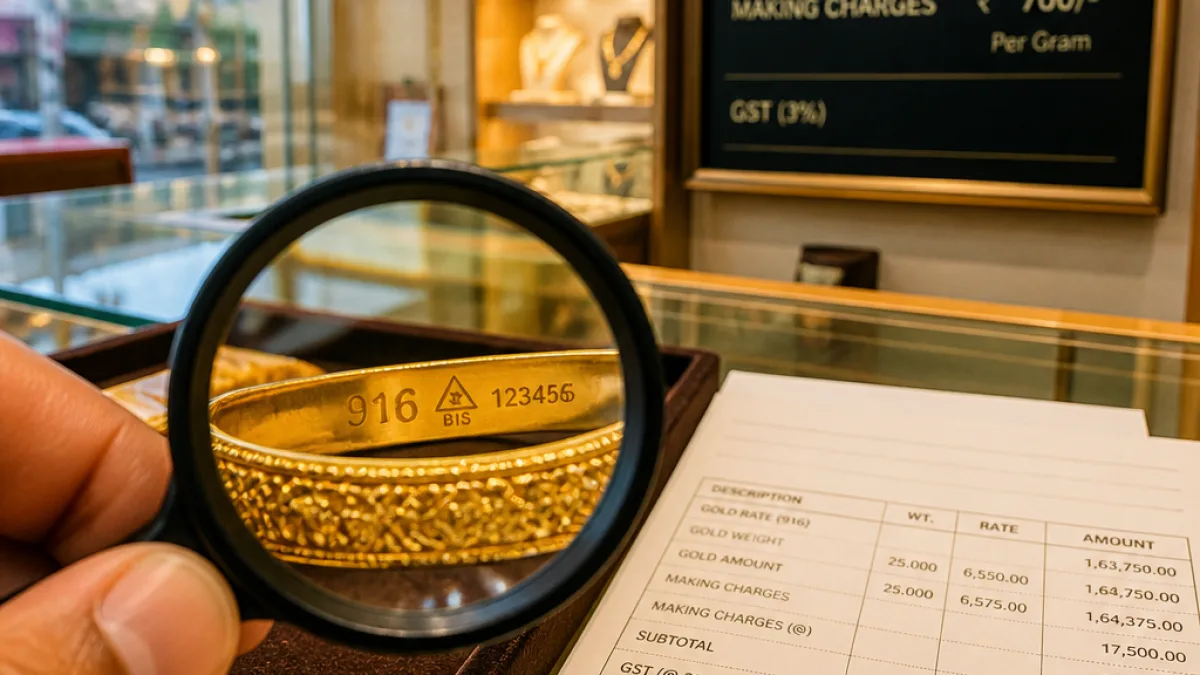
Hallmarking remains the primary safeguard against adulteration. Shoppers are advised to check for the Bureau of Indian Standards logo, the numeric purity indicator (for example 916 for 22K) and the unique 6‑character HUID code, which can be verified on the BIS Care app.
When buying studded jewellery, the gross weight shown on a bill does not always reflect payable gold content. The weight of embedded stones is deducted to arrive at the net gold weight, which is used for pricing. Buyers must insist on clear billing that shows gross weight, stone weight and net payable weight.
Paper gold, storage and tax implications
For investors who want exposure to gold without handling physical metal or paying making charges, there are several financial alternatives frequently recommended by advisers:
- Digital gold — Allows purchase of small quantities, often starting at very low amounts, with storage provided by the seller.
- Gold ETFs and mutual funds — Liquid paper assets that track the physical price of gold and trade on exchanges.
- Sovereign Gold Bonds (SGBs) — Government securities that add a fixed interest component to gold price appreciation.
Tax and regulatory matters also affect decisions. Providing Permanent Account Number (PAN) details is compulsory for purchases above specified thresholds, and large cash transactions attract stricter KYC rules. All physical gold purchases attract 3% GST at the point of sale. Capital gains tax applies on sale of gold depending on the holding period. Inherited gold is not taxed until sold; however, gifts may be taxable if they exceed prescribed limits and are not from specified relatives.
Practical checklist for Bhavnagar buyers
| Action | Why it matters |
|---|---|
| Check BIS hallmark and HUID | Verifies purity and traceability |
| Ask for itemised bill (gross/net/stone weight) | Ensures transparent pricing and correct gold weight |
| Compare making charges across stores | Making charges vary by design and are often negotiable |
| Consider digital or paper gold for small investors | Avoids making charges and simplifies storage |
For Bhavnagar's strong retail market — which serves both local customers and visitors from surrounding districts — clarity on these points helps preserve value and reduces the risk of disputes after purchase. Traders and financial advisers emphasise that simple practices such as verifying hallmarks, insisting on clear invoices and comparing making charges can materially affect the effective price paid for gold.
Buyers who wish to hold physical jewellery should also plan for secure storage and insurance, while those focused purely on price exposure may find ETFs, digital gold or Sovereign Gold Bonds better suited to their needs.