The Union government’s Press Information Bureau (PIB) has accorded clearance for Ahmedabad Metro Phase Three, signalling a procedural advancement for expansion of the city’s rapid transit network, Construction World reported on Thursday. The clearance is a key administrative milestone that allows the Greater Ahmedabad Metro Rail Corporation (or the relevant implementing authority) to move ahead with detailed planning and subsequent approvals.
What the PIB clearance means
PIB clearance typically denotes central government concurrence on project proposals and is a precursor to further clearances, financing discussions and tendering processes. While the report did not detail funding commitments or an execution timeline, the clearance is expected to expedite preparatory work for route finalisation, detailed project reports (DPRs) and procurement processes.
Local observers and industry stakeholders view metro extensions as catalytic for urban development, influencing transit-oriented investments, land values and commercial activity along proposed corridors. Ahmedabad has been steadily expanding its metro network, and Phase Three would further integrate new neighbourhoods and transit nodes with the existing system.
Concurrent local infrastructure moves
The Construction World note that the announcement comes amid other Ahmedabad infrastructure steps that could interact with Metro planning and urban land use:
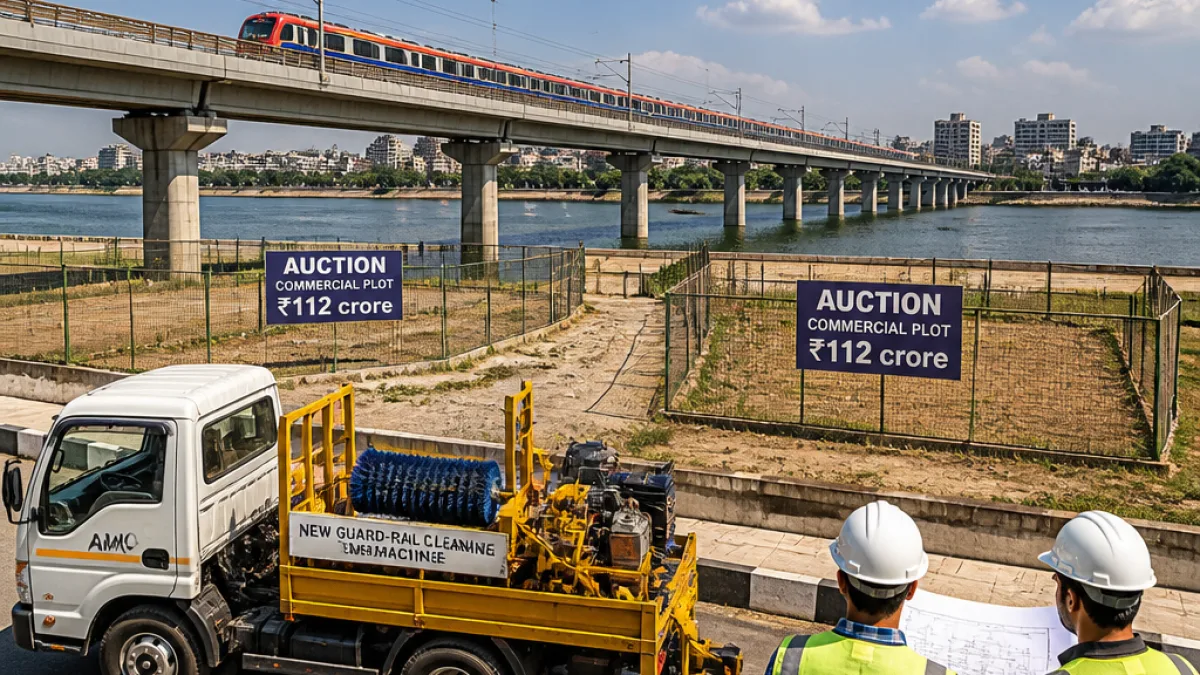
- Sabarmati Riverfront commercial plots: Two plots on the western bank of the Sabarmati Riverfront, adjacent to the Metro Rail Bridge, have been put up for auction with a base price of ₹112 crore each (combined base valuation ₹2.24 billion). The Riverfront Development Corporation framed the sale as part of a phased commercial release to revive development along the riverfront.
- AMC mechanisation proposal: Ahmedabad Municipal Corporation plans to procure four specialised machines for cleaning guard railings along major roads and central verges of BRTS and Metro corridors. The estimated procurement cost is ₹82.8 million excluding GST, with a base price of about ₹20.7 million per machine. An 18% GST would be applicable separately.
“The phased commercial release is aimed at reviving development along the riverfront,” the report said.
Together, these steps suggest coordinated attention to both transit infrastructure and the ancillary urban amenities that affect operations and commercial prospects. Plots adjacent to Metro structures typically attract developers seeking retail, office or mixed-use projects that benefit from commuter footfall.
Local economic and planning implications
The PIB clearance for Phase Three could accelerate investment interest along proposed corridors, particularly where government land or riverfront assets are being offered commercially. For developers and infrastructure contractors based in Gujarat, confirmation of central-level clearance often precedes request-for-qualification (RFQ) and tender notices which in turn mobilise engineering, procurement and construction activity.
For the Ahmedabad Municipal Corporation, the mechanisation of guard-rail cleaning indicates a push towards reducing manual labour on arterial roads and metro/BRTS alignments, and improving maintenance standards. Procurement of specialised equipment may also be tied to contractual arrangements for operation and maintenance of newly developed stretches.
| Item | Value |
|---|---|
| Sabarmati riverfront plots (each) | ₹112 crore |
| Combined base valuation (two plots) | ₹2.24 billion |
| AMC guard rail cleaning machines (total, excl. GST) | ₹82.8 million |
| Price per cleaning machine (base) | ₹20.7 million |
While the Construction World report did not specify exact alignments, station locations or financial closure details for Phase Three, the PIB clearance is a procedural green light that is likely to be followed by technical and commercial decision-making. Stakeholders in urban transport, real estate and municipal services are likely to monitor forthcoming notifications from GMRC and AMC for DPRs, tender schedules and auction processes.
Further updates on project scope, funding pattern and implementation timeline are expected as agencies move from clearance to project execution phases.