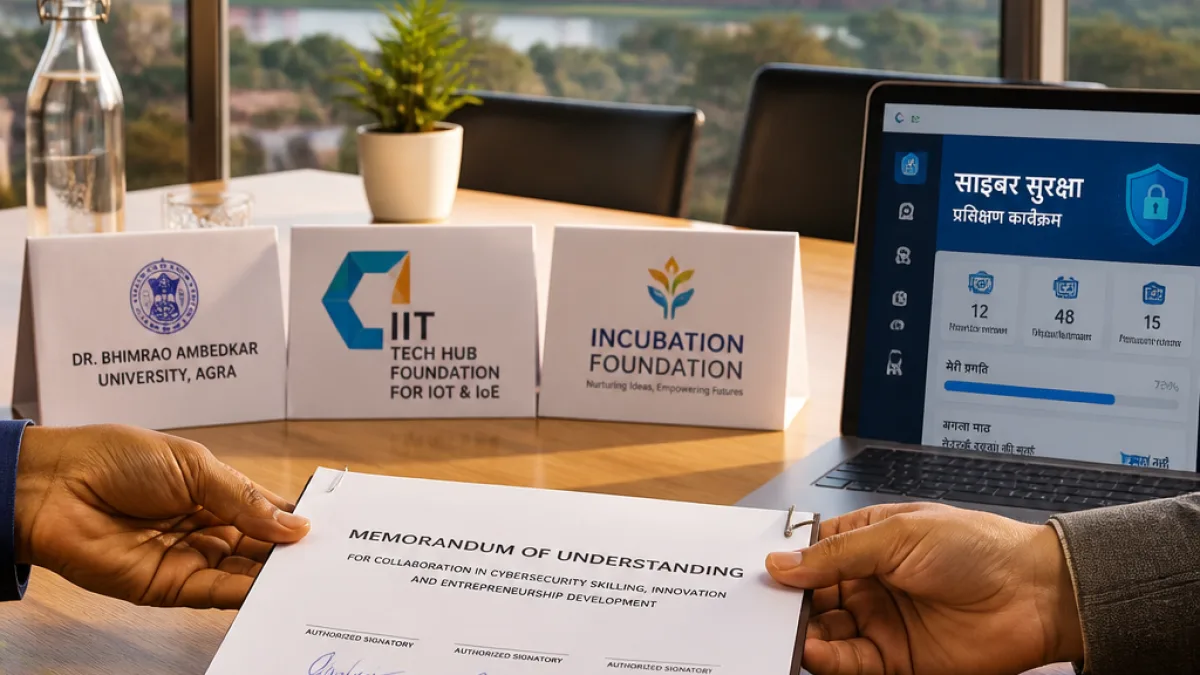
Agra — Dr Bhimrao Ambedkar University (DBRAU), Agra, on Tuesday signed a tripartite agreement with the Indian Institute of Technology, Kanpur, through its C3iHub, and the Vivekanand Incubation Foundation (VIF) to launch a vocational cybersecurity programme to be offered to students across the university’s affiliated institutions.
Scope and delivery
The online course is expected to be delivered in Hindi and aims to reach students in semi-urban and rural areas who may face language barriers in accessing technical education in English. The partners said the programme has the potential to cover more than 3 lakh students enrolled in over 570 colleges affiliated to DBRAU.
Under the collaboration, C3iHub will be responsible for developing and delivering the curriculum, drawing on IIT Kanpur’s research and training experience in cybersecurity. VIF will provide the administrative and technical infrastructure required to deploy the courses at scale, while DBRAU will coordinate outreach to its affiliated colleges.
Support and student protection measures
DBRAU also plans to set up a dedicated Cybersecurity Counselling Cell (CCC) to assist students with cybercrime mitigation, prevention and post-incident support. The CCC is intended to function as both an advisory resource and a point of contact for students who face online threats or security incidents.
- Programme language: Hindi
- Delivery mode: Entirely online
- Target reach: >3 lakh students
- Target institutions: >570 affiliated colleges
“Dr Bhimrao Ambedkar University serves lakhs of students across 570+ colleges, and with that reach comes a responsibility to prepare them for the world they will actually work in,”
The source reported that the agreement was signed by Surendra Baswana, programme director, C3iHub and head of the department of computer science and engineering at IIT Kanpur; Sanjay Chaudhary, director, IQAC and VIF, DBRAU; and Anil Gupta, director, UCC, DBRAU, according to the release.
| Partner | Role |
|---|---|
| IIT Kanpur / C3iHub | Curriculum development and content delivery |
| Vivekanand Incubation Foundation (VIF) | Administrative and technical infrastructure |
| DBRAU, Agra | Outreach to affiliated colleges; set up CCC |
Local context and potential impact
Agra and surrounding districts include many semi-urban and rural communities whose students commonly study at colleges affiliated to DBRAU. The move to offer the vocational course in Hindi seeks to lower a language barrier that can restrict access to technical subjects presented primarily in English.
Cybersecurity training at scale could have multiple local benefits: raising awareness of cyber hygiene among a large student population, reducing vulnerability to identity theft and online fraud, and widening the pool of candidates for entry-level roles in information security and related services. The programme’s vocational focus may also support employability and internships, depending on how industry linkages and recognition are arranged.
Officials said the course will cover topics including cyber hygiene, identity theft, online safety and other core cybersecurity concepts. Further details on the syllabus, enrolment process and certification were not disclosed in the release; the participating institutions are expected to issue operational guidelines as the programme is rolled out.
As digital services expand across government, education and commerce, the initiative reflects an effort to build foundational cyber skills among young users in the region. How effectively the online format, language medium and the CCC combine to reach marginalised students and respond to incidents will determine the programme’s longer-term value for the Agra student community.