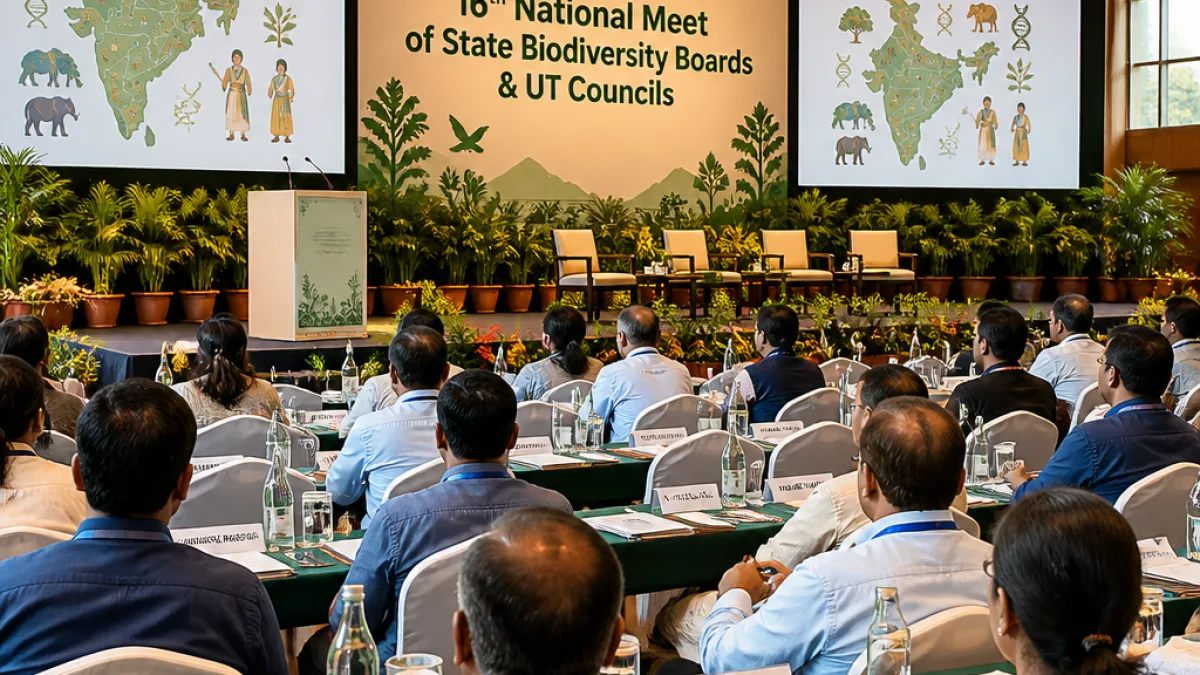
The 16th National Meet of State Biodiversity Boards (SBBs) and Union Territory Biodiversity Councils (UTBCs) was inaugurated in Chandigarh on Sunday, bringing together chairpersons and member secretaries of SBBs and UTBCs from across India for a two-day deliberation on biodiversity governance and conservation approaches.
Senior officials attend inaugural session
The event, organised by the National Biodiversity Authority (NBA), was held from 6–7 September 2026 and saw the presence of several senior functionaries of the Union Ministry of Environment, Forest and Climate Change (MoEFCC) and local administration. Those at the inaugural session included the Governor of Punjab and Administrator, U.T. Chandigarh, Gulab Chand Kataria; Union Minister for Environment, Forest and Climate Change, Bhupender Yadav; and Haryana's Minister for Environment, Forest and Wildlife, Rao Narbir Singh.
Senior MoEFCC officials present included Secretary Tanmay Kumar; Director General of Forests and Special Secretary, Sushil Kumar Awasthi; and Additional Secretary Ashutosh Agnihotri. The NBA was represented by its Chairperson, Virendra Tiwari, and officials from state boards and councils also attended. From the Chandigarh administration, Mandip Singh Brar (Home Secretary, UT Chandigarh) and Saurah Kumar (Secretary, Science & Technology & Renewable Energy, UT Chandigarh) were present.
Key themes: traditional knowledge, community participation
In his address, Governor Kataria underlined India’s biological diversity and the role of traditional environmental practices. He emphasised the links between ecological security and food, water security and livelihoods, and called for integrating traditional knowledge with modern conservation strategies. The Governor also highlighted the ecological value of wetlands, riverine systems and agricultural biodiversity in Punjab and Chandigarh.
Union Minister Bhupender Yadav reiterated India's long-standing environmental ethos and referred to the need for cohesive policy and institutional coordination among biodiversity stakeholders, according to the organisers.
Participants were urged to strengthen local conservation mechanisms, notably Biodiversity Management Committees (BMCs) and People’s Biodiversity Registers (PBRs), and to enhance cooperation between institutional bodies and communities for better biodiversity outcomes.
Practical focus for the meet
The two-day agenda is expected to focus on practical measures to conserve and sustainably use biological resources, capacity-building for local biodiversity governance, and sharing best practices across states and union territories. Delegates include Chairpersons and Member Secretaries of SBBs and UTBCs, senior officials, experts and scientists from across the country.
- Dates: 6–7 September 2026
- Organiser: National Biodiversity Authority
- Key attendees: Governor/Administrator of U.T. Chandigarh, Union Environment Minister, MoEFCC Secretary, DG Forests, NBA Chairperson
Local and national implications
Hosting the meet in Chandigarh gives the city and the wider region an opportunity to showcase local conservation issues such as wetlands and agricultural biodiversity. Officials stressed that enhancing BMCs and maintaining PBRs at the grassroots would help align community priorities with national biodiversity goals. Strengthening these mechanisms is also intended to facilitate compliance with statutory obligations under biodiversity laws and to support equitable sharing of benefits arising from biological resources.
The gathering of policy-makers and practitioners is also significant for inter-state coordination on shared ecosystems and for translating national policy into actionable programmes at local levels. The presence of both central and state-level environment ministers and senior bureaucrats points to an emphasis on policy coherence and institutional support for state and UT biodiversity bodies.
Over the two days, delegates will exchange experiences, discuss challenges in biodiversity management, and identify capacity gaps that require technical or financial support. Outcomes from the meet may inform future NBA advisories and MoEFCC guidance to SBBs and UTBCs.
| Role | Name |
|---|---|
| Governor, Punjab & Administrator, UT Chandigarh | Gulab Chand Kataria |
| Union Minister, MoEFCC | Bhupender Yadav |
| Haryana Minister for Environment | Rao Narbir Singh |
| MoEFCC Secretary | Tanmay Kumar |
| NBA Chairperson | Virendra Tiwari |
The meet is scheduled to conclude on Monday after panel discussions, technical sessions and inter-agency consultations aimed at strengthening biodiversity governance frameworks across states and union territories.