
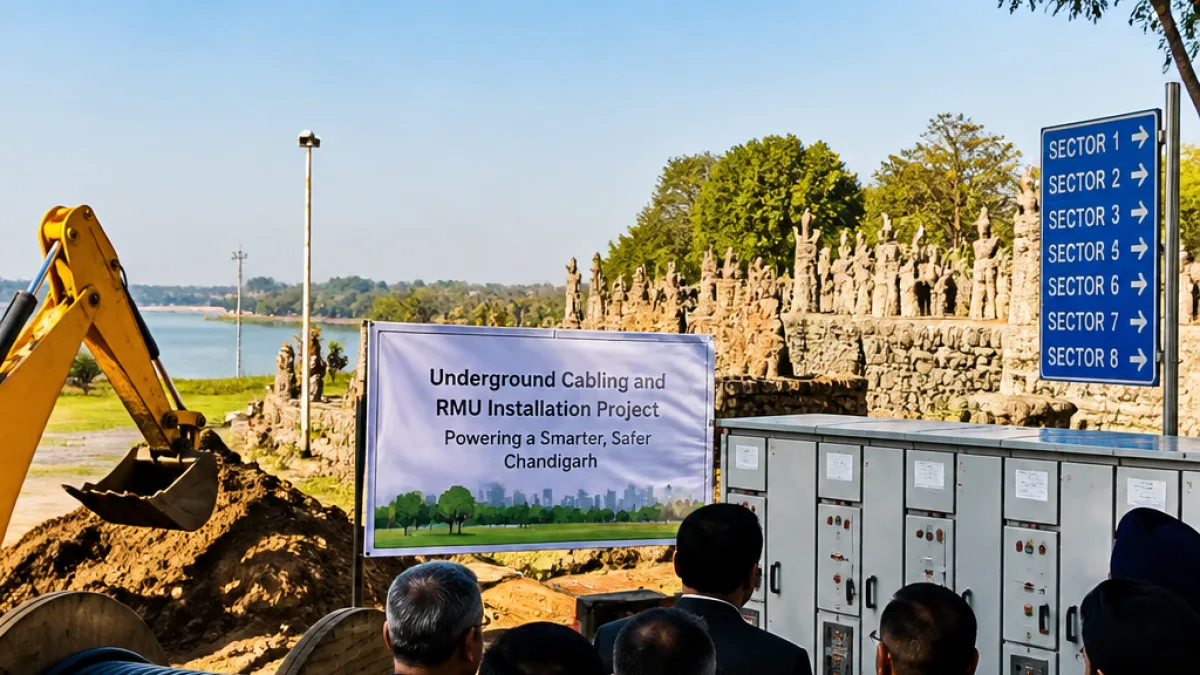
Chandigarh on Sunday saw the launch of a ₹12 crore underground electricity distribution scheme aimed at strengthening supply continuity and reducing outages for roughly 25,000 residents in the city’s northern sectors, officials said.
Project scope and purpose
The project, planned and executed by Chandigarh Power Distribution Limited (CPDL), replaces about 18 km of overhead 11 kV lines with subterranean cables across Sectors 1 to 8. The new network also serves important public institutions and tourist sites including the Punjab and Haryana civil secretariat, the high court, Rock Garden and Sukhna Lake.
“The overground infrastructure, especially overhead lines are vulnerable to weather-related damage which could leave areas without electricity for hours. Taking it underground removes that exposure,” said UT administrator Gulab Chand Kataria during the launch.
Officials said routing the distribution lines underground is expected to reduce interruptions caused by storms, falling trees and other weather-related incidents. Authorities also highlighted the visual and environmental benefits in areas adjacent to the Rock Garden and Sukhna Lake.
Technology and operational features
The infrastructure includes 14 SCADA-controlled ring main units (RMUs) distributed across four distribution feeders that pass through the forest area near the lake. These remotely operated RMUs will allow CPDL’s command centre in Sector 18 to shift load between feeders, isolate faults and expedite restoration.
CPDL’s chief executive, Brajesh Kumar, described the undergrounding as part of a broader modernisation drive that relies on technology-enabled solutions to enhance distribution efficiency and reliability.
- Cost: ₹12 crore
- Length of lines undergrounded: 18 km
- Coverage: Sectors 1–8, ~25,000 residents
- Control features: 14 SCADA-controlled RMUs on four feeders
Policy context and implications
Administrators noted that Chandigarh is the first union territory in the country to transfer electricity distribution to the private sector, a move intended to attract investment and accelerate infrastructure upgrades. Kataria said the handover to CPDL was made with expectations of concrete improvements in distribution assets and service standards.
CPDL has outlined an investment plan in the city; the public launch of the northern sectors project was presented as an early visible deliverable under that plan. Officials argue that undergrounding reduces the exposure of lines to vegetation and weather, lowers the likelihood of prolonged outages and carries ancillary benefits for urban character and wildlife safety.
Practical impact for residents
For consumers in the affected sectors, the immediate benefits should include fewer weather-related interruptions and faster fault localisation and restoration via remote switching. Visual clutter from overhead lines will be reduced in prominent public areas, which municipal planners often cite as desirable for tourism and urban upkeep.
However, undergrounding can increase repair complexity and costs for certain types of faults; CPDL’s use of SCADA and remotely controlled RMUs is intended to offset some operational disadvantages by improving diagnosis and sectionalisation.
| Parameter | Detail |
|---|---|
| Project cost | ₹12 crore |
| Length undergrounded | 18 km |
| Sectors covered | 1–8 |
| Estimated beneficiaries | ~25,000 residents |
| Control tech | 14 SCADA RMUs, command centre Sector 18 |
Officials said the scheme will also lower risks to migratory birds and other wildlife by reducing the exposure of electrical infrastructure, particularly in areas adjoining forested tracts.
Next steps
While the inauguration marks completion of the northern-sector phase, CPDL has indicated the project is one element of further upgrades to the city’s distribution system. The company’s detailed investment timeline and subsequent phases were referenced by officials as part of a larger modernisation programme.
Consumers keen to know how the changes affect billing, outage reporting or complaint redressal were advised to consult CPDL’s official channels; the firm said its command centre in Sector 18 will handle remote operations and fault management for the new network.