New inscription ties Warangal region to Kalyani Chalukya administration
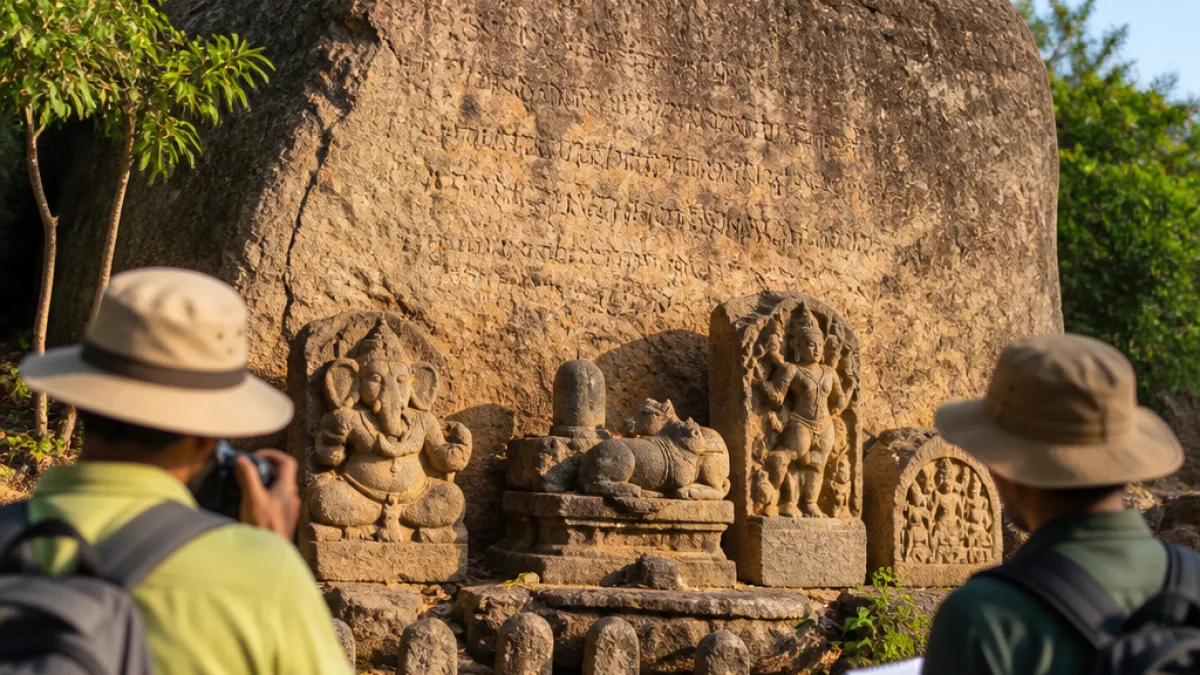
A 10th-century inscription recording a land donation has been identified on a rock at Mulkanoor in Bheemadevarapalli mandal of Hanamkonda district, offering fresh evidence linking the Warangal region to the Kalyani Chalukyas. The epigraph was located on a locally known boulder called Katamayya rock, situated behind the Mahila Sahakara Dairy in Mulkanoor.
The inscription was identified during field exploration by G. Kishore, a research member of the Kotha Telangana Charitrabrundam. Carved text and accompanying carvings provide a partial but important picture of local polity and religious landscape in the post-Rashtrakuta period.
Sculptural elements on and around the rock include images of Ganesha, a Shivalinga on a Vedibhadra pedestal, Nandi and Mahishasuramardini, as well as depictions of the Sun and Moon. Opposite the rock are votive Naga stones. The style of these sculptures has been described as consistent with a post-Rashtrakuta idiom.
"The damaged condition of the inscription has limited the information that can currently be established,"
The inscription is written in Telugu-Kannada script and appears to be in the Kannada language, though large portions are worn and illegible. The readable portion records that during the rule of the Kalyani Chalukyas a Mahasamanta, possibly named Bijjana, who bore the title “Samadhigata Pancha Mahashabda”, made a donation of land at Mulkaluru (Mulkanoor).
Notably, the surviving letters mention the grant of land with water (neer nelanu) on the 12th day of the bright fortnight of Chaitra. The inscription commences with the customary Swasti, outlines the donor’s lineage and refers to the continued prosperity of the kingdom, ending with the conventional appeal that rulers should protect the charitable grant. The exact year, however, could not be read from the damaged text.
The initial identification and reading have been reported by the Kotha Telangana Charitrabrundam. According to Sriramoju Haragopal, president of the group, the inscription’s condition limits current conclusions and a more detailed epigraphic study of the surviving letters could clarify the donor’s name, the precise date and other particulars.
- Location: Katamayya rock, behind Mahila Sahakara Dairy, Mulkanoor, Bheemadevarapalli mandal, Hanamkonda district.
- Language and script: Kannada language in Telugu-Kannada script.
- Key content: Land grant with water, donor a Mahasamanta (possibly Bijjana) with title "Samadhigata Pancha Mahashabda"; date referenced as 12th day, bright fortnight of Chaitra.
The find has local significance for several reasons. First, it provides direct epigraphic evidence connecting parts of present-day Warangal district to the administrative and landed elite structures operating under the Kalyani Chalukyas. Second, the mention of land provided with water highlights the agrarian and hydrological concerns of medieval donors — information that complements archaeological and landscape studies in the Deccan. Finally, the associated religious sculptures and votive Naga stones add material culture context that may help date and interpret local shrines and secular sites.
| Feature | Description |
|---|---|
| Inscription language | Kannada in Telugu-Kannada script (partly damaged) |
| Sculptures | Ganesha, Shivalinga on Vedibhadra pedestal, Nandi, Mahishasuramardini, Sun and Moon |
| Associated stones | Votive Naga stones opposite the rock |
Epigraphists and local heritage groups in Telangana routinely document such finds as part of efforts to map medieval polity and temple networks across the Deccan. Further fieldwork, high-resolution imaging and specialist epigraphic study will be required to recover faint letters and provide a definitive reading of the donor’s name and the precise regnal year of the grant.
For Warangal and Hanamkonda district, the discovery underscores the district’s layered past and the continuing value of systematic field survey. If subsequent readings confirm the donor’s identity and date, the Mulkanoor inscription could become an important datum for scholars working on Chalukyan administration and land grants in the northern Deccan.