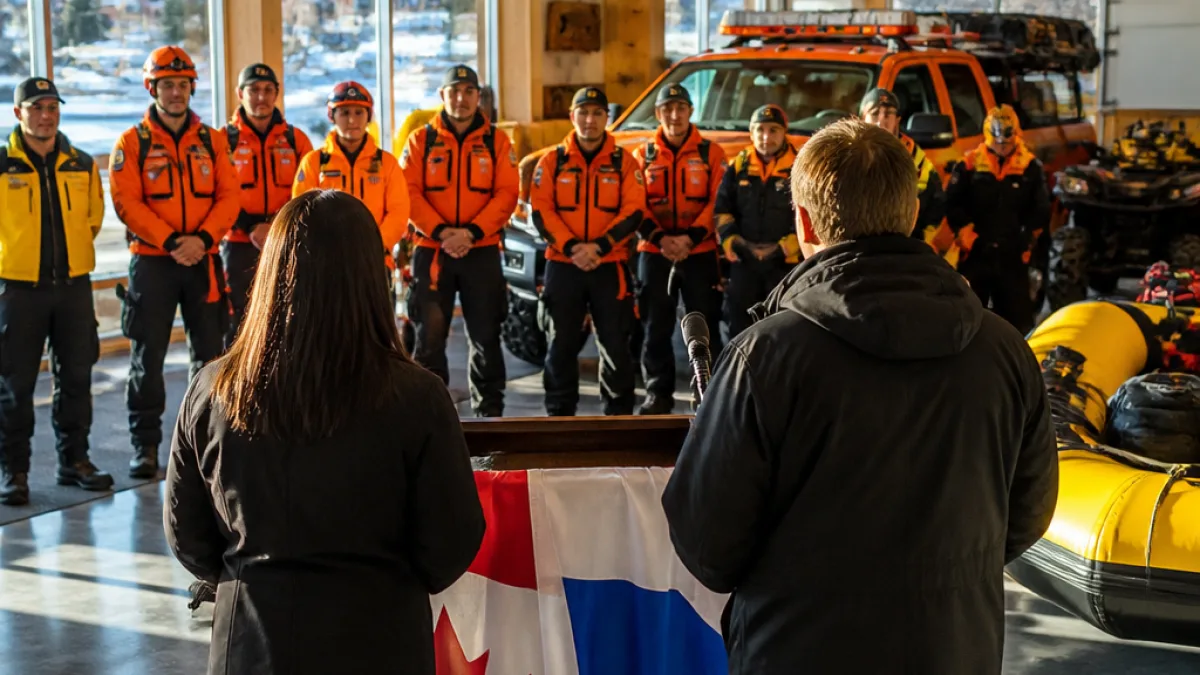
OTTAWA — The federal government announced a three-year, $3 million funding agreement with the Search and Rescue Volunteer Association of Canada (SARVAC) in Yellowknife on Thursday aimed at strengthening volunteer ground search-and-rescue capacity across the country.
Funding details and local relevance
Under the agreement, the government will provide $1 million per year to support the hundreds of ground search-and-rescue teams that represent roughly 10,000 volunteers nationwide. The money is earmarked for developing and maintaining national ground search-and-rescue standards and for coordinating a national volunteer insurance program, officials said.
The announcement came as Emergency Management and Community Resilience Minister Eleanor Olszewski visited the Northwest Territories with Crown-Indigenous Relations Minister Rebecca Alty. The ministers travelled recently to Inuvik and Tuktoyaktuk, and Olszewski said those northern communities underscored the special challenges posed by vast distances and demanding terrain.
“It really drove home how the vastness of the territory and the nature of the terrain, the importance of local knowledge, the further north you go, how important those things are,”
She added, “When someone is lost and they’re in danger, every second matters.” The ministers’ presence in Yellowknife to make the funding announcement highlighted the federal government’s recognition of the northern realities that affect search-and-rescue operations.
What the funds will support
Federal officials said the funding will be used to:
- develop and maintain national ground search-and-rescue standards,
- coordinate a national volunteer insurance program, and
- support volunteer teams that respond when people are lost, missing or in distress.
The agreement directs resources toward a volunteer network that, while national in scope, relies heavily on local knowledge and capacity — particularly in the North, where landscape, weather and remoteness complicate response efforts. Ground search-and-rescue teams frequently depend on volunteers who know local terrain and travel conditions, and who can act quickly when an emergency arises.
Implications for Yellowknife and the territory
For residents of Yellowknife and surrounding communities, improvements to national standards and insurance coordination could reduce administrative burdens on volunteer teams and help ensure consistent training and equipment expectations across provinces and territories. The funding may also ease some costs borne by volunteer groups, such as liability and incident-related expenses, although precise allocations and implementation details were not disclosed in the announcement.
Search-and-rescue activity in the Northwest Territories often involves coordination across long distances and multiple agencies, including municipal responders, territorial emergency services, Indigenous organizations and federal bodies. Enhancing standards and providing a coordinated insurance program are measures that could strengthen those multi-jurisdictional responses without altering the essential role that local volunteer expertise plays in northern searches.
| Item | Amount / Detail |
|---|---|
| Length of agreement | 3 years |
| Total funding | $3 million |
| Annual funding | $1 million per year |
| Volunteers represented | Approximately 10,000 |
Officials have framed the funding as a national measure that recognises the contribution of volunteer search-and-rescue teams. For Yellowknife-area residents, the announcement is a reminder of the importance of local responders and the need for sustained supports to ensure those teams can operate safely and effectively in extreme and remote environments.
Further details about how the funding will be distributed to individual teams, and timelines for rolling out national standards and an insurance program, were not included in the initial announcement.