
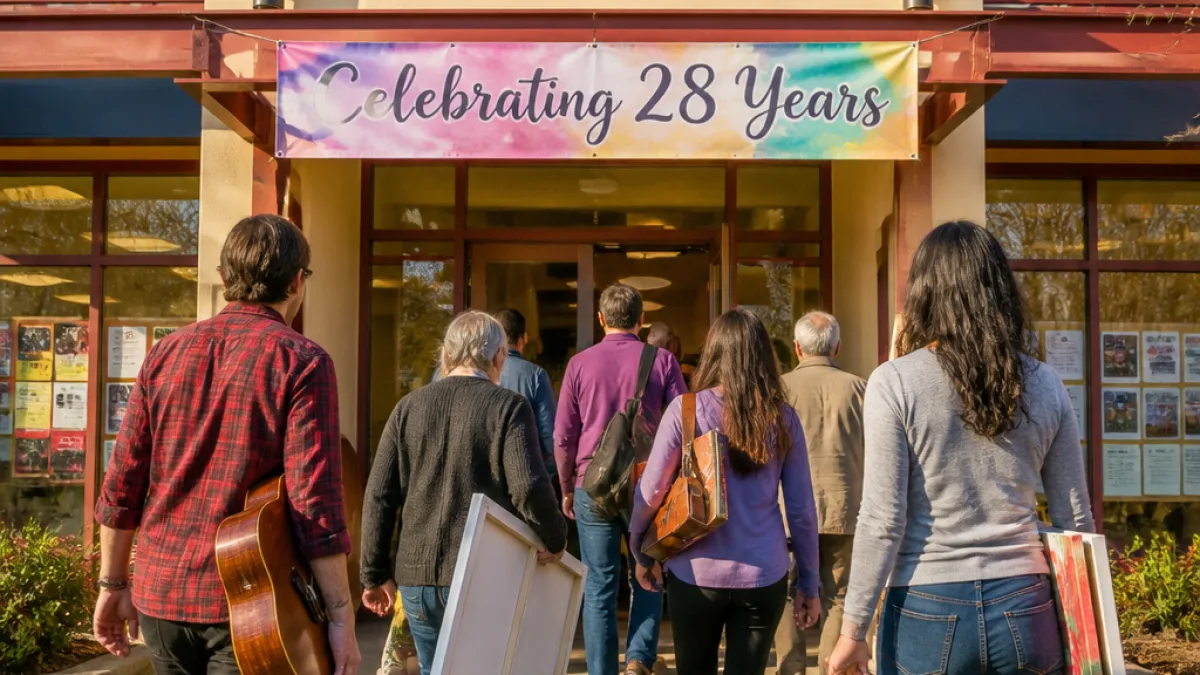
Long tenure saw small local initiative grow into broad community support
Victoria — After nearly three decades leading a Victoria-based non-profit, the executive director of Lifetime Networks Victoria will step down next spring, leaving an organisation that has grown from supporting a handful of people to serving about 300 individuals with developmental disabilities.
Wendy-Sue Andrew has been the only executive director in the organisation’s history. She arrived early in the charity’s life and presided over its expansion from an initiative started in 1998 into a centre that now runs fine arts programs, continuing education and employment supports, among other services.
“It started with five families, supporting five individuals, now we support about 300,” Andrew said, reflecting on the organisation’s growth. Her work has been informed by lived experience: she is the parent of a 39-year-old son with developmental disabilities.
“You can be the smartest person or the most athletic person or the most attractive person, but if you don’t have friends, it’s a very lonely life.”
Colleagues say Andrew prioritised belonging and community. Julie Mason, the organisation’s human resources director, noted that many people’s needs were previously unmet and that Andrew sought to change that by building opportunities for social connection and inclusion.
Laura Austin, program director at Lifetime Networks, praised Andrew as a mentor within the organisation. “She has set the bar so high,” Austin said, adding that she has worked to learn as much as possible before Andrew’s retirement.
Services expanded to meet emerging needs
Lifetime Networks began with a clear social aim: to create networks of friends and reduce isolation among people with developmental disabilities. Andrew has overseen the organisation’s shift from purely social supports to a wider array of services designed to foster independence and community participation.
- Origins in 1998 supporting five individuals and families
- Current reach of about 300 people with developmental disabilities
- Program offerings now include arts, education and employment supports
Staff described a pragmatic approach to meeting needs: where there is demand, the organisation has sought ways to accommodate it. That approach reflects a broader trend among small, local non-profits that scale services in response to community gaps and client needs.
| Metric | Value |
|---|---|
| Founding year | 1998 |
| Years Andrew has led | 28 |
| People supported | About 300 |
Community implications of a leadership change
Andrew’s retirement raises questions about succession and sustaining momentum for services that have developed under a long-standing leader. Staff comments indicate a mix of admiration and apprehension — admiration for the work completed and concern about preserving the organisation’s culture and focus on inclusion.
Lifetime Networks’ model — growing services from a foundation of social connection — is part of a local ecosystem of supports for people with developmental disabilities in Greater Victoria. As the organisation prepares for a leadership transition, stakeholders and families will be watching how the board ensures continuity of programs and the lived-experience perspective that has guided decision-making.
For many families in Victoria, the services and social networks Lifetime Networks has built represent critical supports in daily life. The coming months will be a test of how the charity navigates a change at the top while maintaining the programs that clients and staff alike say have made a tangible difference.
Andrew said the work has personal meaning beyond professional fulfilment, and her colleagues say her departure will be felt across the organisation. The next executive director will inherit not only a larger organisation than the one that began in 1998, but also a mission shaped by the lived experiences of families in Victoria.
















