
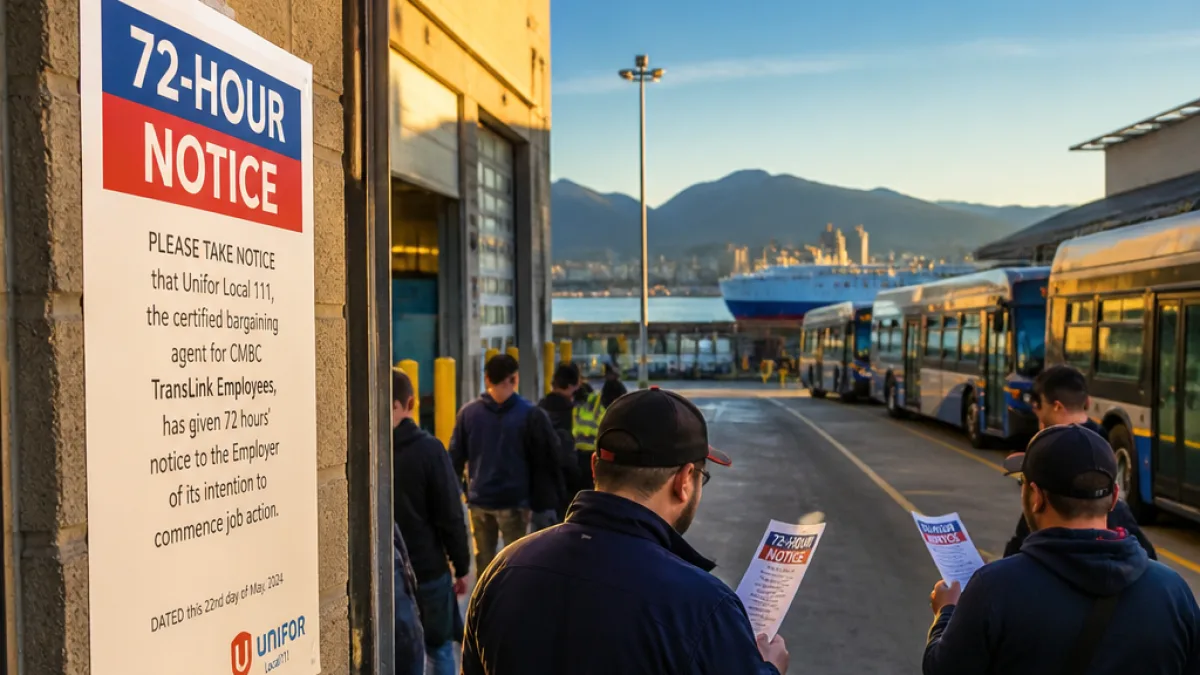
Transit workers choose targeted action as bargaining stalls
Unifor Locals representing Metro Vancouver transit workers have served a 72-hour strike notice to the Coast Mountain Bus Company and will begin a uniform ban on Monday, Aug. 17, union officials announced. The move is a deliberate escalation in long-running contract talks that members say are aimed at pressuring the employer while maintaining public service.
The ban means members will report for their scheduled shifts but will not wear their employer-issued uniforms. Union leaders say bus and SeaBus service will continue to operate normally and that schedules, routes and service levels are not expected to change as a result of the action.
"Our members have chosen a collective show of solidarity as their next step in the bargaining process,"
Unifor National President Lana Payne is quoted in the union release emphasising the central role transit workers play in connecting communities across the region. Unifor Western Regional Director Gavin McGarrigle framed the action as one that exerts pressure without depriving riders of service.
Issues at the bargaining table
Bargaining began in February and later moved into mediation, which the union says did not produce a settlement. The union has identified three core priorities for members:
- Cost-of-living pressures, which members say have eaten into wages;
- Health and safety concerns for workers on the front line; and
- Improved measures for dignity in retirement.
Unifor says it is prepared to return to the table at any point before the notice period expires, signalling that further talks remain possible in the coming days.
Scale and context
The two Unifor locals involved — Local 111 for transit operators and Local 2200 for skilled trades, service and SeaBus workers — represent more than 5,000 transit workers negotiating through a joint committee. Unifor notes it is Canada’s largest private-sector union, representing about 320,000 workers nationally.
| Local | Primary representation |
|---|---|
| Unifor Local 111 | Transit operators |
| Unifor Local 2200 | Skilled trades, service and SeaBus workers |
While the union characterises the uniform ban as a measured step that preserves service, the action is part of a continuum of labour tactics that can escalate quickly if negotiations break down further. Transit workers are integral to daily routines across Vancouver and the Lower Mainland — from commuting to work and school to accessing health-care appointments and essential services.
What Vancouver riders should know
According to the union statement, riders should expect no immediate changes to schedules or routes while the uniform ban is in effect. However, labour disputes historically carry the risk of further escalation. Commuters and organizations that rely on transit should monitor official communications from TransLink, Coast Mountain Bus Company and Unifor for updates.
The union has framed the action as a way to exert leverage without disrupting the public. The coming 72 hours will test whether that strategy leads to renewed bargaining momentum or further steps from either side.
Unifor’s public release did not include details on potential timelines for resolving outstanding issues or specific proposals exchanged during mediation. It also urged public support for transit workers’ demands around affordability, workplace safety and retirement security.
As the situation develops, municipal leaders, transit-dependent institutions and residents will be watching closely for signs of movement at the bargaining table that could affect travel across Vancouver and the broader Metro Vancouver region.











