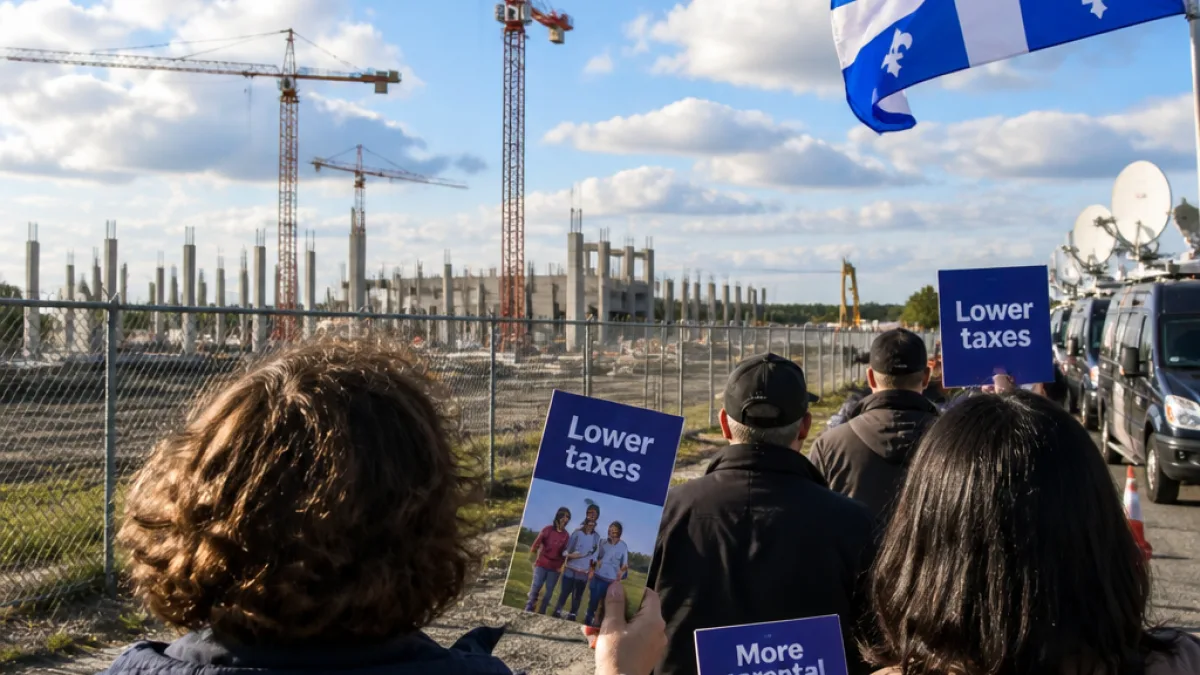
The second day of the Quebec election campaign saw leaders trade sharp attacks over taxes, parental leave and the economic fallout from the escalating Canada–U.S. trade dispute, an early sign that economic concerns will shape voting choices as the Oct. 5 vote approaches.
Big business tax vow from the Parti Québécois
Parti Québécois Leader Paul St‑Pierre Plamondon promised a sweeping reduction in the tax burden on Quebec businesses, saying his party would cut taxes for Quebec companies by 20 per cent during his first term if the PQ wins the election.
Plamondon made the announcement at the site of the cancelled Northvolt electric battery plant in McMasterville, an industrial symbol of a high-profile economic setback. The plant’s collapse drew scrutiny because the provincial government had pledged substantial support for the project.
The Quebec government previously pledged up to $2.9 billion to the Northvolt project, including a $270‑million investment in the Swedish parent company that was lost when the parent went bankrupt. The site served as an anchor for Plamondon’s broader critique of the governing party’s approach to industrial intervention.
“A PQ government will shut off the tap of subsidies to foreign multinationals and focus on Quebec (small and medium businesses),”
Plamondon framed the party’s plan as a pivot toward supporting homegrown firms rather than subsidizing large foreign corporations.
Liberals push diversification amid trade disruptions
Quebec Liberal Leader Charles Milliard used Friday’s events to press a separate economic theme: reducing Quebec’s exposure to a volatile U.S. market. He pledged to cut the share of Quebec exports going to the United States by at least 15 per cent through market diversification if his party forms government.
Milliard announced the plan alongside candidate Madeleine Féquière, a recent Canada consul general in Chicago who will run in the Laval area. The pledge underlines how the province’s exporters are front‑line stakeholders in the rising trade tensions between Ottawa and Washington.
Questions for the Coalition Avenir Québec
Coalition Avenir Québec Leader Christine Fréchette faced criticism from rivals on the campaign trail. Fréchette was the province’s energy minister when the Northvolt project was abandoned, and opponents used that connection to question the CAQ’s record on industrial strategy and risk management.
The party’s earlier involvement in the Northvolt file — and the scale of the financial commitments that were lost when the parent company folded — provided a focal point for debate about the merits of government intervention in economic development.
Campaign themes and what to watch next
The second day highlighted several lines of contest that are likely to persist through the 39‑day campaign:
- The role of government subsidies and industrial policy versus support for small and medium enterprises.
- How to shield Quebec’s economy from external shocks, particularly trade disruptions involving the United States.
- Social policy fault lines such as parental leave, which surfaced alongside fiscal and trade arguments.
Leaders used symbolic locations and recent appointments to underscore their messages: Plamondon at the Northvolt site to showcase perceived failures of government intervention, and Milliard with a former consul general to lend credibility to his export‑diversification pitch.
| Party | Key economic pledge |
|---|---|
| Parti Québécois | Cut business taxes by 20% in first term |
| Quebec Liberals | Reduce exports to the U.S. by 15% through diversification |
| Provincial government (past CAQ actions) | Pledged up to $2.9B to Northvolt; $270M in parent lost |
As the campaign unfolds, voters will be watching not only party platforms but also how leaders respond to ongoing economic shocks. The Northvolt episode is likely to remain a touchstone for arguments about the proper balance between attracting large investment and supporting the province’s small and mid‑sized enterprises.
With the election set for Oct. 5, parties have time to deepen policy offerings and sharpen contrasts. The early volley on taxes, trade and parental leave suggests that voters will have to weigh competing visions of economic recovery and resilience as they head to the polls.
Geneviève Tremblay is the Quebec correspondent for WE NEWS, covering provincial politics and economic policy.