
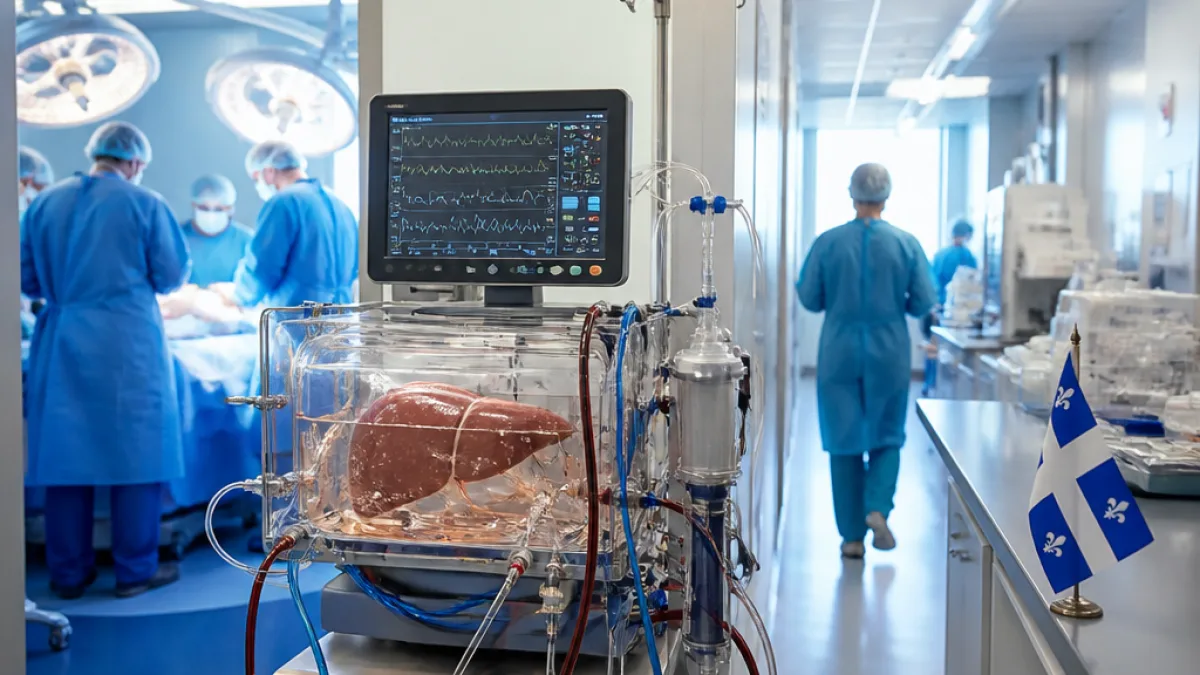
A 64-year-old man from Quebec has become the first patient in North America to receive a transplanted liver that was regenerated with a new technology, marking a milestone that could expand the organ supply and change the landscape of liver transplantation.
What happened
Medical teams in Quebec performed the procedure after preparing a donor liver using a regeneration process. Hospital and research partners described the operation as the first of its kind on the continent. According to reports, the innovation could make dozens of additional livers available for transplant during its first year of clinical use.
Why this matters
Liver failure and end-stage liver disease are among the conditions for which transplantation is the only long-term life-saving option. Across Canada, demand for organs far outstrips supply; many patients spend months or years on waiting lists. The introduction of a reliable method to regenerate or rehabilitate marginal donor livers would increase the pool of usable organs and could shorten wait times, reduce mortality on waiting lists, and widen eligibility for transplant.
Key facts from published reports:
- Patient: a 64-year-old man from Quebec.
- Significance: first regenerated-liver transplant in North America.
- Potential impact: technology could yield dozens more transplantable livers in its first year.
How regenerative approaches could help
The category of treatments described as "regeneration" generally refers to techniques that restore or improve the function and structure of donor organs that would otherwise be deemed unsuitable. These approaches can include cellular therapies, perfusion systems that deliver oxygen and nutrients outside the body, or biologically active agents that reverse injury. While the exact method used in this Quebec case has not been detailed in the public report, the clinical aim is the same: turn marginal organs into viable grafts.
Clinical and regulatory context
Introducing novel organ-reconditioning technologies requires careful clinical testing and regulatory oversight. Health-care institutions must be confident that regenerated organs perform safely and effectively in recipients over the short and long term. If the technique proves reproducible and safe, transplant centres could incorporate it into standard practice, but that will depend on peer-reviewed outcomes, follow-up data and regulatory approvals.
Local impact for Quebec
For Quebec, where transplant centres serve a large and dispersed population, any reliable method to expand the donor pool would have an immediate effect on care delivery. More transplantable livers could mean shorter transfers and waiting times for patients across the province, and fewer cases in which a potentially salvageable organ is discarded.
Questions ahead
Key issues that clinicians and policy-makers will need to address as this technology develops include:
- How many additional organs can consistently be rendered transplantable?
- What are the short- and long-term outcomes for recipients compared with standard transplants?
- How will costs, training and infrastructure required for regeneration systems be funded and distributed across centres?
| Item | Detail |
|---|---|
| Patient age | 64 |
| Projected additional livers in year one | Dozens |
Outlook
This first North American case will be closely watched by transplant teams, researchers and health authorities. If follow-up data confirm safety and benefit, regenerated-liver transplantation could become an important tool in addressing organ shortages. For patients on waiting lists, the promise of more available organs represents hope; for clinicians and administrators, it raises practical questions about implementation and equitable access.
Health-care systems and transplant programmes will be looking for peer-reviewed publications and regulatory guidance in the months ahead to determine how quickly and widely to adopt the approach.
Reporting will continue as more clinical details, outcomes and expert assessments become available.