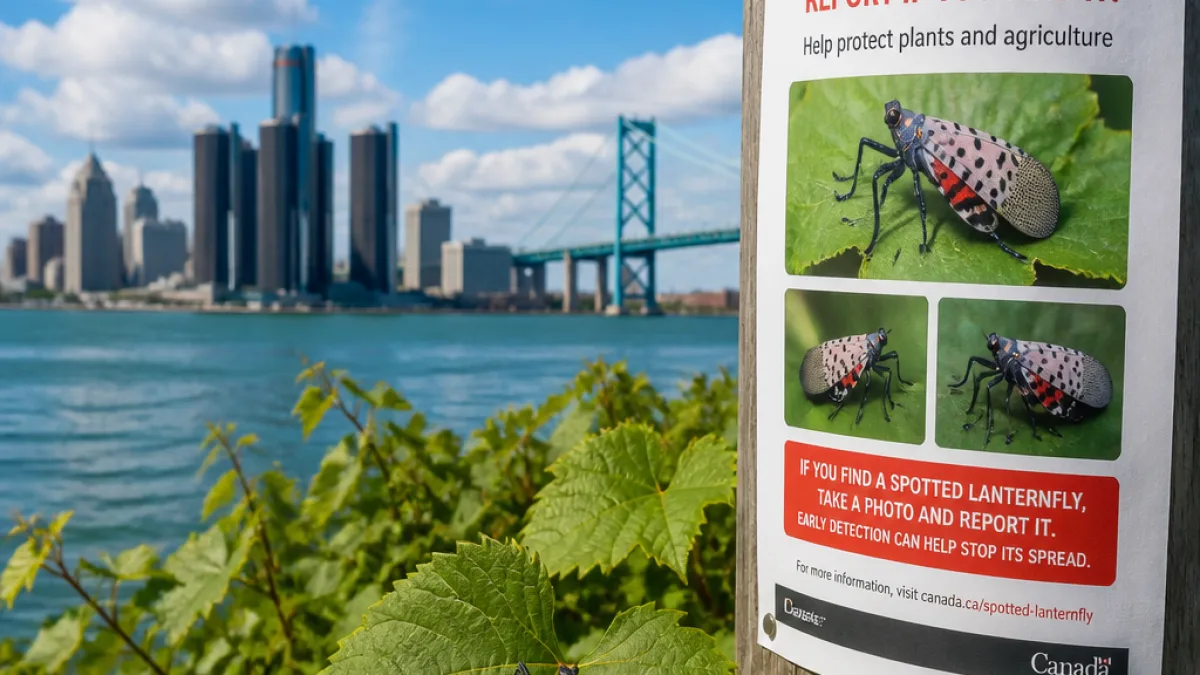
The Canadian Food Inspection Agency (CFIA) has confirmed a detection of the invasive spotted lanternfly in Windsor, marking the first official sighting of the insect in Canada. Federal and provincial agencies are urging residents to be vigilant and report any sightings or egg masses so early action can be taken to prevent establishment.
What officials are saying
The Invasive Species Centre has described the spotted lanternfly as a "significant threat" to several key sectors. That warning specifically lists the grape, wine, horticulture and forestry industries as vulnerable to harm if the insect becomes established in Canada.
"The spotted lanternfly" is a "significant threat" to the grape, wine, horticulture and forestry industries.
What Windsor residents should do
Local authorities and federal officials are stressing that early detection is central to preventing the insect from becoming established. The CFIA has advised residents who believe they have seen the lanternfly or its egg masses to:
- Take a clear photograph of the insect or egg mass.
- Trap or contain any egg masses if it is safe to do so.
- Report the sighting to the CFIA by phone or online.
Local stakes and broader context
Windsor sits at a crossroads for commerce, agriculture and cross-border movement. While the CFIA confirmation does not yet describe the scale of the detection in the city or indicate any regulated area boundaries, the designation as the first official Canadian detection elevates the matter beyond a routine pest sighting. The sectors highlighted by the Invasive Species Centre — grape, wine, horticulture and forestry — represent economic and environmental interests that could face increased management costs and regulatory responses if the insect spreads.
| Sector | Current advisory |
|---|---|
| Grape | Listed as at risk by the Invasive Species Centre |
| Wine | Listed as at risk by the Invasive Species Centre |
| Horticulture | Listed as at risk by the Invasive Species Centre |
| Forestry | Listed as at risk by the Invasive Species Centre |
Why early reporting matters
Federal agencies have repeatedly stressed that rapid reporting and documentation allow for targeted responses — surveys, containment and possible eradication efforts — that are far more effective before a pest becomes widespread. In urban and peri-urban areas such as Windsor, public awareness plays a key role because initial detections often come from residents who notice an unfamiliar insect or egg masses on trees, vehicles or outdoor equipment.
What to watch for
The CFIA has provided guidance to residents for submitting reports, including photographing suspected specimens and trapping or collecting egg masses where it can be done safely. Officials have made reporting options available by phone and online to ensure sightings are recorded and vetted promptly.
This confirmation in Windsor will likely prompt heightened surveillance across southern Ontario and increased outreach to growers and property owners. For now, the critical step for residents is to document and report any possible evidence of the spotted lanternfly to federal authorities so that follow-up action can be coordinated.
Further updates are expected from the CFIA and provincial partners as investigations proceed and any localized response measures are determined.