Neighbours of the Falaise community in Saanich are raising the alarm after learning a sidewalk that was shown in municipal plans has been removed, leaving pedestrians to contend with narrow, curved streets now seeing growing infill and vehicle congestion.
Residents say planning promise disappeared
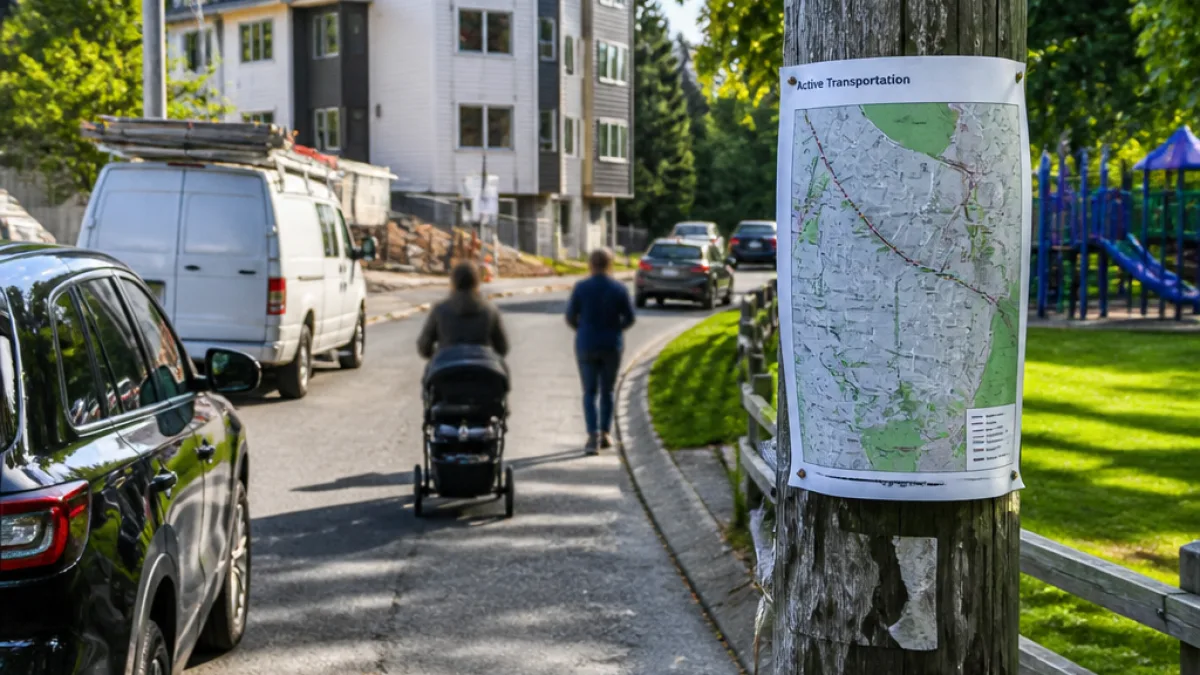
According to a letter published this week, the sidewalk that appeared in Saanich planning documents in 2018 is no longer part of the municipality’s design for Falaise Crescent. The neighbourhood is directly across from Broadmead Village and is focused around a small park with a children’s playground. Residents describe a dense street where multi-tenant homes and business vehicles routinely line the road, at times blocking sightlines.
“We deserve safety. We deserve a sidewalk.”
The letter, signed by a local resident, notes the arrival of a new three-storey, six-unit building with single-car garages that is nearing occupancy and warns that other approved infill projects could add as many as 18 more units along the roughly 450-metre street. With cars often parked on both sides, emergency and service vehicles are said to have difficulty navigating the curved layout.
Conflict with the Active Transportation Plan
Residents point to the Saanich Active Transportation Plan (ATP), adopted in 2024, which commits the municipality to “filling gaps” in the sidewalk network and to a “Vision Zero” approach prioritizing safety for vulnerable road users. The letter asks why a sidewalk shown in earlier planning materials has been removed and questions whether the municipality is meeting that ATP commitment.
The writer also contrasts the missing pedestrian infrastructure with the municipality’s apparent prioritization of cycling infrastructure, asking who is being protected when people with strollers, seniors and people with disabilities must share the road with increasing traffic.
Immediate safety, long-term planning implications
The situation on Falaise Crescent highlights several intersecting pressures for municipalities across Greater Victoria: the push for infill and housing supply, parking and curb space management, and the need to complete pedestrian networks promised in broader transportation strategies. Neighbourhoods built before the recent wave of infill often lack the right-of-way and design to safely accommodate increased footfall and parked vehicles without upgrades.
- Density and parking pressure: Multiple-tenant homes and business vehicles increase demand for curbside parking.
- Infill units near occupancy: A new six-plex is about to bring more residents to the street, and other projects could add up to 18 units.
- Policy mismatch: Residents say removing the sidewalk conflicts with the ATP’s gap-filling and Vision Zero priorities.
Residents are calling on the District of Saanich to reinstate the sidewalk shown in earlier plans and to halt approvals of what they describe as excessive infill until infrastructure can be upgraded. They argue the municipality has a duty to provide safe passage for pedestrians, and warn of potential liability if an accident occurs on a street where promised infrastructure was removed.
| Item | Figure |
|---|---|
| Length of Falaise Crescent cited | 450 metres |
| New building units nearing occupancy | 6 units (three-storey six-plex) |
| Potential additional units in pipeline | Up to 18 units |
The District of Saanich did not immediately respond to a request for comment about the removal of the sidewalk from planning documents or about whether the ATP’s commitments require reinstatement. Municipal responses typically clarify whether edits to neighbourhood plans are part of a broader review, a change in priorities, or the result of technical constraints such as right-of-way limits and utility placement.
For residents, however, the concern is immediate: streets must be safe for children, seniors and people with mobility challenges today, not at some unspecified future date. As Saanich and other municipalities continue to balance growth with neighbourhood livability, the Falaise Crescent dispute underscores the challenge of aligning long-term transportation strategies with on-the-ground planning decisions.
Neighbourhood advocates say they will press council to restore the sidewalk commitment and to ensure future infill approvals include appropriate pedestrian and parking infrastructure. The outcome will be watched by other communities where promised sidewalk and active-transportation investments remain incomplete.
Reporting for WE NEWS from Saanich — textured West Coast coverage that weighs growth, environment and community.