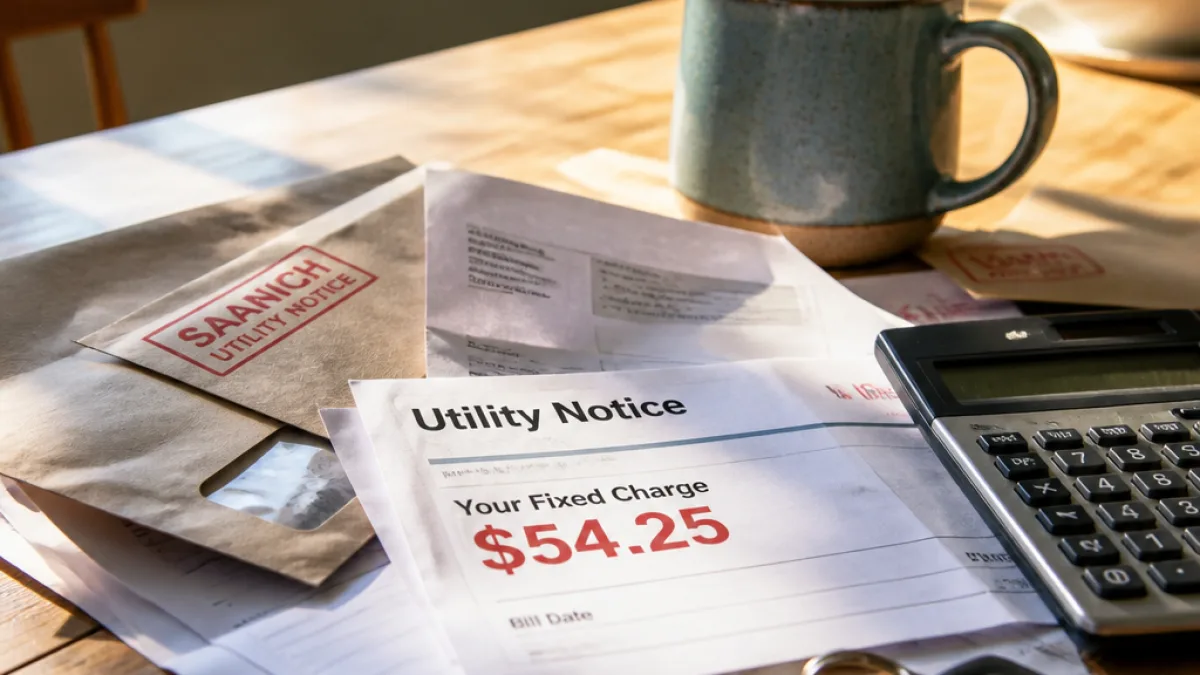
The latest municipal utility notices landing in Saanich mailboxes show sharply higher fixed charges for water and sewer after a 2024 decision by council to change the consumption-versus-fixed-cost split for utility billing.
What changed and who is affected
Saanich council in 2024 adopted a new costing model that shifts the balance between consumption-based rates and fixed connection fees from 90/10 to 50/50. The change moves more of the utility revenue burden onto fixed charges tied to the connection size rather than to metered consumption.
A recent letter to local media from a Saanich resident lays out the practical effect: for a home with a typical 19 mm water line, fixed water and sewer charges (municipal plus CRD) rose from $76 annually in 2024 to $417 in 2026 — an increase the writer calculates as 448% over the 2024 level. When fully phased in to the 50/50 split, the writer says fixed charges will reach $684, an overall increase of roughly 800% compared with 2024.
“My utility bills from Saanich are now much higher than two years ago, despite using less water,” the resident wrote.
Council, staff and the contested projection
The writer identifies Saanich’s director of engineering, Harley Machielse, as having advised council in 2024 that the model change would have no net effect on customers. According to the letter, reality has diverged from that advice as fixed portions of bills have climbed sharply while consumption rates have not been reduced sufficiently to offset the shift.
Municipal staff and elected officials routinely review utility rate models to balance revenue stability with affordability. In this case, the council has voted unanimously each year since 2024 to enact the scheduled increases to fixed rates, the resident notes. More phased increases remain to reach the intended 50/50 split, meaning further growth in fixed charges is planned.
Arguments and alternatives
The resident argues the increased fixed-cost share is regressive: it raises bills for households regardless of whether they conserve water. They urge adoption of a tiered-fee structure that would place a larger share of costs on high-volume users, saying that would better align payment with consumption and conservation incentives.
- Equity concern: Fixed fees can disproportionately affect low-usage households, including seniors living alone or households conserving water.
- Transparency question: Residents point to a mismatch between staff projections given in 2024 and the larger-than-expected burden now appearing on bills.
- Policy timing: The issue comes ahead of the municipal election this October, and the writer says they will not support incumbents over the matter.
Numbers at a glance
| Item | Amount |
|---|---|
| Fixed water and sewer (typical 19 mm line) — 2024 | $76 |
| Fixed water and sewer — 2026 | $417 |
| Projected fixed water and sewer when 50/50 reached | $684 |
| Increase from 2024 to 2026 (fixed portion) | 448% |
| Projected increase by full phase-in | ~800% |
Local consequences and next steps
For many households the immediate effect is a higher predictable charge on the annual bill regardless of actual consumption. That reduces the price signal that encourages lower usage, unless consumption rates are concurrently adjusted to compensate. The resident’s letter suggests council consider reinstating stronger consumption-based incentives — such as tiered volumetric rates — to protect low-use households and preserve conservation goals.
The council’s unanimous votes to proceed with the increase suggest broad political agreement to stabilise utility revenue through higher fixed charges. Proponents typically argue fixed fees ensure reliable funding for infrastructure and allow fair allocation of costs tied to connection size and availability. Critics point to affordability and fairness for those who use less.
With more increases scheduled to complete the transition to a 50/50 model, the debate over how to balance revenue stability, conservation incentives and affordability is likely to be a talking point in the municipal election this fall.
Residents seeking clarity should watch for council meeting agendas and staff reports that detail the phasing schedule and any accompanying changes to consumption rates, and contact their elected representatives for explanation of the trade-offs behind the model change.