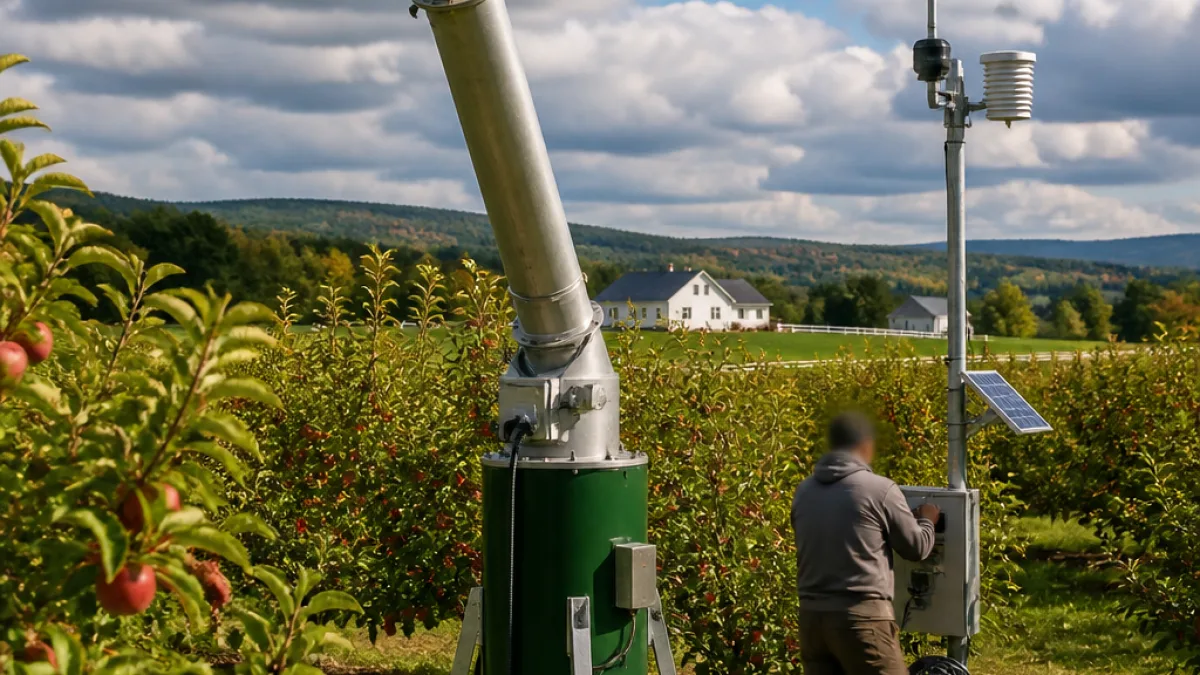
BOIS-FRANCS REGION — A Quebec apple orchard has turned to an unconventional defence against increasingly severe summer storms: a Spanish-made anti-hail cannon that its owner says will safeguard fruit trees and limit economic losses.
What the device does and why the orchard bought it
At Verger des Bois-Francs, located southeast of Montreal, fourth-generation grower Maxime Brie has installed the machine after weighing the risk that hail poses to his family business. Hail can shred fruit and force entire harvests into processing for juice or sauce, a transformation that sharply reduces returns.
Brie said the device — bought for about $160,000 — produces controlled detonations near the ground to send shockwaves upward. Those waves, the manufacturer says, disturb the formation of hailstones so that falling precipitation arrives as rain instead of damaging ice.
“For sure it has millions of dollars of loss when we get hit by hail,”
The cannon's operator works with meteorological support: the unit at the orchard is connected to a weather station network operated by SPAG, with monitoring conducted from a facility in Brazil. Brie described a coordination routine in which meteorologists will notify the orchard via a WhatsApp group before activating the system.
Technology and provenance
Anti-hail cannons originated in Europe and have been produced in several countries, including New Zealand and Germany. The model now at Verger des Bois-Francs was manufactured in Spain and, according to Brie, has not previously been used in Canada.
Proponents say a single cannon can cover substantial ground — Brie estimates up to 80 hectares per unit — making it an appealing option for larger properties or cooperative deployments among neighbouring farms.
| Feature | Specification |
|---|---|
| Estimated coverage | Up to 80 hectares |
| Purchase price | $160,000 |
| Manufacturer origin | Spain |
| Weather monitoring | SPAG station, monitored from Brazil |
Economic stakes for growers
Hail remains one of the most costly hazards for fruit producers. When crops are battered, damaged fruit often cannot be sold at premium prices and is diverted into lower-value processing streams. For family farms with multigenerational ties to the land, a single severe hail event can wipe out a season's earnings.
Brie's investment reflects a broader calculus: whether the upfront cost of advanced mitigation can be justified by avoided losses over several seasons. For some producers, communal approaches — sharing the cost of a cannon among neighbours — are discussed as a way to spread expense and risk.
Local context and next steps
Quebec's agricultural sector has faced more frequent episodes of extreme weather in recent years, a trend growers attribute to shifting climate patterns. Technologies such as anti-hail cannons are one of several strategies farmers are exploring alongside crop insurance, diversification and changes in orchard management.
- Device triggers controlled detonations to alter atmospheric conditions that form hail.
- Connected to remote meteorological monitoring for timely activation.
- Claims coverage of up to 80 hectares per cannon, depending on local conditions.
Brie said the orchard team has trained on the system and established communication protocols with the monitoring service to ensure timely, coordinated use during approaching storms. He expects the cannon will be used only when conditions are right and warned that it is one tool among many to reduce weather-related damage.
As Quebec growers evaluate options to protect crops, the experience at Verger des Bois-Francs will be watched closely by peers weighing the costs and benefits of importing and operating relatively costly mitigation technologies in Canadian conditions.
Geneviève Tremblay is the Quebec correspondent for WE NEWS, reporting on agriculture, rural economies and climate impacts in the province.