Quebec’s premier has opened the door to restoring American wines to provincial liquor-store shelves — but she made clear Monday that any change would be conditional and linked to broader trade improvements for the province.
Linking wine sales to trade wins
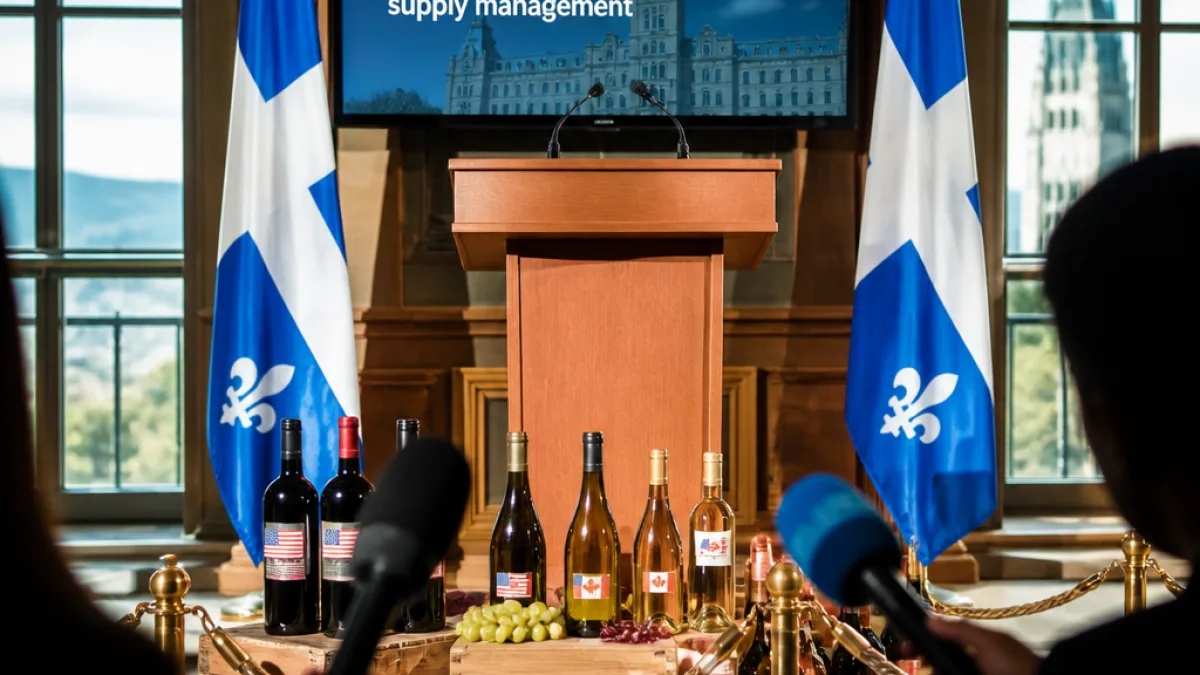
Christine Fréchette told reporters she would consider allowing U.S. wines to come back into Government-run outlets, provided Quebec sees concrete progress in bilateral trade talks. She singled out reductions in tariff barriers in sectors such as forestry, aluminium and manufacturing as examples of the kinds of gains she expects.
“We are open to that, but not at any price,”
The premier reiterated that the province’s position on other sensitive matters is firm: she will not agree to weaken the province’s supply management system, nor to accept any measures that could affect Quebec’s culture and language as part of trade negotiations.
Background: a provincial boycott and looming U.S. tariffs
Quebec's liquor authority was ordered last year to stop selling American products in response to earlier rounds of U.S. tariffs. The move formed part of a broader provincial response to measures announced by the U.S. government that targeted Canadian goods.
Fréchette’s comments come as a new set of U.S. duties — described as 50 per cent tariffs on a range of Canadian products — are scheduled to take effect on Aug. 19. Unlike some previous U.S. measures, those levies reportedly include no exemptions for items that comply with the Canada–United States–Mexico trade agreement.
Conditions the premier is setting
The premier framed any reopening of liquor-store shelves to American wines as contingent on reciprocal trade results. Based on her remarks, Quebec’s conditions include:
- Concrete tariff reductions for key export sectors such as forestry, aluminium and manufacturing.
- Preservation of the province’s supply management regime for dairy and poultry.
- Guarantees that Quebec’s language and cultural protections will not be compromised.
| Issue | What Quebec seeks |
|---|---|
| Market access for U.S. wine | Conditional reinstatement in provincial outlets |
| Tariffs | Reduction on forestry, aluminium, manufacturing exports |
| Supply management | No weakening allowed |
| Culture and language | Must remain protected |
Implications for consumers and producers
Allowing U.S. wines back into Quebec’s retail network could lower prices and expand choice for consumers, but Fréchette’s hesitation signals that any such consumer benefit would be weighed against perceived risks to local producers and regulatory frameworks. For forestry, aluminium and manufacturing exporters, the premier’s demand for tariff relief underscores how provincial leaders are tying domestic economic interests to decisions on consumer-facing policies.
Analysts say moves to link access for imported consumer goods to broader trade concessions are part of a negotiation strategy that uses visible items — such as wine on store shelves — as leverage in talks that affect higher-value exports.
Political and cultural red lines
Supply management has long been a politically sensitive subject across Canada. Quebec’s firm stance that it will not countenance changes to that system aligns the province with other jurisdictions that view those protections as central to rural economies and farm incomes.
Similarly, Fréchette’s invocation of culture and language reflects a persistent theme in provincial politics: trade and economic policy are often considered alongside, and sometimes subordinated to, the preservation of Quebec’s distinct identity.
What to watch next
Key developments to follow will include the outcome of federal-level negotiations with Washington, any formal proposals from U.S. counterparts to ease tariffs on Quebec’s priority sectors, and directives from the provincial government to the liquor-board regulator about the sale of American products.
For now, Quebec consumers and exporters are likely to watch closely as the Aug. 19 tariff deadline approaches and as officials seek to convert trade conversations into tangible adjustments on store shelves and at the border.
Geneviève Tremblay is WE NEWS’s Quebec correspondent.