
One Delta frames platform around affordability, safe streets and investment
One Delta has released the first elements of a strategic plan it describes as a "comprehensive blueprint" for governing Delta, laying out three initial priorities designed to address immediate pressures on households while preparing the city for future growth.
The slate, which has candidates from Ladner, North Delta and Tsawwassen, presented the priorities in a Sept. 10 campaign press release as municipal voters begin to weigh options ahead of the next local election. The team says the city is "at a crossroads" and needs leadership that focuses on practical outcomes rather than further studies.
"It’s time for leadership that delivers tangible results for Delta, not slogans or studies. We have built a team that represents the entire community. We’re focused on doing the work, listening to residents and building a city that proactively plans ahead instead of just reacting to crises,"
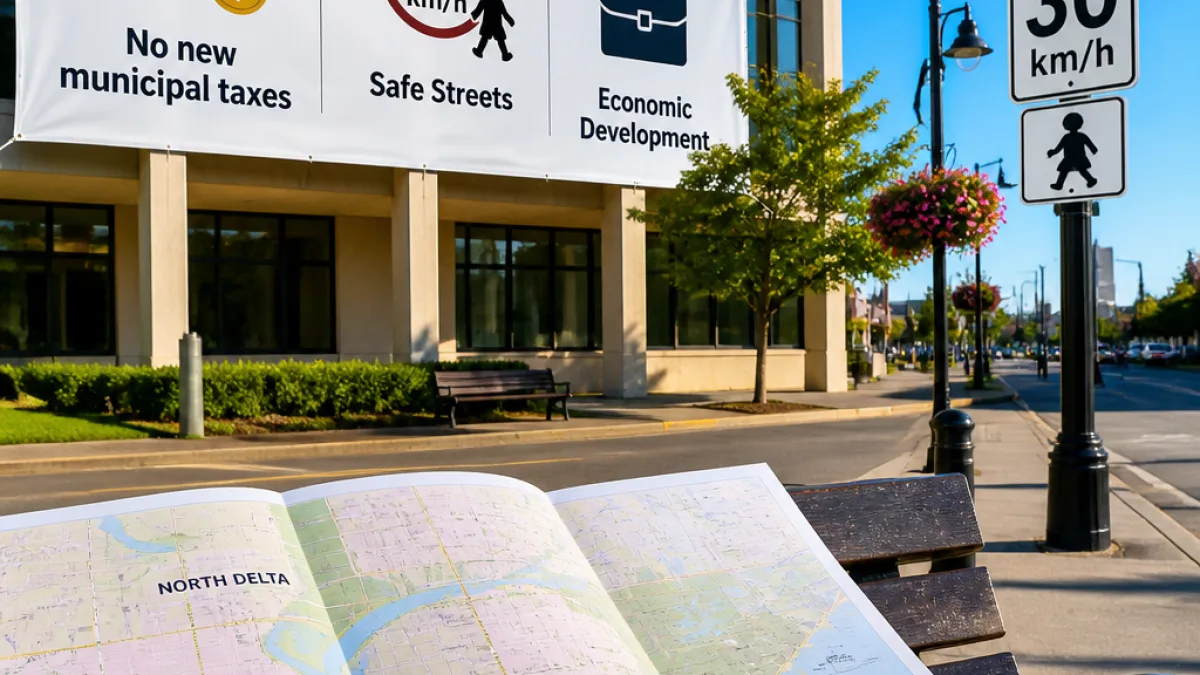
The three pillars announced are:
- Affordability — a commitment to no new municipal taxes, levies or fees;
- Safe neighbourhoods — a push to introduce 30 kilometre-per-hour speed limits on residential roads and a partnership with the school board on a Safe Routes to School program;
- Attracting investment — establishing Delta’s first Economic Development Office to support local businesses and encourage job creation.
Policy detail and municipal implications
The affordability plank centres on a pledge to avoid additional municipal taxation. That commitment directly speaks to households facing rising costs, although the announcement does not set out how existing service needs or capital projects would be funded under a no-new-tax rule.
On traffic calming and neighbourhood safety, the 30 km/h proposal reflects a trend in many municipalities to lower speeds on residential streets to reduce collisions and improve safety for pedestrians and cyclists. One Delta pairs that measure with a Safe Routes to School initiative in partnership with the school board, aimed at improving walking and cycling access for children.
The pledge to create an Economic Development Office is billed as Delta’s first dedicated municipal unit to co-ordinate business support and drive job creation. The platform describes the office as a mechanism to help local firms grow and to give the city tools to proactively plan for expansion rather than "falling behind."
Questions residents and council will need to consider
While the three pillars offer a concise set of priorities, they raise operational and budgetary questions that councillors and residents are likely to press on. For example, implementing a city-wide 30 km/h residential limit requires traffic engineering work, signage changes and public education — all of which have costs. Similarly, the creation of an Economic Development Office implies staffing, operating budgets and measurable targets for job creation.
There is also the question of trade-offs under a no-new-tax commitment. Municipalities typically rely on property taxes, user fees and other charges to maintain infrastructure and services. If new revenues are constrained, council would need to identify savings, reprioritise projects or seek alternative funding partnerships to maintain or expand services.
Where the slate positions itself
In its release, the One Delta campaign framed its agenda as "back-to-basics service delivery," emphasising fixing what is broken and investing in essential services so families receive reliable daily infrastructure support. The team argues that this approach will steady neighbourhoods and provide a platform for measured growth.
With candidates drawn from across Delta’s three communities, the slate is presenting a unified municipal vision rather than neighbourhood-specific platforms. How those priorities resonate with voters will become clearer as the campaign develops and competing slates lay out alternative approaches on taxation, safety and economic strategy.
| Priority | Headline commitment |
|---|---|
| Affordability | No new municipal taxes, levies or fees |
| Safe neighbourhoods | 30 km/h residential limits; Safe Routes to School partnership |
| Attracting investment | Create Delta’s first Economic Development Office |
The One Delta announcement sets the stage for a municipal conversation about priorities, trade-offs and implementation. Residents will be watching for further detail on costs, timelines and measurable outcomes as the slate expands its strategic plan.
Reporting from Delta's communities where housing, traffic and local jobs shape daily life.
















