Federal grant to target climate risk assessments and a nature-based pilot in Hamilton
Hamilton has been awarded $210,000 in federal funding to accelerate work on its climate adaptation planning and to fund a feasibility study for a nature-based pilot project the city is calling a "sponge plaza", city officials said.
The funding is being delivered through the Federation of Canadian Municipalities’ Green Municipal Fund (GMF) Local Leadership for Climate Adaptation initiative and will be split into two parts: $140,000 to update and speed up the city's Climate Change Impact Adaptation plan and $70,000 for a feasibility study of a sponge-plaza pilot.
City staff say the work funded by the grant will include updated climate-risk assessments, economic analysis of adaptation measures, community engagement and improved monitoring tools — elements intended to refine how Hamilton evaluates and prepares for climate impacts.
- $140,000 — Update and accelerate the Climate Change Impact Adaptation plan (risk assessments, economic analysis, engagement, monitoring)
- $70,000 — Feasibility study for a nature-based "sponge plaza" pilot (trees, native plants, permeable surfaces)
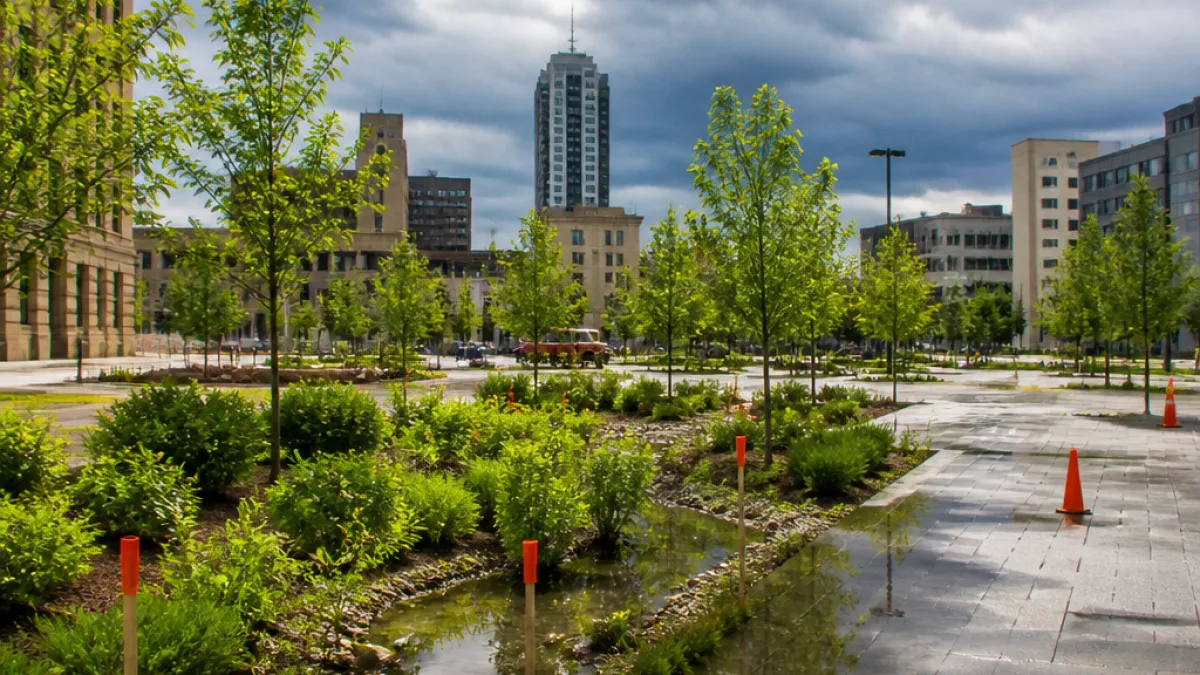
According to city officials, a sponge plaza would use trees, native vegetation and permeable surfaces to absorb and retain rainfall, aiming to reduce flood risk while creating cooler, greener public spaces.
"A sponge plaza uses trees, native vegetation and permeable surfaces to absorb and maintain rainfall," city officials said.
While the grant’s details focus on planning and study rather than construction, the approach reflects a broader municipal interest in nature-based solutions that can serve multiple purposes: stormwater management, heat mitigation and enhanced public amenity.
Why this matters to Hamilton residents
For residents, updated climate-risk assessments and stronger monitoring tools could mean earlier identification of neighbourhood vulnerabilities and evidence to support targeted investments. Economic analysis of adaptation options is intended to help municipal decision-makers weigh costs and benefits before committing to larger projects.
The sponge-plaza concept explicitly links environmental performance with public space design. If the feasibility study supports proceeding to pilot construction, Hamilton could see a prototype public plaza that demonstrates how natural systems can be integrated into urban settings to manage intense rainfall events and moderate local temperatures.
| Funding purpose | Amount |
|---|---|
| Climate plan update and acceleration | $140,000 |
| Sponge-plaza feasibility study | $70,000 |
The federal dollars arrive under the GMF Local Leadership for Climate Adaptation initiative, which supports municipalities across Canada as they plan for the impacts of climate change. For Hamilton, the funding is geared toward both technical work and community engagement — the latter a key component if nature-based infrastructure is to be located in or adjacent to neighbourhoods.
Local officials have emphasised the dual goals of reducing flood risk and making public spaces cooler and greener. Those aims align with a growing municipal interest in climate-resilient design that also improves quality of life.
For now, the money will support planning and the feasibility phase. Any decision to build a sponge plaza or pursue other adaptation projects will follow further study and municipal processes, including community consultation and financial approvals.
As Hamilton moves from planning toward action, residents and community groups are likely to watch how the city balances technical assessments, costs and neighbourhood priorities when shaping adaptation investments.