ALBERTA — During a visit to Grande Prairie, Premier Danielle Smith rejected the idea of using Alberta's energy exports as leverage in the escalating trade dispute with the United States, saying any move to tax or cut off oil and gas shipments would backfire on workers and provincial economies.
Premier urges diplomacy, not economic retaliation
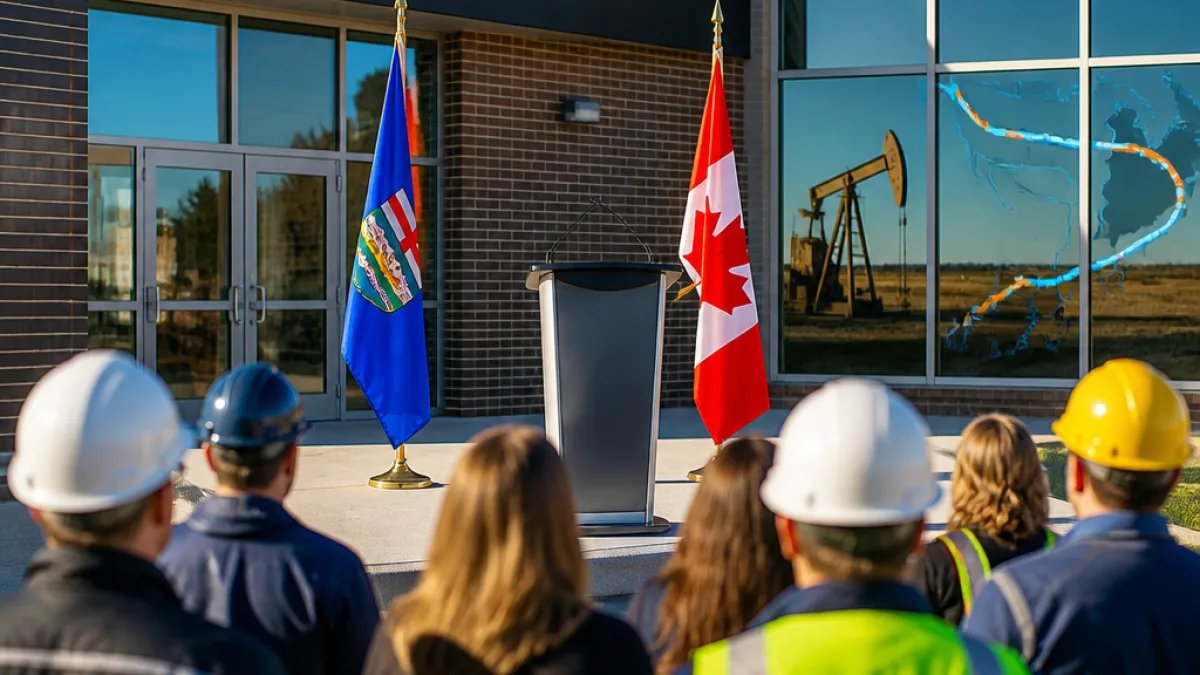
Speaking Wednesday at the ribbon cutting for the new Skilled Trades Training Centre at Northwestern Polytechnic, Smith argued the province should "double down" on diplomatic channels rather than resort to restrictive measures against U.S. markets. The centre is a new 40,000-square-foot facility aimed at training trades workers and supporting workforce development in northwestern Alberta.
Smith said Alberta sends the majority of its crude oil to the United States and warned that a Canadian tariff on those exports would invite a harsh American response. She said a 50-per-cent Canadian tariff on the roughly four million barrels of oil exported daily to the United States could prompt reciprocal measures.
"I cannot think of a more disastrous policy decision than cutting off or taxing Alberta's oil to the United States," Smith said in Grande Prairie.
Economic consequences the premier cited
The premier detailed a sequence of effects she expects from aggressive trade actions: U.S. retaliation in the form of tariffs on Canadian energy products, job losses concentrated in Alberta and spillover impacts in other provinces, and potential supply disruptions for Eastern Canada.
- Smith estimated an American tariff of between 50 and 100 per cent on Canadian oil and gas products would result in sizeable job losses.
- She warned that cutting exports entirely could lead to the U.S. restricting refined fuel shipments to Ontario and Quebec.
- Smith also suggested American refineries would source replacement crude from elsewhere if Alberta exports were curtailed.
On numbers, Smith said such a tariff regime would "result in the loss of about half a million jobs at a minimum," with most of those positions concentrated in Alberta but with substantial impacts in Ontario and Quebec as well.
Local angle: training and workforce resilience
Smith's remarks came at a workforce-focused event, highlighting the provincial government's interest in skills training while emphasising Alberta's reliance on export markets. The new trades facility in Grande Prairie is intended to bolster local labour capacity in the face of economic shifts in the energy and construction sectors.
While the premier framed diplomacy as the preferred route, her comments underscore the vulnerability of Alberta's energy-dependent regions to trade measures. Grande Prairie's economy, tied to energy and resources alongside agriculture and services, is directly affected by any disruption in export markets:
| Item | Figure |
|---|---|
| Daily oil exports to U.S. | ~4,000,000 barrels |
| Hypothetical Canadian tariff referenced | 50% |
| Potential minimum job losses cited | ~500,000 jobs |
| Size of new training facility | 40,000 sq. ft. |
Officials at the event linked the training centre to broader efforts to keep Alberta workers employable amid market uncertainty. The premier's public rejection of export-based retaliation reinforces provincial messaging that economic interdependence with the U.S. makes punitive energy measures risky for both countries.
For Grande Prairie residents, the debate is not abstract: energy flows and tariffs translate into project schedules, refinery demand and employment prospects. The trades centre opening reflects a practical, local response — strengthening labour supply while the provincial government pursues political and diplomatic channels to address cross-border trade tensions.
As the federal and provincial governments consider responses to U.S. tariffs, Grande Prairie businesses and workers will be watching for policy choices that affect market access, refinery supply chains and regional employment.