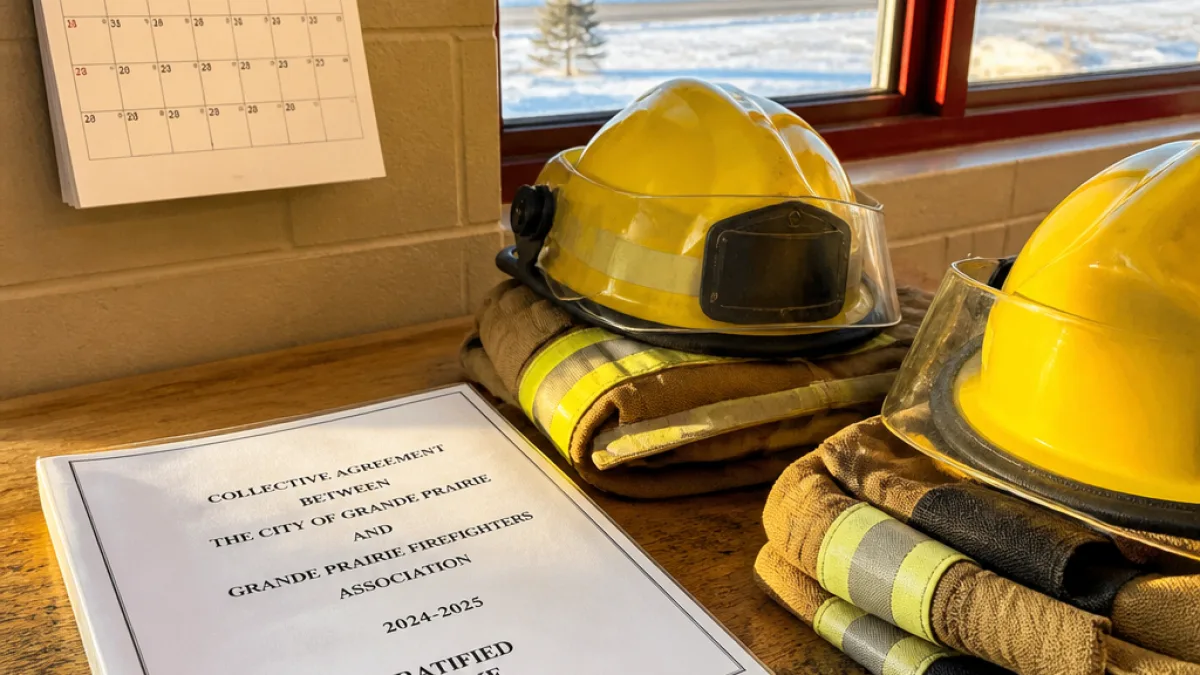
GRANDE PRAIRIE — A new collective agreement covering about 50 employees in the County of Grande Prairie fire service was ratified in June and brings modest wage increases, clarified work schedules for prevention staff and adjusted language around medical testing.
Who the deal covers — and who it does not
The agreement represents members of the International Association of Firefighters Local 5108 and applies to most personnel in the county fire department. It specifically excludes senior management and certain categories of workers. Those excluded are:
- fire chief
- deputy fire chiefs
- district fire chief
- all management and staff employed in a confidential capacity related to labour relations
- volunteer firefighters
- firefighters in training not yet qualified for full-time, part-time or temporary positions
- fire services administration assistant
The new bargaining unit now also includes fire marshals, who were not previously part of the union unit covered by the contract. The deal covers a range of positions including firefighters, fire prevention officers, marshals and captains.
Wages and timing
The agreement sets out annual pay increases for the period covered. The negotiated raises were:
| Effective date | Wage increase |
|---|---|
| 1 January 2024 | 3.85% |
| 1 January 2025 | 3.50% |
| Total over term: 7.35% | |
Those increases are slightly lower than the prior contract, which provided raises of about 3.9 per cent and 3.6 per cent in its years. The previous agreement expired at the end of 2023. Although this new deal was only formally ratified in June — roughly two-and-a-half years later — it covers a two-year period that technically already concluded at the end of last year.
Work rules and medical testing changes
The new contract spells out scheduling for certain prevention staff and modifies how medical and fitness testing is triggered.
- Full-time fire prevention workers are scheduled on a four-shift pattern of 10 hours each per week — a specific schedule absent from the prior agreement.
- Language that previously referred to medical exams or functional capacity evaluations occurring “upon reasonable cause” has been revised so those assessments are now initiated “when two supervisors have deemed appropriate.”
“upon reasonable cause”
The change shifts discretion for triggering medical or fitness assessments away from a more vaguely defined standard toward a supervisory decision-making process.
Mobility for prevention staff
A new clause provides an internal mobility pathway for prevention officers who did not originally come from Local 5108. After 24 months, those officers can apply for full-time suppression positions, but must complete all departmental firefighter recruitment testing and meet the same standards as external applicants.
What it means locally
The agreement brings clarity on scheduling and eligibility that could affect staffing flexibility within the county fire service. Including fire marshals in the bargaining unit consolidates more frontline safety roles under the union, which may influence future collective-bargaining topics and departmental organisation.
From a municipal finance perspective, the total 7.35 per cent wage growth over the two-year span is a known line-item for budgeting — albeit slightly lower than the previous round — but the delay in ratification means the contract’s formal timing and retroactive application could complicate payroll and accounting depending on how the county has managed those pay periods since the prior deal lapsed.
For Grande Prairie and surrounding county residents, the contract matters because it governs the people who respond to fires, medical first-response calls and other community emergencies. Clearer scheduling and defined pathways between prevention and suppression work may help retain staff and improve operational predictability.
The text of the agreement was located in the provincial database of collective agreements and was ratified in June. No additional financial details, arbitration notes or implementation timelines were provided in the material reviewed.
Reporting from Grande Prairie for WE NEWS.