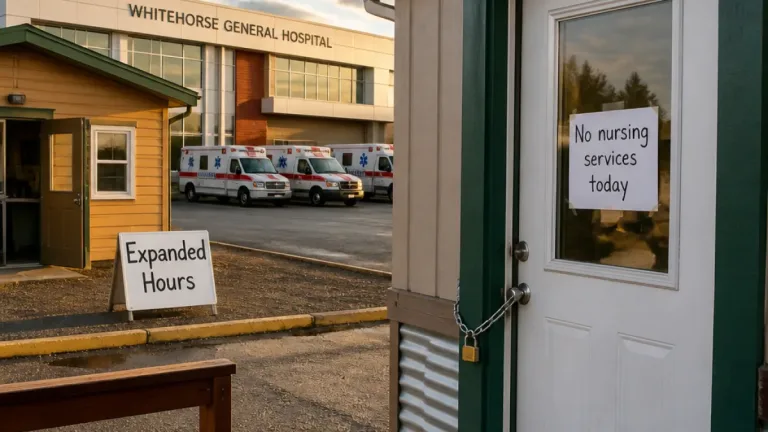

WHITEHORSE — Federal and territorial health ministers met in Whitehorse on Aug. 18 to compare notes on health-care pressures in the North, but the conversation made clear differing priorities: Ottawa framed problems as national and programmatic, while the Yukon pressed for significant infrastructure investment, particularly for Whitehorse General Hospital.
Federal Health Minister Marjorie Michel said her week‑long visit to the North was intended to deepen Health Canada’s understanding of conditions shaping care in remote and Indigenous communities. Her remarks stressed common themes she sees across jurisdictions: access to care, the opioid crisis and supports for Indigenous health.
“I would say the challenges that we are seeing here are quite the same as the ones that I see across the country, like access to care, the opioid drug crisis, particularly in the remote communities,” Michel said. “It’s across Canada.”
Michel repeated that the federal government’s role is to support territorial priorities rather than directly deliver services. She pointed to the Yukon’s early adoption of the federal Working Together agreement — a seven‑year mental‑health funding program — as an example of federal support aligning with territorial plans.
Funding, infrastructure and a different lens
From the territory’s perspective, the primary need is capital investment. Territorial Health Minister Brad Cathers used the meeting to restate the Yukon’s top priority: expanding Whitehorse General Hospital to meet growing demand and modern care standards. The federal government has earmarked a national health‑infrastructure fund to help with such projects.
Michel highlighted the federal $5‑billion national health‑infrastructure fund announced last year and said the Yukon has signed on for roughly $74.8 million from that pot. She also described a revised cost‑sharing approach in the territories: Health Canada will cover 75 per cent of eligible project costs, leaving 25 per cent to territorial partners in recognition of northern needs and capacity.
| Item | Detail |
|---|---|
| National fund | $5 billion |
| Yukon allocation (signed) | ~$74.8 million |
| Federal/territorial funding split | 75‑25 (federal covers 75%) |
That funding model is intended to speed project delivery in places where capacities and economies differ from provinces. The move to more generous federal support was welcomed by territorial officials, but questions remain on timelines, project scope and how much of the hospital expansion the signed amount will cover.
Program announcements aimed at youth and Indigenous research
Alongside infrastructure discussion, the federal minister announced several programmatic initiatives aimed at improving services on the ground. One is an Integrated Youth Services model that will include a Whitehorse facility and a mobile unit designed to deliver full‑service supports to outlying communities.
Health Canada also announced the establishment of the Yukon Network Environments for Indigenous Health Research, intended to strengthen culturally relevant research and support evidence‑based approaches in Indigenous health programming.
- Integrated Youth Services: Whitehorse facility + mobile unit
- Working Together agreement: seven‑year mental health funding
- Yukon Network Environments for Indigenous Health Research: new federal support
Territorial leaders framed those program investments as important but secondary to the immediate need for built infrastructure, particularly as hospitals and clinics struggle with capacity, staff recruitment and retention. The federal and territorial ministers agreed that improving access to care in remote communities remains a priority.
The Aug. 18 meeting offered Health Canada a chance to see Yukon realities directly: Michel said travelling with her deputy minister allowed federal officials to observe conditions on the ground and adjust their work accordingly. Still, the balance between programmatic supports and one‑time capital investments emerged as a clear point of divergence.
For Yukoners watching the process, the key questions are how quickly federal funds can be mobilized, whether the current signing commitments are sufficient for a hospital expansion, and how integrated services like the youth facility and Indigenous research supports will roll out across communities. Both ministers pledged ongoing collaboration, but the territory said it will continue pressing for the scale of infrastructure funding it believes is needed.
This meeting was one stop on Michel’s northern tour, part of a broader effort by Health Canada to align national priorities with on‑the‑ground realities in the territories.