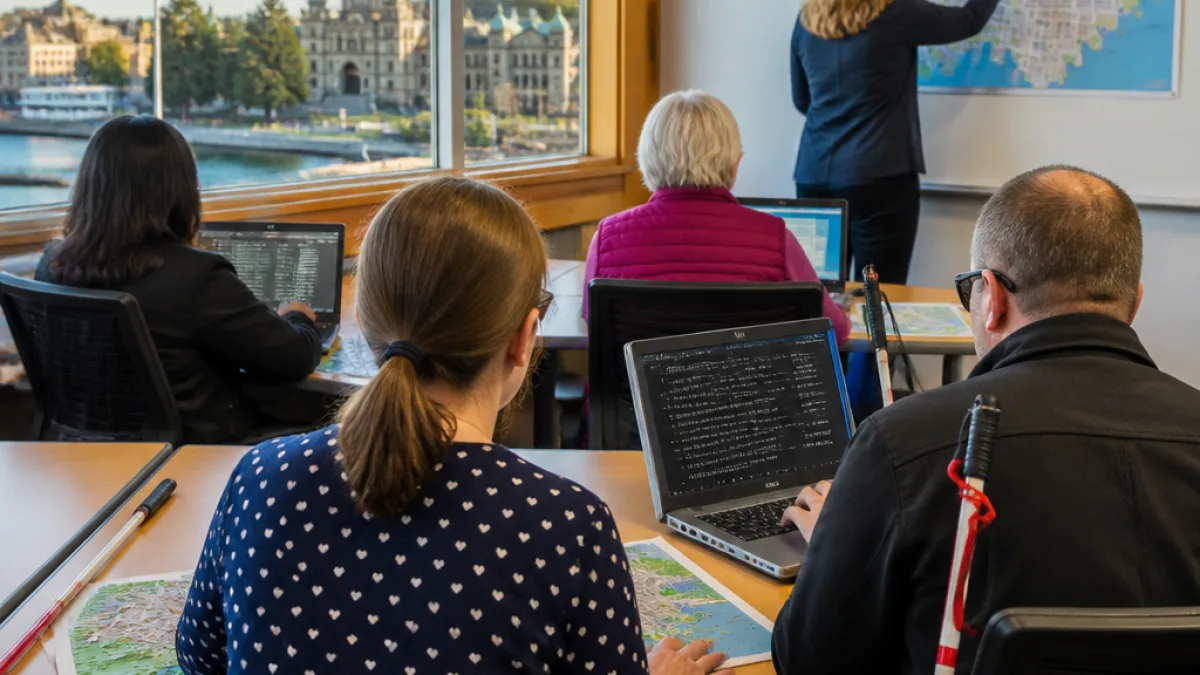
Victoria will be one of four British Columbia communities to receive targeted employment supports for people experiencing vision loss after the federal government announced more than $840,000 in funding on Aug. 17. The investment will be delivered locally by the Canadian National Institute for the Blind (CNIB) and aims to help participants develop essential skills, complete occupational training and gain on-the-job experience with local employers.
Program design and local delivery
The CNIB initiative will run cohorts in Victoria alongside sites in Kelowna, Prince George and New Westminster. Each local cohort will be delivered on a full-time, group-based model and combine several phases designed to support long-term employment.
- 11 weeks of essential and employability skills training
- 5 weeks of occupational skills training
- 13 weeks of workplace experience with local employers
- 4 weeks of individualized follow-up supports to aid labour-market attachment and job retention
Organizers say the model blends classroom-based learning with real workplace placements and individualized follow-up, intended to address barriers beyond training—such as access to assistive technology and workplace accommodations.
Scale and urgency
The new funding will support two cohorts of eight people each in the province, meaning small class sizes intended to deliver tailored supports. CNIB’s BC-Yukon executive director Ana Booth pointed to the broader scale of sight loss in the province: nearly 250,000 British Columbians are affected by sight loss, yet only two in five of those people are employed.
“This is due to inaccessible employment, to gaps in assistive technology, gaps in skills and barriers, misconceptions,”
Booth said the program seeks to build both a resilient employee and a more inclusive labour market.
Local political support and context
Local MLAs welcomed the announcement. Juan de Fuca–Malahat MLA Dana Lajeunesse, who serves as the province’s Parliamentary Secretary for Accessibility, framed the investment as a partnership that strengthens the workforce while expanding participation in the growing provincial economy.
Oak Bay–Gordon Head MLA Diana Gibson also underlined the community benefit, saying better access to training and employment helps ensure everyone in the community can “live life to the fullest.”
Implications for employers and the community
The program’s workplace placement component—13 weeks of on-the-job experience—will rely on local employers willing to host participants. For employers, the model offers a structured way to recruit and evaluate talent while receiving supports to make workplaces accessible. For the broader Victoria community, the initiative promises to address longstanding gaps that limit employment for people with sight loss, including awareness, accommodations and assistive technologies.
| Program element | Duration |
|---|---|
| Essential and employability skills | 11 weeks |
| Occupational skills training | 5 weeks |
| On-the-job placement | 13 weeks |
| Follow-up supports | 4 weeks |
While the announcement does not specify the range of occupational skills to be offered in Victoria, CNIB and local partners typically tailor training to local labour-market needs and participant goals. The small cohort size suggests an emphasis on individualized supports and practical placement opportunities rather than large-scale rapid hiring.
What this means going forward
Advocates and service providers say investments like this are needed to close the employment gap for people with disabilities. The CNIB program in Victoria will be a test of how coordinated training, technology supports and employer partnerships can translate into sustained job outcomes. Success, measured in job placements and retention, would bolster calls for scaled-up programs and increased employer engagement across the region.
For now, organizers are preparing to recruit participants and secure employer placements locally. The structure of the program—training, placement and follow-up—aims to move people from preparation to paid work in a supported pathway that addresses both skills and accessibility barriers.