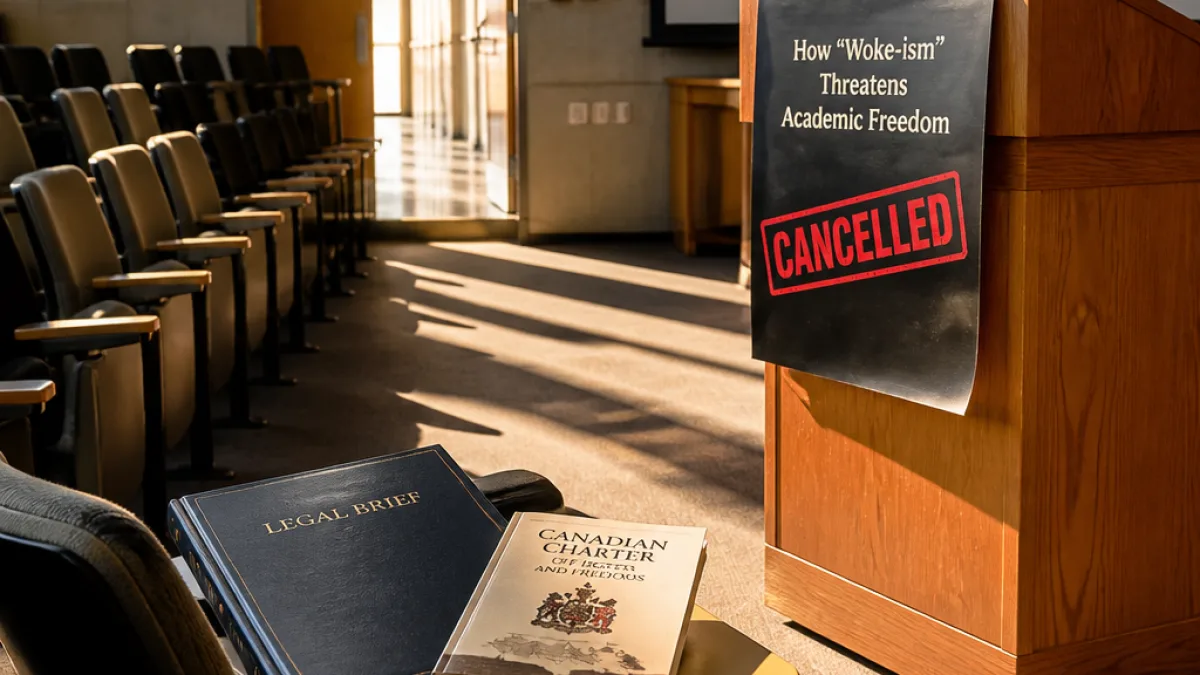
Judge: university failed to weigh Charter rights before cancelling lecture
The Court of King's Bench has ruled the University of Lethbridge was wrong to cancel a February 2023 lecture by controversial academic Frances Widdowson, saying the institution’s decision was "fundamentally and fatally flawed" because it did not expressly consider rights protected by the Canadian Charter of Rights and Freedoms.
The lecture, advertised as "How 'Woke‑ism' Threatens Academic Freedom", had been scheduled for Feb. 1, 2023, after a faculty member invited Widdowson to speak on campus. The university subsequently withdrew permission for the event following backlash, prompting Widdowson and a student, Jonah Pickle, who planned to attend, to seek a judicial review.
- Event: "How 'Woke‑ism' Threatens Academic Freedom" lecture
- Date scheduled: Feb. 1, 2023
- Parties seeking review: Frances Widdowson and student Jonah Pickle
"The University erred in law by not expressly considering and mentioning the Charter in making the decision," Justice Chris Simard wrote in the ruling.
In handing down the decision, Justice Chris Simard found the university failed to appreciate and address the Charter‑protected rights at stake — specifically the freedoms of thought, belief, opinion and expression under section 2(b) and the freedom of peaceful assembly under section 2(c). The judge’s written reasons, released Thursday, said the university did not adequately take those rights into account when cancelling the on‑campus event.
The university’s cancellation drew public attention at the time and prompted protests by some students on campus, part of a broader national debate over how post‑secondary institutions balance campus safety and inclusion with free‑speech protections. The court ruling focuses narrowly on process: whether the university considered Charter rights when it made its decision.
What the ruling means for the university and campus debate
Legal observers and campus stakeholders will be watching the practical consequences of the ruling. At minimum, the decision underscores that public universities in Alberta must factor Charter considerations into decisions that affect expression and assembly on campus. For the University of Lethbridge, the judge’s finding calls into question the adequacy of the institution’s decision‑making process in this instance.
The plaintiffs argued the cancellation infringed their Charter rights. In his reasons, Justice Simard concluded the university did not expressly consider the Charter in its decision and therefore erred in law. The ruling did not, in the reporting, specify a remedy such as an order to reinstate the event or an award of damages; the immediate legal finding is about the lawfulness of the university’s decision‑making.
| Item | Detail |
|---|---|
| Lecture title | How 'Woke‑ism' Threatens Academic Freedom |
| Scheduled date | Feb. 1, 2023 |
| Judicial finding | University erred by not considering Charter rights |
For students, faculty and administrators in Lethbridge, the ruling serves as a reminder that decisions to permit or cancel on‑campus events will be scrutinized for compliance with legal obligations under the Charter. Campus policies that govern invited speakers, event security and protest management may need to reflect more explicitly how Charter rights are balanced with other institutional responsibilities.
At a broader level, the case is one of several in recent years testing the intersection of academic freedom, campus safety and free expression across Canadian universities. Courts have increasingly been asked to review how post‑secondary institutions handle controversial speakers — and this ruling reinforces that public universities must show they considered constitutional protections when restricting expression.
Members of the University of Lethbridge community and local residents who follow campus affairs will likely await any further steps from the parties, including whether the university will seek to appeal or whether the plaintiffs will request specific relief based on the judge’s ruling. For now, the Court of King's Bench has concluded the university’s 2023 decision was legally deficient because it did not explicitly weigh Charter‑protected rights in its reasoning.
The ruling adds a legal dimension to the ongoing conversation in Lethbridge about how to protect inclusive campus environments while respecting the free‑speech rights that govern public institutions in Canada.