
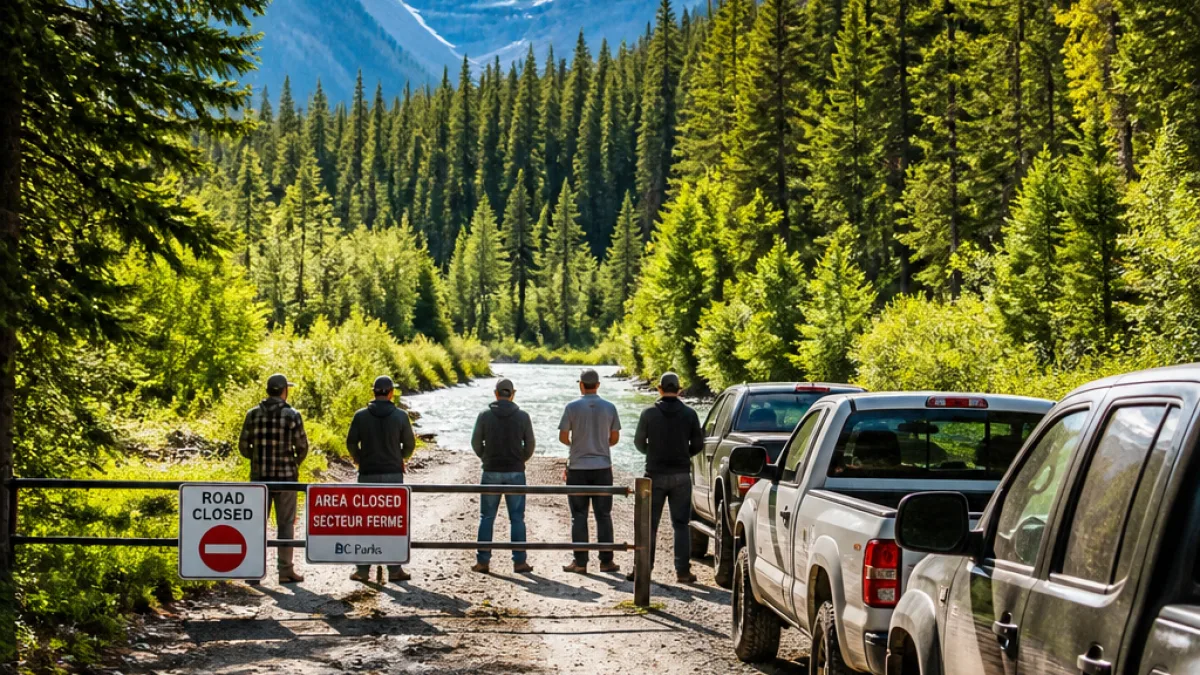
Provincial plans to permanently deactivate a forest service road that provides the only vehicle access to homes and backcountry near Trout Lake have provoked an unusual coalition of residents, industry representatives and environmental advocates across British Columbia.
Concerns over consultation and access
The Incomappleux Forest Service Road (FSR) runs up the Incomappleux River toward Glacier National Park and has been the focal point of monthly meetings for roughly two years by a broad group pushing to keep the route open. They say the province has not done meaningful consultation and that closure would cut off property access and recreational opportunities.
On July 8, about 70 stakeholders gathered near Trout Lake for a site visit that brought people from Nakusp, Salmo, Kamloops, Osoyoos, 100 Mile House, Logan Lake, Vancouver and other communities, according to reporting by Black Press Media. The group includes local property owners, backcountry users, forestry interests and environmentalists.
Province cites safety, costs and environment
The road’s history helps explain the current dispute. Built originally by the Ministry of Highways as a public road, it was converted into a forest service road in the 1990s and now sits within the Selkirk Natural Resource District. The province says the road has not been used for forestry purposes and has been closed to general traffic since 2005 and gated since 2017. It has been slated for deactivation since 2021.
Provincial engineers raised alarms after a rockfall in 2006 damaged a crevice bridge, undermining the structure’s integrity. The Ministry of Forests has argued the road poses ongoing hazards and that funds are not available to keep it maintained.
“Once an FSR is no longer required for industrial use, it is deactivated,”
The province has said deactivation relieves the permit or tenure holder of maintenance obligations and can reduce risks to environmental, social and economic resources from hazards like landslides and erosion. Officials also point to potential benefits for fish and wildlife habitat and species recovery when roads are no longer in use.
What opponents say
Locals and other stakeholders counter that deactivation would strand property owners and limit access for search-and-rescue, tourism and recreational use. The campaign to keep the road open has produced a petition signed by thousands of supporters and ongoing efforts to secure a pause in the deactivation process.
Those pressing to retain access say long-standing gate closures and limited maintenance have not eliminated the need for a safe, managed public corridor to homes and backcountry destinations.
- Property owners: risk of being cut off from their land and services
- Backcountry users: loss of access for hiking, hunting and recreation
- Industry: concerns about future operational flexibility and land management
- Environmental groups: divided — some support deactivation for habitat recovery while others worry about fragmented consultation
Timeline
| Year | Event |
|---|---|
| 1990s | Road converted from Ministry of Highways route to a forest service road |
| 2005 | Road closed to general traffic |
| 2006 | Rockfall damaged a crevice bridge; engineering concerns raised |
| 2017 | Gated; public access restricted |
| 2021 | Slated for deactivation by the province |
Local stakes and next steps
The dispute illustrates the competing priorities that often emerge in interior B.C.: public safety, environmental restoration and costs on one side; private property access, rural connectivity and recreational economies on the other. Those assembled in Trout Lake are seeking a formal pause to the deactivation so they can pursue alternatives, including potential funding models, engineering solutions or negotiated access agreements.
Provincial officials say deactivation is standard practice when an FSR is not required for industrial use and that it can provide ecological benefits. Opponents argue the province should first demonstrate that closure will not unduly harm residents and users who continue to rely on the corridor.
For communities around Trout Lake and stakeholders farther afield, the question now is whether a pathway can be found that balances safety and environmental goals with continued, well-managed access. With thousands of petition signatures and a network of organized stakeholders from several regions of B.C., the fight over the Incomappleux FSR is likely to continue as both sides press the province for a resolution.
















