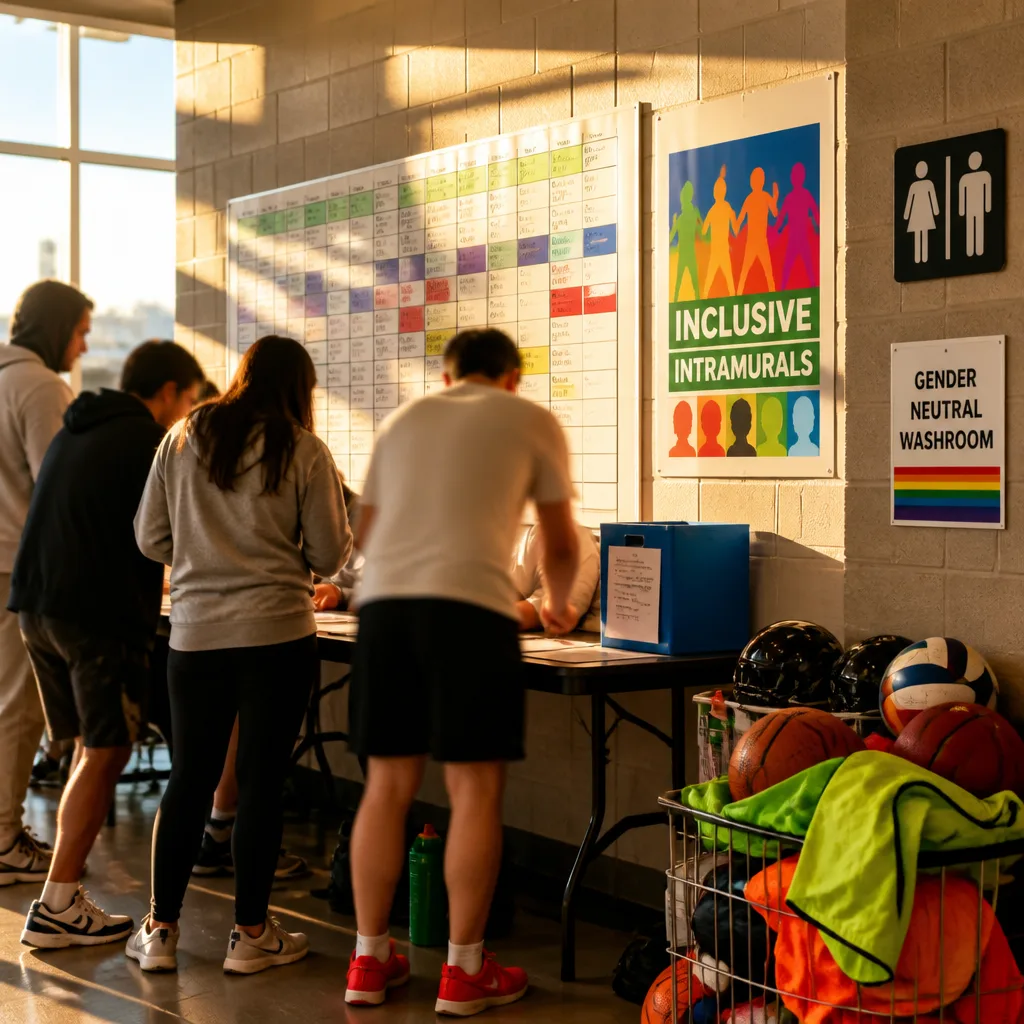
With September looming and campuses preparing to welcome thousands of students, researchers and campus recreation staff are urging universities and colleges to rethink intramural sport design after finding that women and gender‑diverse students routinely encounter barriers that limit participation and undermine belonging.
Research identifies consistent deterrents
An interdisciplinary team — comprising student leaders, campus recreation employees, sport participants and academic researchers — used surveys and interviews to probe experiences in an intramural program at a Canadian university. The team presented results as creative nonfiction vignettes that knit together multiple voices to surface common motivations, barriers and outcomes.
The research corroborates earlier work (Stankowski et al., 2017; Zhou & Liu, 2025; Wilson & Millar, 2021) showing that women and gender‑diverse students often cite concerns about skill level, fear of injury, and negative past experiences as deterrents. Participants also described male‑dominated sport environments and dynamics — such as being treated as a “quota player,” limited playing time and mismatched competition levels — that erode belonging even in programs intended to be inclusive.
Consequences for health and campus life
Those barriers have tangible consequences. Researchers warn that when women and gender‑diverse students avoid intramurals, they miss out on the physical, mental and social benefits broadly associated with campus recreation. The study emphasises that exclusion is not always overt; it can be structural or cultural, rooted in how teams are organised, how playing time is allocated and how competition levels are matched.
- Skill and confidence: Concerns about ability reduce sign‑ups and willingness to try new sports.
- Safety and injury fears: Worries about getting hurt discourage participation, especially where contact sport norms persist.
- Past negative experiences: Previous exclusionary treatment or marginalisation deters future engagement.
- Male‑dominated environments: Team cultures and selection practices can make women and gender‑diverse players feel tokenised or sidelined.
The stories derived from the research make clear there is no single explanation or remedy. Instead, the authors argue, campus rec staff must approach inclusion as an ongoing, adaptive process.
Practical steps: listen first, co‑design second
From the project’s co‑creative approach emerges a clear prescription for administrators: listen early and often to both participants and non‑participants and then co‑design programming that acknowledges diverse needs. The research team stresses that “no one‑size‑fits‑all” approach will work; solutions must be tailored to local contexts and the distinct experiences of varied student groups.
| Barrier | Common effect on participation |
|---|---|
| Perceived low skill | Lower sign‑up, avoidance of mixed‑ability play |
| Fear of injury | Avoidance of contact sports, limited engagement |
| Negative past experiences | Distrust of programs; lower retention |
| Male‑dominated environments | Tokenisation, short playing time, mismatched competition |
The research does not prescribe a universal checklist. Instead, it offers a governance model: involve student voices in planning, create flexible participation pathways, monitor how playing time and team selection operate in practice, and adjust competition levels so that players face peers rather than mismatched opponents.
For campus recreation managers, the findings are a timely reminder that intramurals are often a first access point to sport for new students. Thoughtful programming can enhance campus well‑being and social connectedness; ignoring these barriers risks reinforcing exclusion and preventing large cohorts of students from reaping those benefits.
As post‑secondary institutions finalise schedules and marketing for the fall term, the researchers’ message is straightforward: start by listening, then co‑create. That sequence, they say, is the best route to making intramurals truly accessible for all students.