
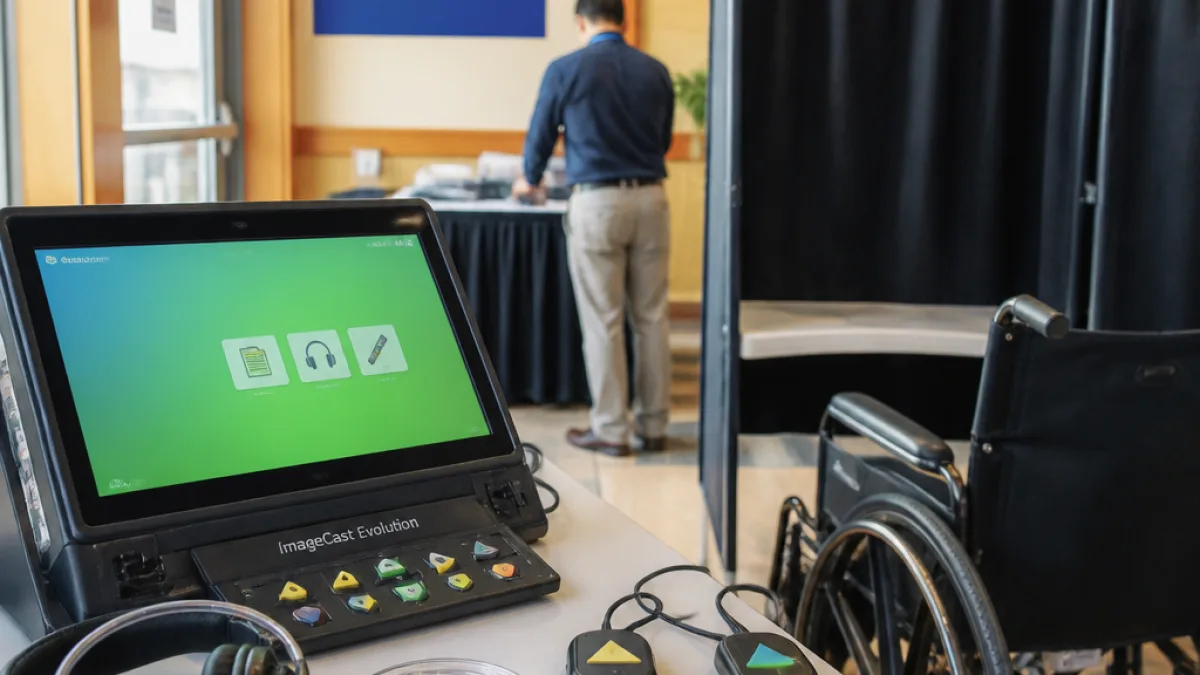
Burnaby voters with disabilities will have a new option for casting ballots independently in the municipal election this October as the city pilots its first accessible ballot-marking device.
What the pilot offers
The ImageCast Evolution (EVO) will be available at the Edmonds Community Centre during all three advance voting days — Oct. 3, 7 and 10 — and on general voting day, Oct. 17. The machine provides three accessibility controls designed for a range of needs: a tactile button controller with headphones for voters with visual impairment, a sip-and-puff controller for electors who cannot use their hands or feet, and left and right paddle controllers for those with fine motor challenges.
Burnaby's chief election officer, Dennis Back, told the city’s Access Advisory Committee last week that presiding election officials will receive special training to operate the device and assist voters who wish to use it. He and deputy chief election officer Josh Comia demonstrated the EVO at the meeting.
“That’s not independent voting,”
Back said of the current practice that allows presiding officers to help voters mark ballots under laws and policies that permit such assistance. He added that the machine is being brought in because many voters want to mark their ballots without direct human help.
Secrecy and ballot counting
To preserve the secrecy of the ballot, votes cast using the accessible machine will not be identified or separated during counting. Back explained that the EVO creates a unique mark on each ballot that resembles one made by a Sharpie, so there will be no visible indication of which ballots were marked on the device.
Input from the accessibility community
The demonstration included citizen representative Karim Damani, who is blind. He helped present the audio-tactile interface for people with visual impairments and recommended that officials assisting visually impaired voters begin by describing the locations of controls on the device. The presence of a community representative during the demonstration indicates the city sought input from people with lived experience of disability while preparing the pilot.
- Device: ImageCast Evolution (EVO)
- Location: Edmonds Community Centre
- Advance voting days: Oct. 3, 7, 10
- General voting day: Oct. 17
| Feature | Who it helps |
|---|---|
| Tactile button controller + headphones | Voters with visual impairment |
| Sip-and-puff controller | Voters without use of hands/feet |
| Left & right paddle controller | Voters with fine motor challenges |
Local context and consequences
Burnaby’s move echoes broader efforts across Canadian municipalities to reduce barriers to voting for people with disabilities. Traditionally, some electors have had to rely on family members, caregivers or election workers to mark ballots — a process that can compromise privacy and discourage participation.
By offering an accessible ballot-marking device at a central polling site during advance and general voting days, the city is testing whether on-site technology can increase independent participation among residents who otherwise would not be able to mark their ballot privately. The limited scope of the pilot—one machine at one location—means uptake and practical issues such as queueing, device familiarization and staff training will be closely watched.
City staff say presiding officers will be trained to operate the EVO, but officials will still need to balance assistance with preserving autonomy. If the pilot is successful, the city may consider broader deployment in future elections; if not, officials will gather feedback to guide next steps.
For many residents with disabilities, the difference between being able to vote independently and requiring assistance is fundamental. The pilot does not change voting law, but it does offer a tangible step toward making municipal elections more accessible in practice rather than merely in principle.
Burnaby voters planning to use the device are encouraged to attend on the listed advance voting days or on general voting day at Edmonds Community Centre and to ask election staff about training and the device’s controls.
















