
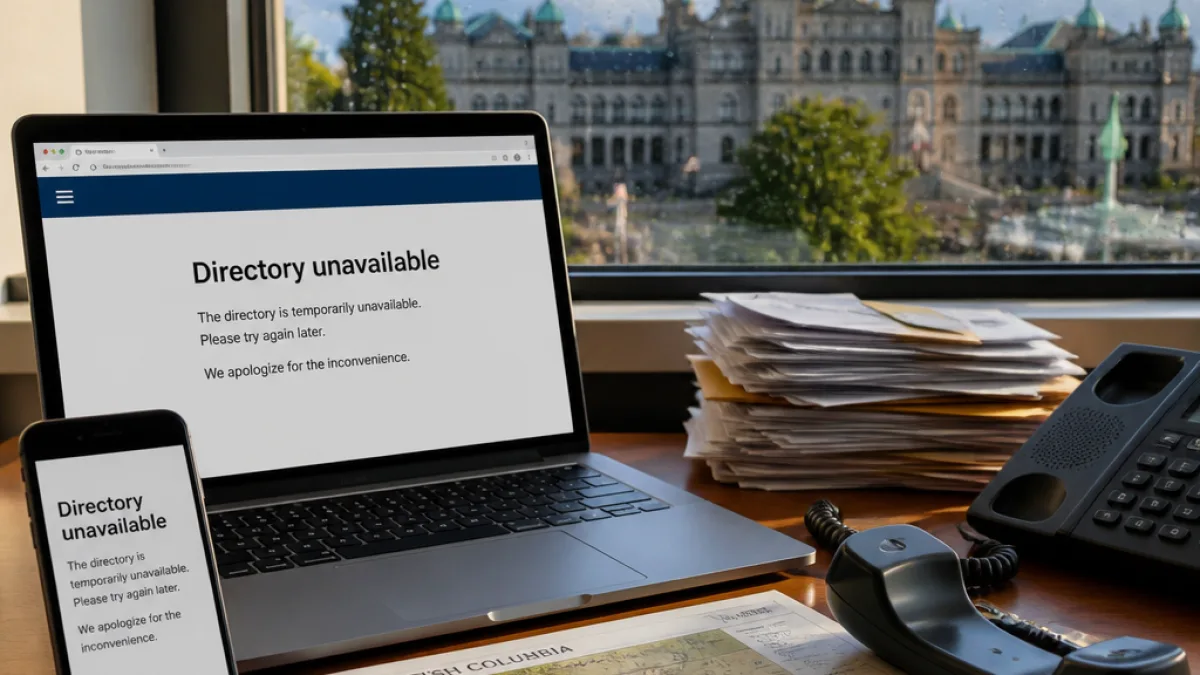
The province of British Columbia has disabled its public online government employee directory, a sudden change that leaves citizens, journalists and businesses without a central way to find who works for government or how to reach them.
Government cites cybersecurity threats
The Citizens’ Services Ministry removed public access to the directory on Aug. 18, saying the decision was prompted by cybersecurity threats, specifically phishing risks. A ministry spokesperson told media the action followed "proactive advice from law enforcement partners, including the RCMP." The directory historically provided names, titles and phone numbers for public-sector employees across ministries and agencies.
While the ministry has closed public access, internal government employees will reportedly retain the directory. No timetable has been provided for when — or whether — the public version will be restored.
Transparency advocates express concern
Information and Privacy Commissioner Michael Harvey said the cybersecurity threat must be taken seriously, noting documented cases of government employees being doxxed. At the same time, he described the removal of the public directory as "regrettable" and emphasised the value of public-facing information.
"We think that our public bodies should have a human face," Harvey said in an emailed statement.
His office said it is exploring ways to provide similar contact information for the commission itself going forward, and encouraged other public bodies to consider their own approaches to balancing safety and openness.
Business groups and users say access is vital
Users who rely on the service — from business owners chasing permits to journalists and community organisations — warned the change removes a layer of accountability and complicates everyday transactions with government.
Ryan Mitton of the Canadian Federation of Independent Businesses told media the removal reflects a growing "fortress mentality" that is unhelpful for entrepreneurs who need to reach officials for permits, supports or problem resolution.
A resource with a long history
The directory is not a new invention. Government records show the publication has been issued in print since at least 1930. It evolved in size and scope over the decades and moved online in 2007.
| Year | Pages (printed record) |
|---|---|
| 1930 | 27 |
| 1977 | 144 |
| 2004 | 463 |
| 2007 | Directory moved online |
Those figures underscore how the directory developed from a modest government listing into a comprehensive online resource used by a wide range of stakeholders.
Questions about alternatives and accountability
Critics asked whether the government considered more targeted mitigations — for example, redacting specific personal information, introducing CAPTCHA or two‑step verification for bulk access, or limiting automated scraping — rather than a blanket shutdown.
Information and privacy specialists say there are trade-offs between openness and personal security, but that wholesale removal risks eroding the public’s ability to hold government to account and to obtain timely assistance from civil servants.
Practical impacts for the public
With the directory offline, people seeking to contact ministry staff will need to rely on ministry switchboards, email contact forms, or local constituency offices. That may increase the time required to resolve matters such as permit applications, service requests or media enquiries.
- Individuals can contact ministries through general switchboard numbers and official websites.
- Businesses should keep records of previous direct contacts and use official service portals for applications.
- Journalists and watchdog groups may increasingly seek access to information requests for staff contact details when necessary for news reporting.
The Citizens’ Services Ministry has not published a public timeline or detailed explanation beyond its statement about law-enforcement advice. For now, the decision raises fundamental questions about how governments should weigh citizen access against the growing reality of online threats.
As British Columbians adjust to the absence of a familiar contact resource, pressure is likely to build for a transparent plan that restores public access in a way that protects employees — or for clear alternatives that preserve accountability while reducing risk.