
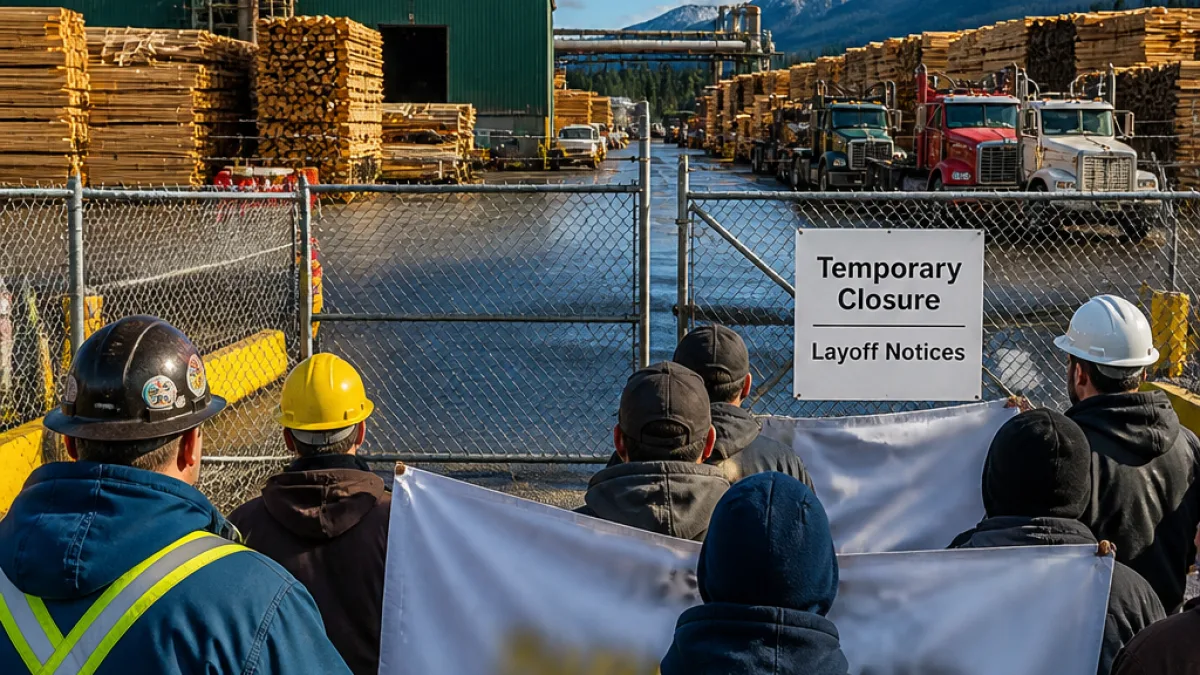
As Labour Day approaches, British Columbia labour leaders are urging federal and provincial governments to prioritise workers in the face of a widening trade dispute with the United States that they say has already damaged local industries and communities.
Workers first, union leaders say
Federal authorities have announced Canada will impose counter-tariffs amounting to $27.6 billion in U.S. imports as a dollar-for-dollar response to American duties. B.C. unionists say the dispute is not abstract — it is cascading into mill closures, layoffs and wider community stress.
Sussanne Skidmore, president of the B.C. Federation of Labour, warned Ottawa and Victoria that support for businesses must be explicitly linked to protections for workers and their families.
"It doesn't just impact the workers. It impacts their communities, it impacts their families and their children and their neighbours."
Skidmore and other leaders say recent actions by the U.S. — including tariffs that, in some cases, have pushed total duties on Canadian softwood lumber to about 45 per cent — have had a tangible effect on the province's forestry-dependent towns.
Forestry hit hardest in B.C.
While the broad trade measures involve many sectors, labour advocates identify forestry as among the hardest hit. They caution that tariffs are not limited to raw logs but extend to value-added wood products, widening the fallout.
The Forest Products Association of Canada has flagged that the new American duties affect a range of items, including:
- Plywood
- Fibreboard
- Paper and packaging
- Laminated wood products
For workers in mill towns, the consequence is straightforward: reduced demand, constrained operations and, in some cases, plant shutdowns. Labour leaders say that when mills close the economic pain radiates through families and local services.
What unions want from government
Union demands are focused on making public support contingent on preserving jobs. Skidmore said any government assistance aimed at sustaining businesses should ensure that workers — not just companies or shareholders — are the principal beneficiaries.
That call reflects a long-standing tension in industrial policy: whether taxpayer-funded support should prioritise corporate survival or employment retention. In B.C., where whole communities may depend on single large employers, the labour movement is pressing for the latter.
How the tariffs widen the impact
Previous rounds of U.S. duties have already elevated the effective tariff on many Canadian softwood imports. Labour leaders stress that newer measures extend beyond sawlogs to include processed and packaging products, threatening jobs across multiple points in the supply chain.
| Product | Why it's important |
|---|---|
| Plywood | Key value-added item used in construction and manufacturing |
| Fibreboard | Used in furniture and building materials; supports mill employment |
| Paper and packaging | Broad market reach; disruptions affect logistics and production jobs |
| Laminated wood products | Higher-value products that sustain specialized manufacturing roles |
Labour leaders also note the social consequences beyond paycheques: reduced municipal revenues, cuts to local services and increased stress on families when employment is lost. They say these secondary effects must shape any policy response.
As the federal government prepares its countermeasures, B.C. unions are pressing Ottawa to ensure resources directed to companies carry clear conditions to protect jobs and support displaced workers. Without such measures, labour advocates warn, the province risks a deeper and longer-lasting economic pain in regions that rely on forestry employment.
With Labour Day providing a platform to highlight the stakes for working families, the message from B.C.'s labour movement is emphatic: in a trade fight that began with tariffs on timber, the people on the shop floor and in mill towns should not be the afterthought.
















