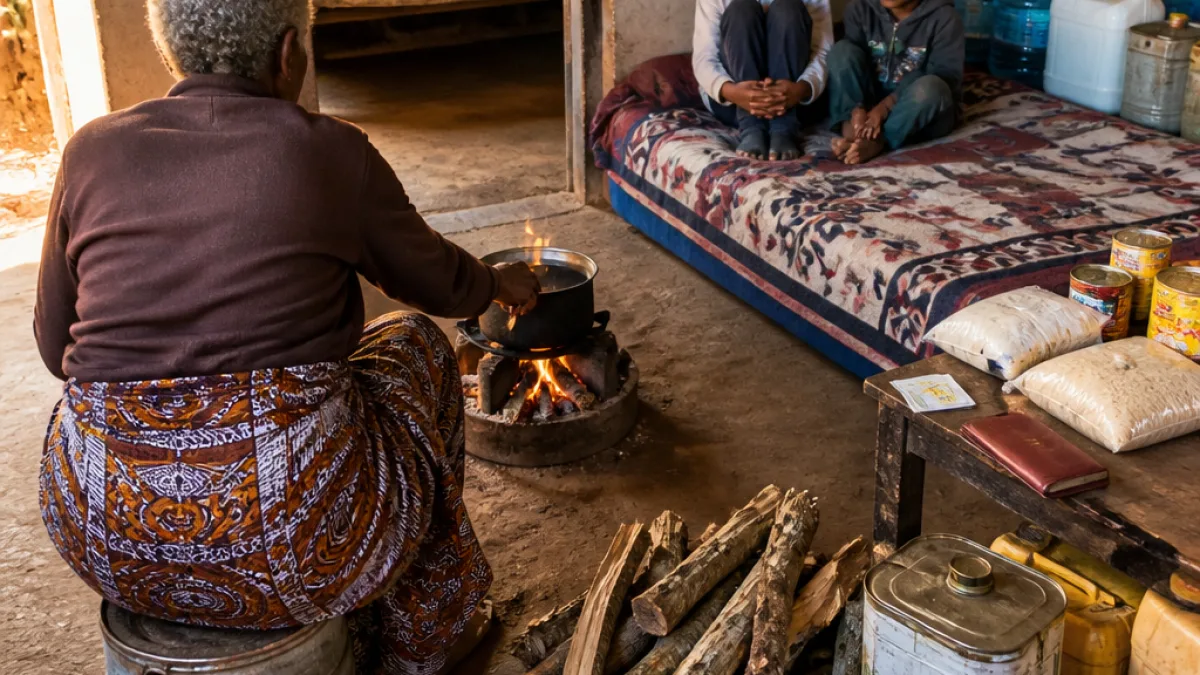
GA-MOTODI, Burgersfort — When food runs out in Sekhwele Mnisi’s two-bedroom house in Ga-Motodi village, the 66-year-old tells his grandchildren to drink water and to keep faith that God will provide, according to a report by Daily Maverick. Mnisi’s small household — three adult children and two young grandchildren — subsists on pensions and child grants that total R3,460 a month, while basic services and housing needs remain unmet.
Daily struggle on a limited budget
Mnisi receives an old-age grant and the grandchildren receive child support grants, yielding a combined income of R3,460 per month. He told the reporter that the family spends roughly R1,500 on food each month to feed four adults and two children: that is about R50 per person per day when averaged across the household.
The remaining money is used for essentials such as water, wood, paraffin and candles. According to the report, the family does not have electricity or running water in the house; large water containers occupy most of the kitchen space and cooking is done on open fires, increasing the cost and time required to prepare meals.
“We pretend to watch television until they dish out an evening meal,” the family’s youngest daughter said of spending time at neighbours’ homes when the household has no food.
How the household stretches resources
Mnisi does odd jobs when he can and sometimes accepts food as payment. When food is exhausted, his children visit neighbours, where they wait to be offered a meal. The family’s RDP house is reported to be in disrepair, adding pressure on already limited resources.
- Monthly household income: R3,460 (old-age grant plus child support grants)
- Average monthly food spend: R1,500
- Household composition: 3 adults, 2 children, 1 pensioner (total 6 people)
- Utilities and services: No electricity, no running water reported; cooking on open fires
Costs laid out
| Item | Estimated monthly cost |
|---|---|
| Food | R1,500 |
| Other essentials (water, wood, paraffin, candles) | R1,960 |
| Total income | R3,460 |
The table above uses amounts reported by Daily Maverick to show how the family’s income is allocated. With food accounting for roughly 43% of monthly income, any unexpected expense — a medical bill, school requirement or home repair — can push the household into crisis.
Wider context and community coping mechanisms
The household’s reliance on neighbours, odd jobs and the precariousness of grant incomes points to broader problems facing rural and peri-urban communities in Limpopo: limited access to municipal water and electricity, ageing housing stock, and the insufficiency of social grants to cover basic living costs for larger households.
The report describes local coping strategies such as backyard gardens and informal food stokvels in other families, but in Mnisi’s case the lack of consistent income constrains those options. Community solidarity — neighbours sharing meals — provides short-term relief but is not a structural solution.
What this means for local services
For local authorities and social development practitioners, cases like Mnisi’s underline the importance of:
- ensuring household access to basic services (piped water, electricity) to reduce indirect living costs;
- reviewing social support and grant top-ups for pensioner-headed and multi-generational households;
- supporting community food security initiatives such as gardens and local stokvels with training and resources.
Daily Maverick’s reporting on the family notes the physical state of the RDP house and the high non-food costs that eat into the limited grant income. The account raises questions about how municipal services and social welfare programmes are reaching vulnerable households in Ga-Motodi and similar communities in Limpopo.
Local residents and civil society organisations often say that small, targeted interventions — from food parcels and school feeding schemes to repairs to stalled RDP houses — can have immediate, measurable benefit. However, without reliable employment opportunities or increased social support, households remain vulnerable to recurring hunger.
This portrait of one household’s daily reality is part of a wider series exploring how families in vulnerable communities manage food insecurity. It offers a human view of the trade-offs families are forced to make and highlights the persistent need for coordinated responses from social development, the municipality and civil society.
— Reported from Ga-Motodi, Burgersfort, using reporting by Daily Maverick.