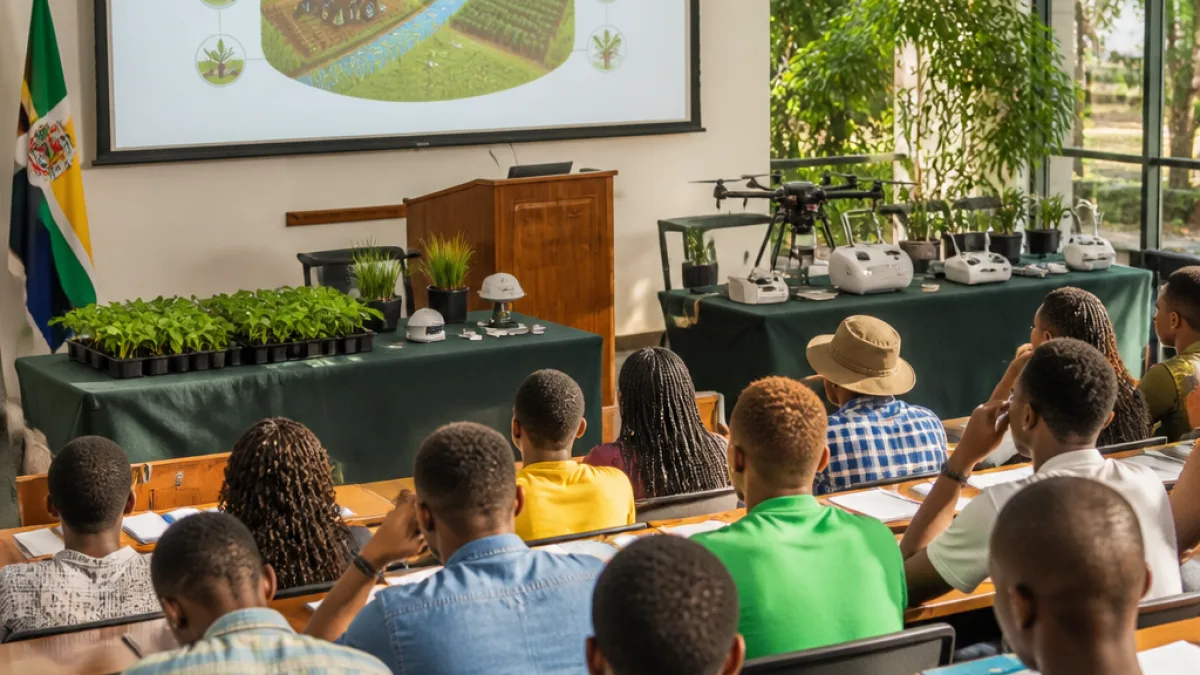
The University of Mpumalanga (UMP), in partnership with the Department of Agriculture, convened a focused dialogue with farmers and young agripreneurs on 3 August to explore how education, research and government support can accelerate sustainable agriculture in the province.
Bridging university research and frontline farming
Attendees included UMP vice-chancellor Prof Thenjiwe Meyiwa, Deputy Minister of Agriculture Nokuzola Capa, and the provincial Member of the Executive Council for Agriculture, Rural Development, Land and Environmental Affairs, Khethiwe Moeketsi. The meeting aimed to strengthen academic–industry links and amplify the voices of young people seeking careers in agriculture.
Organisers said the dialogue centred on four priorities: strengthening academic and research partnerships, amplifying youth voices in policy and practice, expanding opportunities for young farmers and agripreneurs, and accelerating the adoption of smart, sustainable farming practices.
Focus on youth, skills and technology
The vice-chancellor encouraged participants to embrace innovation, entrepreneurship and technology as central to sustainable agricultural development. The event underscored the role higher education institutions can play in equipping graduates with practical skills and research-driven solutions that respond to climate variability and market demands.
Speakers highlighted the need to link campus-based research with extension services so smallholder and emerging farmers can access tested, locally appropriate technologies. This includes precision irrigation, climate-smart cropping systems and digital tools that help farmers plan and market produce more effectively.
Collaboration across sectors
Deputy Minister Capa emphasised collaboration between government departments, universities and private-sector stakeholders as essential to growing the agricultural sector. The provincial MEC, Moeketsi, joined the call for coordinated support to turn small-scale and youth-led agricultural projects into sustainable businesses.
- Research partnerships: Improve uptake of university research at farm level.
- Youth engagement: Create pathways into agripreneurship and commercial farming.
- Technology: Promote smart farming tools that save water and increase yields.
- Market access: Link new farmers to value chains and processing opportunities.
Practical implications for Mpumalanga
For Mpumalanga, a province where agriculture remains a cornerstone of rural livelihoods and tourism-linked food systems, the workshop signalled an intent to prioritise youth-led productivity. If research is successfully translated into extension services and business support, emerging farmers could benefit from improved yields and stronger market access.
Local municipalities and extension officers will need to coordinate with UMP researchers to identify pilot sites and demonstration farms. Such practical collaboration could shorten the time between innovation and uptake, helping farmers adapt to increasingly unpredictable weather patterns and constrained water resources.
Next steps and follow-up
Organisers indicated that the dialogue was a first step in a broader process of building formal partnerships. Specific programmes and timelines were not detailed at the event; further announcements are expected as departmental and university teams consolidate proposals for training, research collaboration and youth support initiatives.
| Participant | Role |
|---|---|
| Prof Thenjiwe Meyiwa | Vice-Chancellor, University of Mpumalanga |
| Nokuzola Capa | Deputy Minister of Agriculture |
| Khethiwe Moeketsi | MEC for Agriculture, Rural Development, Land and Environmental Affairs (Mpumalanga) |
The event reflected growing attention to preparing a new generation of farmers while preserving natural resources. For local residents and aspiring agripreneurs, the dialogue offered a roadmap: engage with university research, seek out training opportunities, and pursue partnerships that can turn small-scale projects into viable enterprises.
As Mpumalanga balances agricultural production with tourism and conservation, the success of such initiatives will depend on sustained cooperation between universities, government and the private sector — and on turning policy talk into field-level action.