
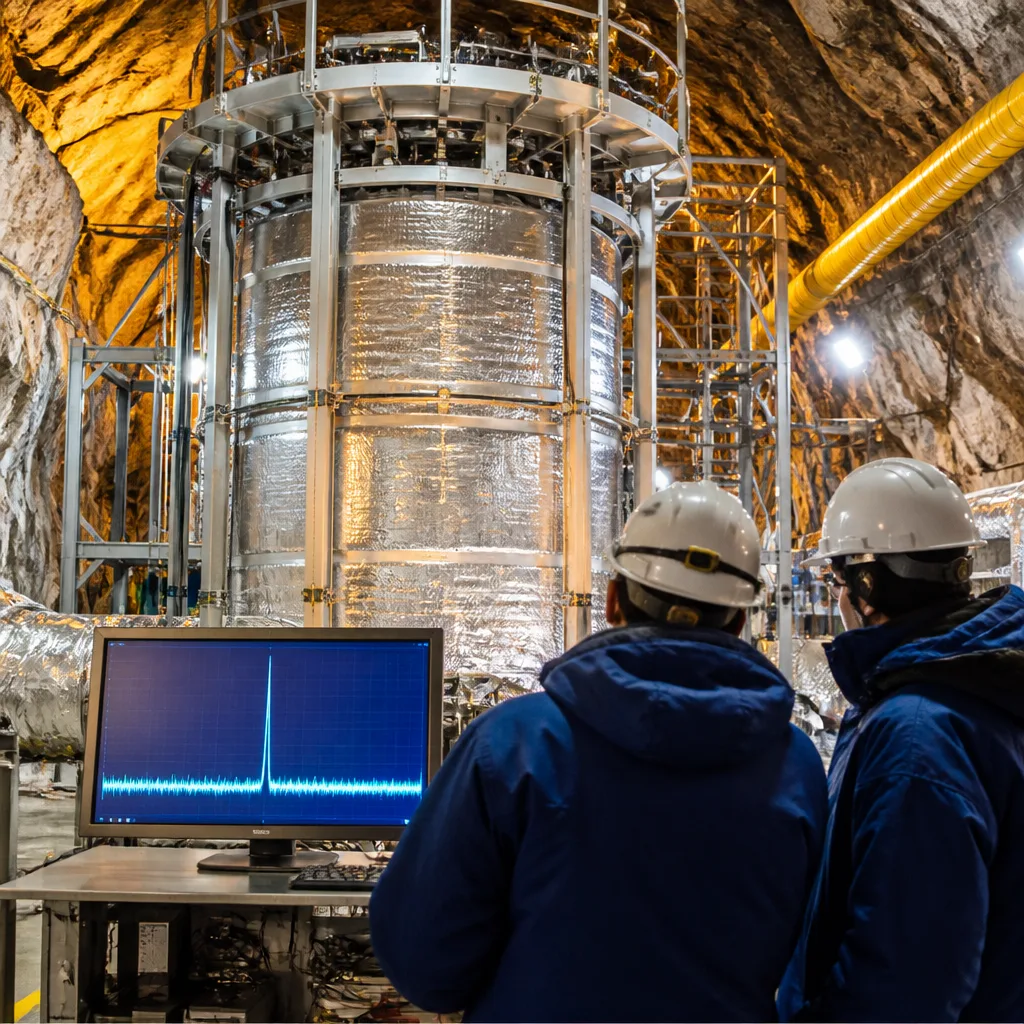
Scientists working with the LUX‑ZEPLIN (LZ) dark matter experiment at the Sanford Underground Research Facility in South Dakota have announced a single particle interaction that could be the first experimental hint of a dark matter particle, according to a preliminary report presented at a conference in Japan.
What was observed
The researchers analysed data from the highly sensitive LZ detector — a tonne-scale instrument designed to record tiny flashes of light when particles interact with atoms inside its liquid xenon target. After two years of running and a collaborative effort by about 250 scientists and engineers from 39 institutions in six countries, the team identified one interaction in their dataset that might be compatible with a Weakly Interacting Massive Particle (WIMP), a leading theoretical candidate for dark matter.
"Following a huge amount of scientific effort, this is incredibly exciting," said Dr Sam Eriksen, the lead researcher and a senior research associate at the University of Bristol. "It could be the first step in understanding dark matter as a particle."
Why the finding is cautious
Although the observation drew attention at the conference, the LZ team and outside scientists emphasise that this single event on its own is not conclusive. The report has not yet undergone independent peer review and the statistical evidence is described by the collaboration as weak for claiming a discovery. The interaction could ultimately prove to be a background event or an otherwise understood process unrelated to dark matter.
Dark matter is inferred from its gravitational effects on galaxies and large-scale structure, but it does not emit or absorb light, which is why direct detection efforts focus on rare collisions between dark matter particles and ordinary atoms. WIMPs are hypothetical particles that would interact so feebly with normal matter that huge, ultra-sensitive detectors located deep underground are required to shield them from cosmic rays and other spurious signals.
How LZ searches for dark matter
- Detector type: Liquid xenon time-projection chamber that registers tiny bursts of light (scintillation) and delayed charge signals when particles interact.
- Location: Sanford Underground Research Facility, nearly a mile beneath the surface to reduce background noise from cosmic radiation.
- Collaboration: Approximately 250 researchers and engineers across 39 institutions in six countries.
| Item | Detail |
|---|---|
| Experiment | LUX‑ZEPLIN (LZ) |
| Facility | Sanford Underground Research Facility (South Dakota, USA) |
| Data examined | Two years of detector exposure |
| Significant finding | One particle interaction potentially consistent with a WIMP |
Context and next steps
Direct detection of dark matter has been an unresolved goal in physics for decades. Experiments such as LZ complement astronomical and cosmological measurements by testing whether dark matter has non‑gravitational interactions with ordinary matter. A single candidate event is interesting but insufficient for confirmation. The collaboration must exclude all known background explanations, accumulate more exposure to increase statistical power, and submit the analysis for peer review. Independent verification by other detectors would be needed before the community could treat the signal as a genuine discovery.
For now, the LZ report is best described as a potentially important early hint that requires rigorous follow-up. If future data strengthen the case, the implications would be profound: identifying the particle nature of dark matter would resolve a central mystery about the composition of the universe and open new directions in particle physics and cosmology. Until then, the scientific response is appropriately guarded: hopeful, but methodical.


