
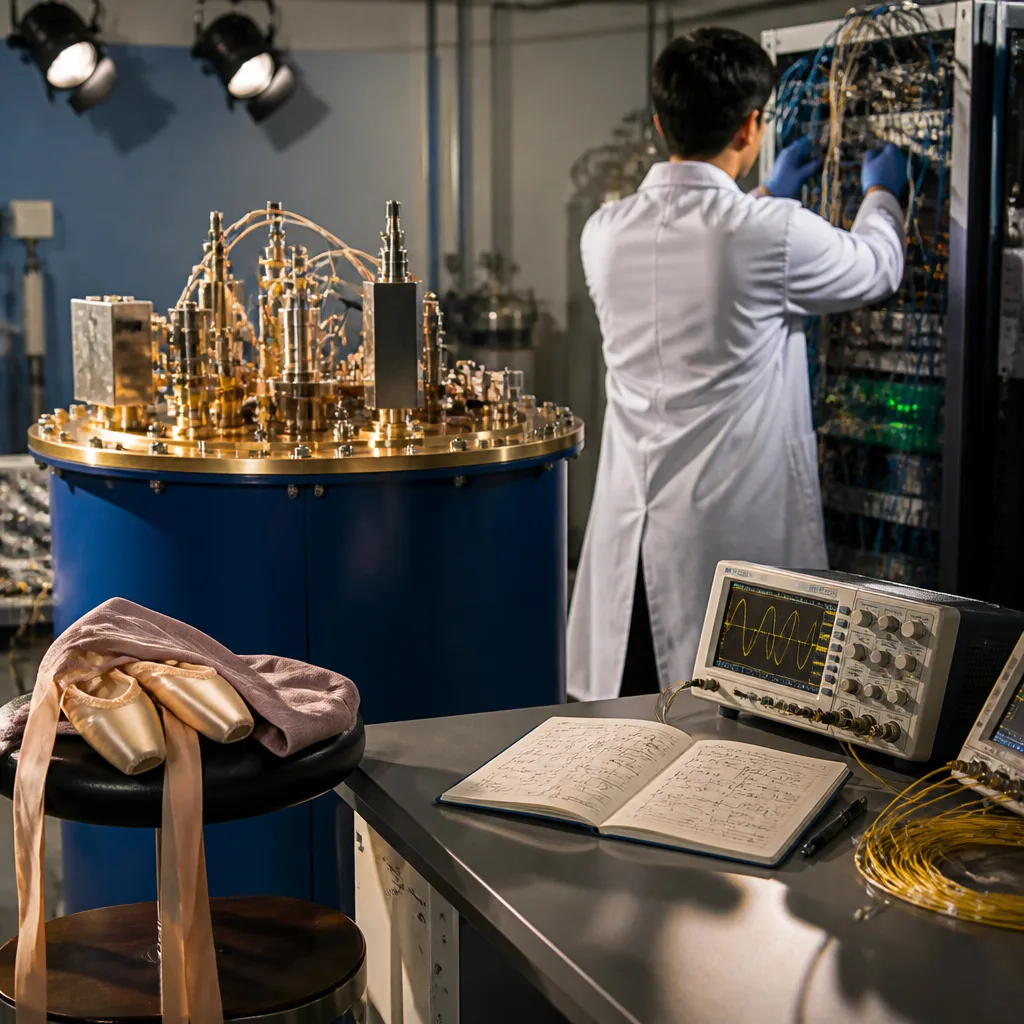
Physicists across the globe are searching for the particle that comprises about 85% of the universe’s matter, yet has never been detected directly. One of those scientists is Jessica Fry, a fifth‑year physics PhD candidate in the Laboratory for Nuclear Science at the Massachusetts Institute of Technology (MIT), whose research focuses on finding the axion, a leading theoretical candidate for dark matter.
The scientific question
Dark matter is the name given to the unseen mass that exerts gravitational influence on galaxies and large‑scale cosmic structure. While its presence is inferred from astronomical observations, no laboratory experiment has isolated a particle that accounts for it. The axion is a hypothetical, very light particle proposed as a solution to problems in particle physics and cosmology; it is one of several candidates physicists are pursuing experimentally.
A path that blends experiment and performance
Fry’s biography, as reported by MIT, shows an unusual blend of experimental physics and stage performance. She grew up in the San Francisco Bay Area, not far from the SLAC National Accelerator Laboratory, and developed an early interest in both dance and physics. A photograph of her in an early recital — in a ham costume — sits on her office desk as a reminder of an approach she describes with characteristic candour: she says she does not "half‑ass" anything.
“I was hooked,” she said, recalling how working with defunct detectors from SLAC and replicating a 1960s experiment set her on the path to experimental physics.
At Stanford University, Fry double‑majored in physics and theatre and performance studies. A mid‑undergraduate episode illustrates how strongly she committed to both fields: after being accepted for a Broadway production she nonetheless completed a summer research placement at CERN and then joined the performance. She later took two years away from Stanford to perform professionally, training intensively in ballet, contemporary and jazz dance, as well as learning traditional Māori dance, Peking‑opera movement and stage combat.
Why the background matters to laboratory work
Fry’s early hands‑on experience is notable: a high‑school teacher gave her defunct detectors from SLAC and encouraged her to do something with them. She found a 1960s paper using similar equipment, replicated the experiment and wrote up the project — an origin story that demonstrates how experimental technique, ingenuity and historical methods still matter to today’s searches.
- Research focus: experimental searches for the axion as a dark‑matter candidate.
- Training: physics and performance studies at Stanford; doctoral research at MIT.
- Early experience: hands‑on detector work and a summer placement at CERN.
Experimental hunts for dark matter span many approaches and instruments: from large underground detectors that look for weakly interacting massive particles (WIMPs), to precision measurement experiments tuned to very light particles such as the axion. Fry’s work sits within that broader experimental ecosystem, where meticulous instrument design, calibration and creative reuse of techniques are crucial.
| Detail | Information from report |
|---|---|
| Current role | Fifth‑year physics PhD candidate, MIT Laboratory for Nuclear Science |
| Area of study | Experimental search for the axion (dark matter candidate) |
| Early influence | Defunct SLAC detectors in high school; replicated a 1960s experiment |
| Other training | Stanford double major in physics and theatre/performance; professional stage experience |
It is important to stress what the report makes clear: the search for dark matter remains unresolved. Individual researchers contribute pieces of technique, instrumentation and insight, but no single experiment has yet produced a definitive detection. Work such as Fry’s — combining experimental skill, interdisciplinary awareness and persistence — exemplifies the long, collaborative effort that fundamental particle searches require.
For South African science readers, the story underscores two practicable points: first, fundamental physics advances through careful, incremental instrumentation and measurement; second, unconventional backgrounds and cross‑disciplinary skills can be assets in experimental science. The hunt for dark matter continues, and researchers like Fry illustrate the human and technical breadth of that endeavour.


