The Aerospace Systems Research Institute (ASRI) at the University of KwaZulu‑Natal has set an ambitious timetable to put South Africa on its own launch path: a suborbital flight by 2028, followed by an orbital launch of a South African satellite on a locally built rocket by 2030.
Funding and skills gaps threaten schedule
ASRI says the programme will require substantial additional resources. The institute estimates development of its planned two‑stage Commercial Launch Vehicle (CLV) will cost roughly R3 billion. That contrasts sharply with ASRI’s current funding: a R100 million allocation from the Department of Science, Technology and Innovation covering two years.
ASRI also warned that its core engineering team must expand rapidly. The institute currently has about 20 staff in the principal engineering group and believes that number must grow to at least 120 to design, build and test the CLV.
- Target milestones: suborbital flight (2028); orbital launch (2030).
- Estimated cost: R3 billion for CLV development.
- Current two‑year funding: R100 million from DSTI.
- Staff scaling: from roughly 20 to about 120 engineers.
Commercialisation and partnerships under way
ASRI leaders accept a university structure alone cannot absorb the scale of long‑term operations they foresee. To bridge that gap, the institute is working with UKZN and government bodies to spin its activities into a commercial entity.
Partnerships are already forming with local industry. ASRI has an exclusive agreement with Cape Town‑based firm Mura Space to commercialise a sounding rocket launch facility at the Denel Overberg Test Range near Arniston. Early discussions are also under way about a potential rocket assembly facility near Cape Winelands Airport, ASRI said.
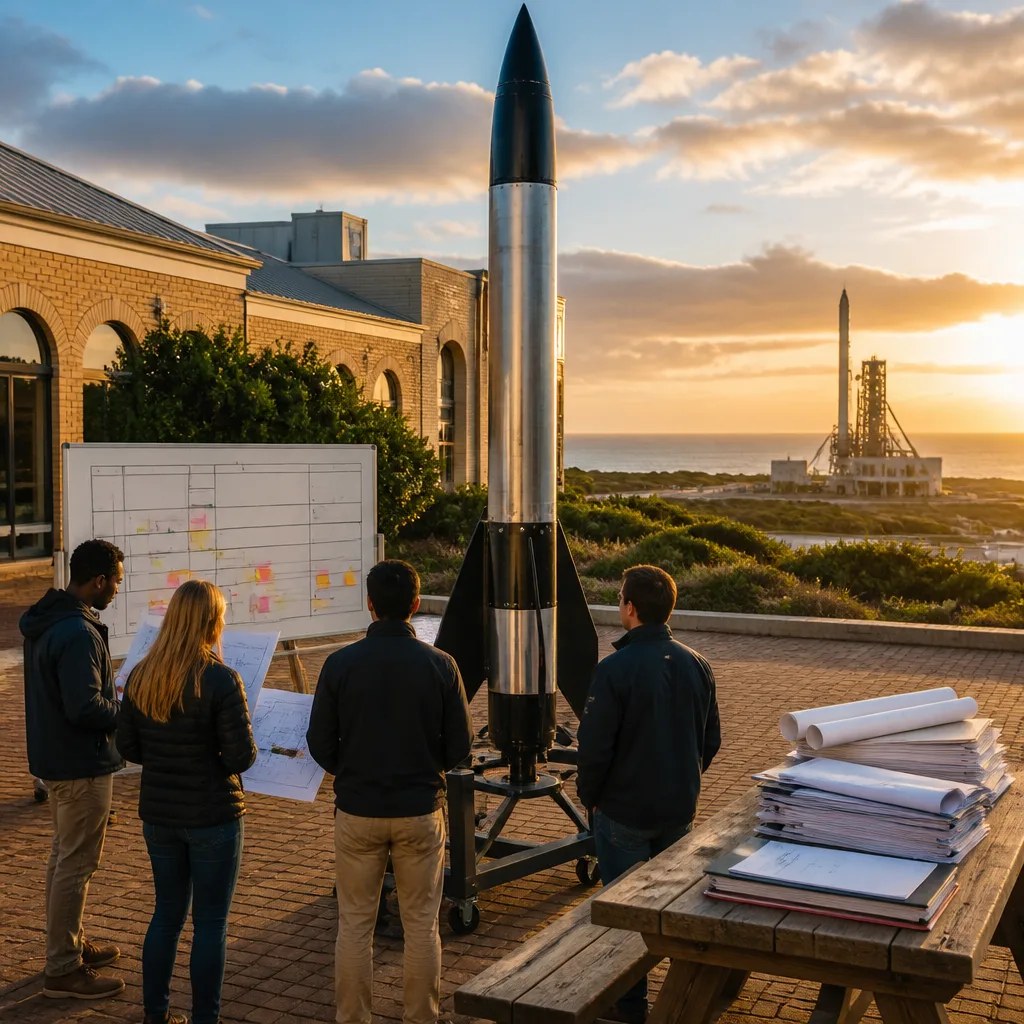
Infrastructure progress includes construction of a permanent launch gantry at Overberg. The six‑storey‑tall gantry was built in partnership with local engineering firm TF Design and has been commissioned for use.
Flight heritage and testing
ASRI’s flight record rests largely on the Phoenix hybrid rocket series, which the institute describes as both a demonstrator and a training platform to build local rocket engineering capabilities.
| Phoenix programme | Detail |
|---|---|
| Number of flights | 8 flights across 5 campaigns |
| Notable altitude | African hybrid altitude record: 17.9 km (2021) |
| Recent objectives | Payload data recovery and validating the new gantry (late 2024) |
ASRI says the Phoenix series is intentionally inertly fuelled as a safety and training platform. Recent flights in late 2024 focused less on maximum altitude and more on payload recovery and verifying the newly commissioned launch infrastructure.
Challenges ahead
ASRI’s plan faces three interlinked challenges: securing the multi‑hundred‑million‑rand financing needed to complete a two‑stage CLV; rapidly expanding the skilled workforce; and transitioning from a university research programme to a commercially capable organisation able to operate launch services.
The institute has begun steps to address those challenges: commercial agreements, an operational gantry and site partnerships. But the scale gap between current funding and the estimated R3 billion price tag remains large.
Meeting ASRI’s targets could deliver new high‑technology jobs and position South Africa as a regional launch provider, but the institute’s timetable and ambitions depend on rapid mobilisation of both public and private support. Details around who would provide the additional funding, the proposed governance of a spun‑out commercial entity, and the timeline to scale staff were described as ongoing discussions.
ASRI’s dual aim — a suborbital flight within two years and an orbital launch by 2030 — marks one of the most concrete roadmaps yet from a South African institution to move from sounding rockets to a locally built orbital launcher. Whether the plan stays on schedule will depend on closing the financing and skills shortfalls it has identified.