
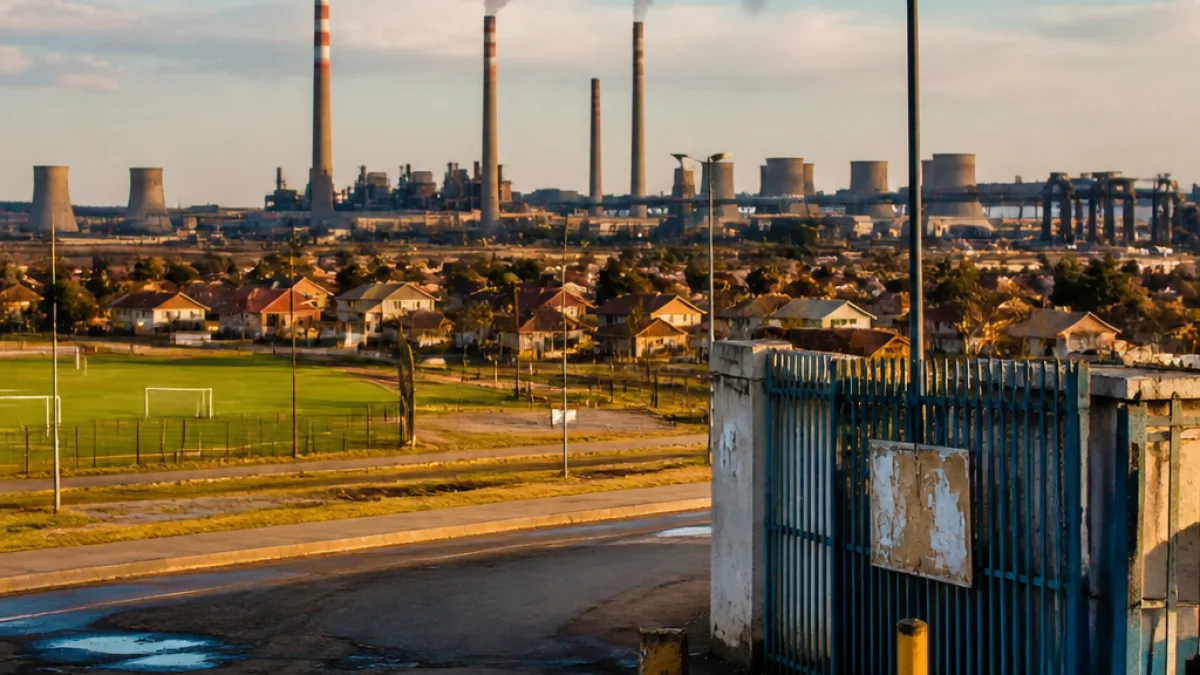
The fate of Secunda is increasingly bound up with the future of its largest industrial neighbour. New analysis by Trade and Industrial Policy Strategies (TIPS), drawing on emissions estimates from the Centre for Research on Energy and Clean Air (CREA), highlights both the economic centrality of the Sasol complex and the heavy environmental and health toll associated with its operations.
Emissions, health and an anchor employer
The research attributes an estimated 1,000 deaths a year to pollution stemming from Sasol’s Secunda complex, a figure that strengthens scrutiny of the company’s environmental footprint. TIPS reports that Secunda accounts for 83.7% of Sasol’s Scope 1 and 2 emissions, with Sasolburg contributing a further 8.4%. The scale of emissions positions Sasol as the country’s largest industrial emitter after Eskom.
At the same time, TIPS underlines Sasol’s role as an economic anchor. The company’s operations and value chains support about 500,000 jobs nationally, and the analysis suggests more than 70% of Secunda residents are directly or indirectly dependent on Sasol for employment or economic activity. That dependence raises immediate concerns about livelihoods if large-scale operational change proceeds without an articulated local transition strategy.
- Health impact: Estimated 1,000 annual deaths from pollution connected to Secunda operations (CREA/TIPS).
- Emissions concentration: Secunda responsible for 83.7% of group Scope 1 and 2 emissions.
- Economic dependency: Company supports ~500,000 jobs across value chains; >70% of Secunda residents rely on Sasol economically.
Decarbonisation promises, practical challenges
Sasol has set a target of a 30% reduction in greenhouse gas emissions by 2030 and net zero by 2050. But TIPS warns that the path to these targets remains unclear, noting that planned reductions appear to depend substantially on carbon offsets and renewable energy purchases rather than fundamental process transformation at its heavy-polluting facilities.
“The path to achieving these reductions remains ambiguous, requiring the inclusion of carbon offsets and renewable energy purchases rather than deep process transformation,”
The report also highlights operational pressures arising from changes in coal supply. Several mines that historically supplied Sasol are approaching the end of life, pushing the company to source coal from more distant, non-Sasol-owned operations. TIPS says these shifts have raised unit costs and added logistical complexity, straining production efficiency.
| Item | Figure |
|---|---|
| Estimated pollution-related deaths (annual) | 1,000 |
| Secunda share of Sasol Scope 1 & 2 emissions | 83.7% |
| Sasol group jobs supported (approx.) | 500,000 |
Local consequences and the need for a transition plan
For Secunda, the policy and commercial choices facing Sasol are simultaneously public health, environmental and economic questions. Residents who rely on jobs and municipal revenues face an uncertain horizon if the plant must significantly scale back operations to meet climate commitments or if declining local coal reserves force operational restructuring.
There is also a broader energy and tourism angle that matters locally. Secunda sits in a region where reliable industrial energy underpins both heavy industry and smaller enterprises. Any large operational change at Sasol would have ripple effects for contractors, service industries and municipal income that fund local services and attract investment.
Implementing a just transition in and around Secunda will require coordinated planning between Sasol, national and provincial government, labour and local stakeholders. That planning would need to address:
- Measures to reduce air pollution and monitor public health outcomes;
- Skills development and re-employment programmes for workers;
- Economic diversification efforts so the town is not wholly dependent on a single employer.
TIPS’ analysis places Secunda at the heart of an urgent conversation about how South Africa balances decarbonisation with jobs and regional stability. For local residents, the coming decade will test whether climate commitments can be matched by credible plans that protect both health and livelihoods.













