
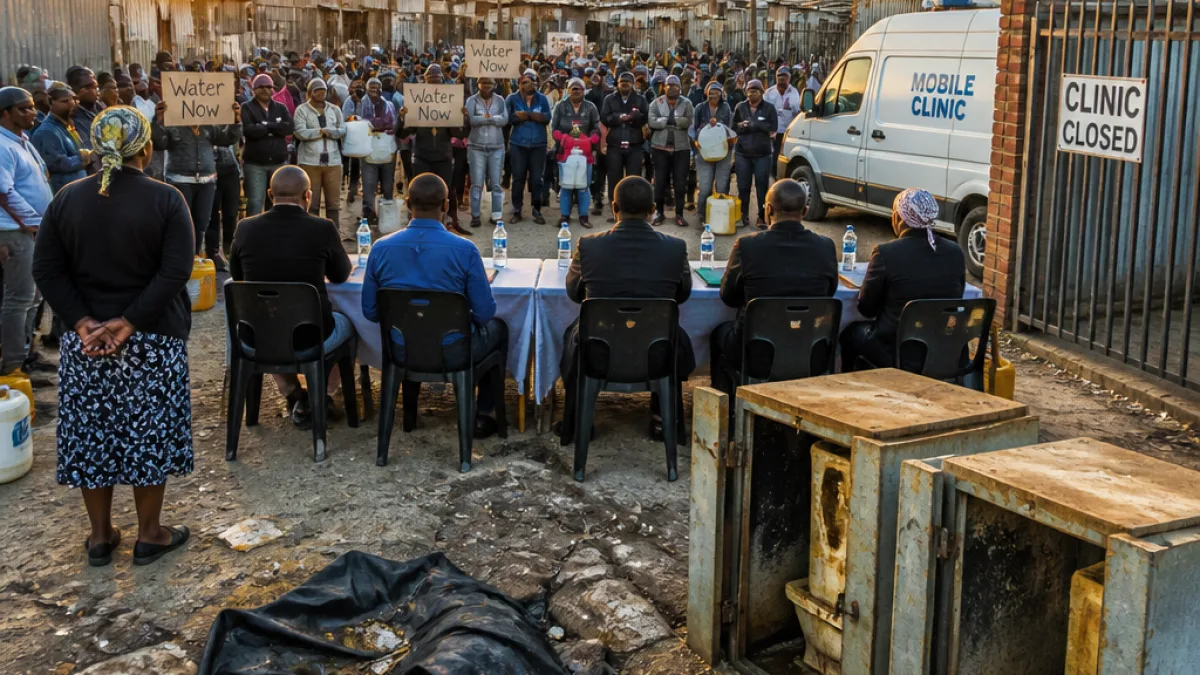
EMFULENI — Tensions and impatience were plain to see at the Ramaphosa Informal Settlement Imbizo on Wednesday as residents confronted provincial leaders about a catalogue of service delivery failures, including dry taps, broken toilets, poor roads and a lack of reliable healthcare.
Residents list priorities; clinic closure fuels anger
Acting Gauteng Premier Lebogang Maile, accompanied by MECs and Emfuleni local government officials, attended the community meeting held as part of the provincial "Imbizo Wednesdays" programme. Several residents used the platform to press for immediate fixes.
One of the most urgent complaints came from Kethani Khumalo, who said the local clinic is closed and forces families to travel to Vereeniging for treatment — a burden many cannot afford. She called for a mobile clinic to provide basic health services in the interim.
“We have a clinic problem. The clinic we have here doesn’t work and it’s closed. We have to go to Vereeniging, but don’t always have money for transport. We need a mobile clinic,” said Khumalo.
Another resident, Lindiwe Mbatha, pleaded for improvements to water and sanitation, saying broken toilets and unreliable water supply are daily realities. Mbatha also raised concerns over slow ambulance response times.
Broad list of community grievances
Residents raised a range of issues beyond health and sanitation, including:
- Unreliable water supply and non-functioning toilets;
- Poor road conditions affecting access and emergency services;
- High unemployment and few local economic opportunities;
- Electricity outages and illegal electricity-related hazards;
- A shortage of sports facilities and school infrastructure;
- Lack of visible policing, illegal taverns and scrapyards;
- Uncertainty over the settlement’s formalisation status.
Provincial response: honesty and limited promises
Maile acknowledged the frustrations, thanking residents for raising their concerns "respectfully" and saying the community was not insulting leaders but demanding solutions. He said the provincial government would be straightforward about what it can and cannot deliver.
On safety, Maile pointed to Community Policing Forum volunteers who patrol at night and urged that they be supported with basic equipment such as reflector jackets and torches.
Maile’s remarks signalled a pragmatic approach: an admission of limitations coupled with targeted support measures rather than broad immediate infrastructure rollouts.
What this means locally
The Imbizo highlighted the gap between community needs and what residents perceive as municipal and provincial delivery. For a settlement where access to basic services is intermittent, the closure of a clinic and broken sanitation infrastructure have immediate health implications, particularly for children, pregnant women and the elderly.
Residents’ demands for a mobile clinic are a practical short-term request that can ease pressure on families needing primary healthcare while longer-term repairs or a reopening plan for the clinic are negotiated.
| Issue raised | Provincial response |
|---|---|
| Closed clinic / health access | Premier acknowledged problem; mobile clinic requested by residents |
| Water and sanitation failures | Concern acknowledged; no immediate repair timeline announced |
| Crime and policing | Support for Community Policing Forum volunteers suggested |
Next steps and practical information
Residents should expect follow-up from municipal offices to map urgent repairs and to assess feasibility of a mobile clinic deployment. Community members who need assistance with transport to medical facilities were advised at the meeting to register specific cases with local ward councillors to help prioritise emergency referrals.
Provincial officials have the task of balancing immediate relief measures with long-term planning for formalisation and infrastructure investment — a process that typically requires budget allocations, intergovernmental coordination and timelines that can stretch over months.
The Imbizo emphasised that community pressure remains an essential accountability mechanism. For residents, the meeting was both a vent and a test of whether promises will be matched by action on the ground.
Key demand areas remain clear: restoration of clinic services or a mobile clinic, reliable water and sanitation, road repairs to improve access and emergency response times, and steps to address unemployment and illegal trading activities that affect safety and the local economy.














