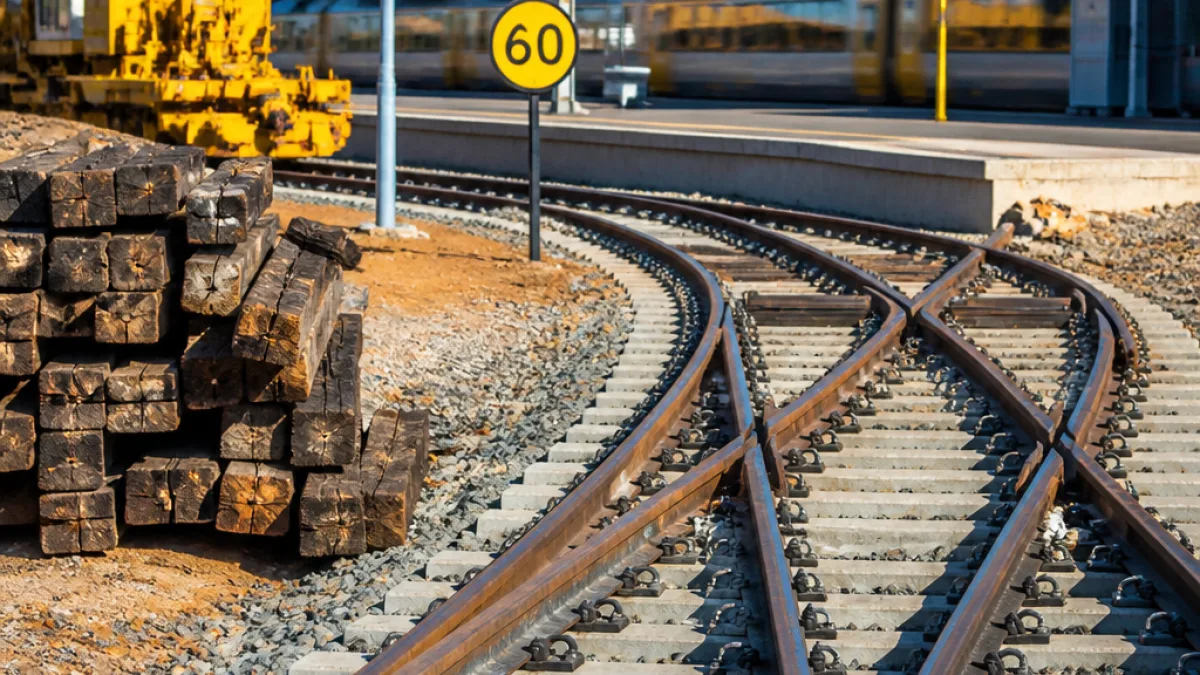
The Passenger Rail Agency of South Africa (Prasa) has completed installation, testing and commissioning of a new diamond crossing at Crossmoor Station in KwaZulu‑Natal, part of its multi‑year Passenger Rail Recovery Programme aimed at restoring capacity and reliability on the province's commuter network.
Faster, smoother and more durable track
The new crossing, delivered by Maziya Group subsidiary Maziya General Services in partnership with voestalpine South Africa (VAE SA), replaces an older installation that sat on wooden sleepers. Built on durable concrete sleepers and manufactured at VAE SA’s Isando facility in Johannesburg, the crossing will allow trains to move through the junction at higher speeds and with less vibration.
Prasa said the previous speed restriction of 15km/h over the old crossing has been lifted to 60km/h after completion of installation, testing and commissioning. The improved track geometry is also expected to reduce noise and vibration, producing smoother train movements through the section.
“The upgrade forms part of Prasa’s multi‑year Passenger Rail Recovery Programme and will dramatically improve reliability, safety and travel times for thousands of daily passengers,”
said Athanacious Makgamatha, executive: group capital delivery and execution at Prasa. Sizwe Mkhize, business development officer at VAE SA, described the diamond crossing as “a highly specialised piece of rail infrastructure” suited to areas with limited space.
How it was done
The installation of the diamond crossing and associated turnouts at Crossmoor was carried out using PEM‑LEM turnout replacement machines together with a specialised, dedicated track installation team. The teams managed placement, gauging, levelling and securing of rails and components to ensure the track geometry complies with operational and safety standards.
Heinrich Mostert, signalling director at Maziya General Services, said the upgrade also helps address capacity constraints on parts of the line previously affected by vandalism.
- Manufacturers & installers: VAE SA (manufacture) and Maziya General Services (delivery and installation)
- Technology used: PEM‑LEM turnout replacement machines and dedicated track teams
- Operational change: Speed restriction uplifted from 15km/h to 60km/h
- Materials: Concrete sleepers replacing wooden sleepers
Practical benefits for commuters
For daily passengers who use Crossmoor and adjacent sections, the work should mean shorter journey times through the junction and fewer delays caused by slow speed limits. The reduction in vibration and noise will also be welcome for both passengers and communities living close to the line.
Prasa has framed the intervention as part of a broader recovery programme. While this single upgrade will not resolve all challenges on the KZN network — which has faced sustained problems from vandalism, theft of infrastructure and operational undercapacity — it represents a concrete improvement in a specific chokepoint.
| Feature | Before | After |
|---|---|---|
| Speed limit | 15km/h | 60km/h |
| Sleeper type | Wooden sleepers | Concrete sleepers |
| Installation method | Older, worn installation | PEM‑LEM machines and specialised track team |
Context and limits
Prasa’s Passenger Rail Recovery Programme comprises multiple projects across lines and signalling systems. Upgrades such as the Crossmoor diamond crossing form part of efforts to restore service reliability and capacity. Officials link infrastructure improvements with broader objectives of restoring mobility, dignity and opportunity for commuters.
However, the agency still faces systemic challenges across the province. Vandalism and theft of rail infrastructure have been cited repeatedly as contributors to service disruptions. While targeted engineering works reduce bottlenecks, long‑term resilience will depend on sustained maintenance, security measures and network investment.
For passengers, the immediate practical impact is clear: trains should be able to pass the Crossmoor junction faster and with fewer interruptions. Commuters who rely on the network daily will be watching to see if the upgrade translates into consistently improved timetables and fewer unplanned delays.
Prasa did not provide a schedule for further works at Crossmoor or adjacent sections in its supplied statement. The agency said the installation had been completed and commissioned and emphasised that the work aligns with its multi‑year recovery plan.
Local rail users and community groups will likely expect follow‑up information from Prasa on maintenance plans and on how this upgrade connects with other recovery projects in KwaZulu‑Natal.