
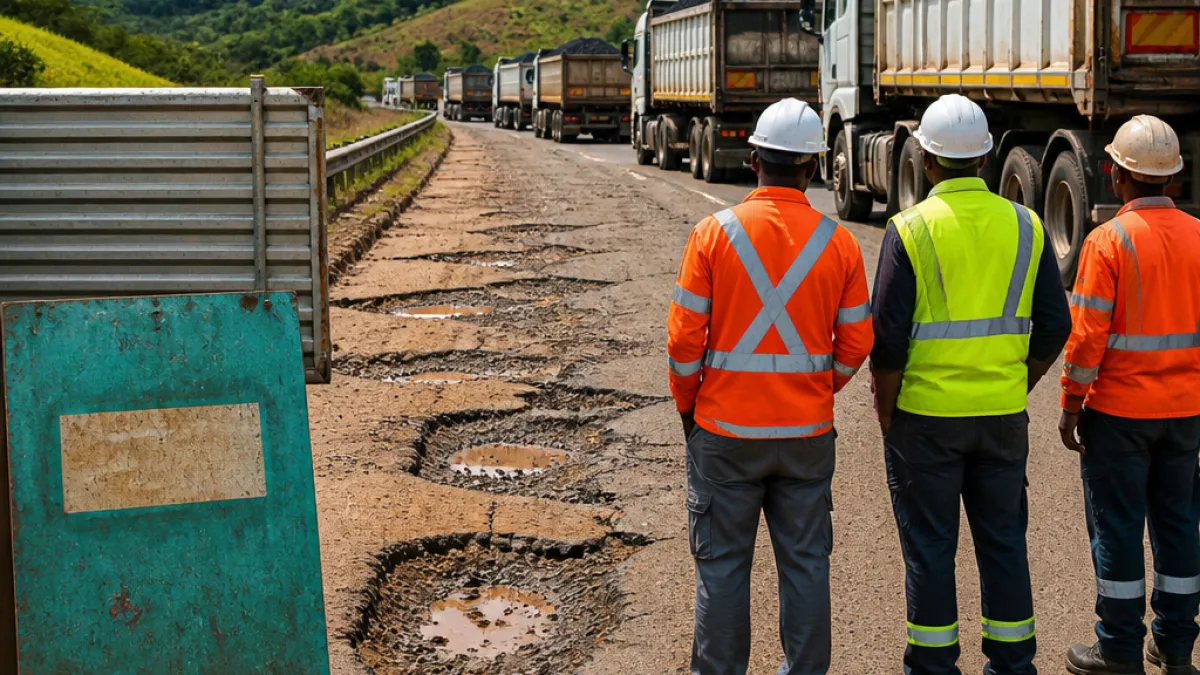
Mpumalanga officials have told the National Council of Provinces (NCOP) that the province requires roughly R38 billion to rehabilitate and maintain its badly damaged road network, underlining a growing safety and economic risk for motorists, tourists and freight operators.
Road transfers to SANRAL, but funds not included
During an oversight engagement on 18 August 2026, a delegation from the provincial Department of Public Works, Roads and Transport said a number of provincial routes were handed over to the South African National Roads Agency (SANRAL) because the province lacks the budget to carry out the necessary reconstruction and routine maintenance.
Provincial representatives and NCOP delegates inspected the severely degraded R36 in the Thaba Chweu Local Municipality and described the route as hazardous to road users. SANRAL confirmed the roads were transferred without an accompanying budget and will need to raise funds for reconstruction work.
"We wish SANRAL could speed up their processes because there is no road left there. What we saw there is serious hazard to our motorists and tourists who use that road daily,"
— Mpumalanga Provincial Whip in the NCOP, Syvia Nxumalo, speaking at the oversight visit.
Timing, costs and condition
SANRAL told the NCOP that work on the R36 is not expected to begin until 2028. Delegates said that timeframe is too slow given the current safety risk.
Officials said much of the province's network has been worn down by heavy loads — particularly coal-haulage trucks — and vehicles that would be better suited to rail transport. Some provincial routes are reported to carry more than 1,000 heavy trucks a day, accelerating pavement failure and drainage damage.
Local mitigation and maintenance needs
Mining companies operating in the affected area have made limited, interim contributions to improve safety; the NCOP noted an investment of R70 million by mining firms to make the R36 temporarily safer while plans for full reconstruction are prepared.
Delegates highlighted that some routes, such as the R37, mainly require maintenance work — cleaning drains and culverts, vegetation control, line marking, guardrail and sign repair, crack sealing, edge repairs and spot re-gravelling of shoulders — while the R36 will need complete rebuilding.
- Estimated rehabilitation need: R38 billion across Mpumalanga provincial roads.
- Key route for reconstruction: R36 (complete rebuild required; construction projected from 2028).
- Other concerns: R37 and various provincial routes needing routine maintenance.
- Interim funding: R70 million from mining companies for temporary safety improvements.
What this means for residents, tourism and freight
The deteriorating condition of these roads has direct consequences for local economic activity and safety. Poor road surfaces increase vehicle operating costs, heighten accident risk, and can deter tourists from travelling to attractions in the province. For commercial operators, higher maintenance costs and travel delays translate into greater logistics expenses.
Mpumalanga's officials and the NCOP noted that the pressure on roads is expected to ease when the planned road-to-rail migration for heavy bulk freight is implemented, reducing the number of heavy trucks using provincial routes. However, the migration is a medium- to long-term shift and will not resolve immediate hazards posed by failing pavements and damaged drainage.
Practical advice for road users
Motorists who use the R36 and other affected routes are advised to plan for slower travel, expect rough surfaces and watch for emergency repairs or temporary traffic measures. Tour operators and courier services should factor in additional travel time and the likelihood of detours. Road users should also report serious damage that poses immediate safety threats to local municipal or provincial road authorities so rapid-response teams can be deployed where possible.
| Road | Condition | Required action | Planned start |
|---|---|---|---|
| R36 | Severely degraded; hazardous | Full reconstruction | 2028 (SANRAL) |
| R37 | Worn; needs maintenance | Routine maintenance (drains, markings, shoulders) | Not specified |
Next steps
The transfer of routes to SANRAL with a condition that they will not be tolled after upgrades was welcomed by NCOP delegates as a positive intervention. The delegation urged SANRAL to accelerate planning and mobilisation of funds to address urgent safety concerns ahead of the 2028 reconstruction timeline.
Provincial leaders will also need to engage with national departments, SANRAL and private sector stakeholders to bridge the immediate funding gap for maintenance while broader capital funding and modal-shift strategies for freight are advanced.
For residents, commuters and businesses in Mpumalanga, the key questions remain who will pay for interim repairs, how quickly critical routes can be stabilised, and whether national and provincial actors can expedite work to reduce risk on roads that support livelihoods, tourism and the provincial economy.















