
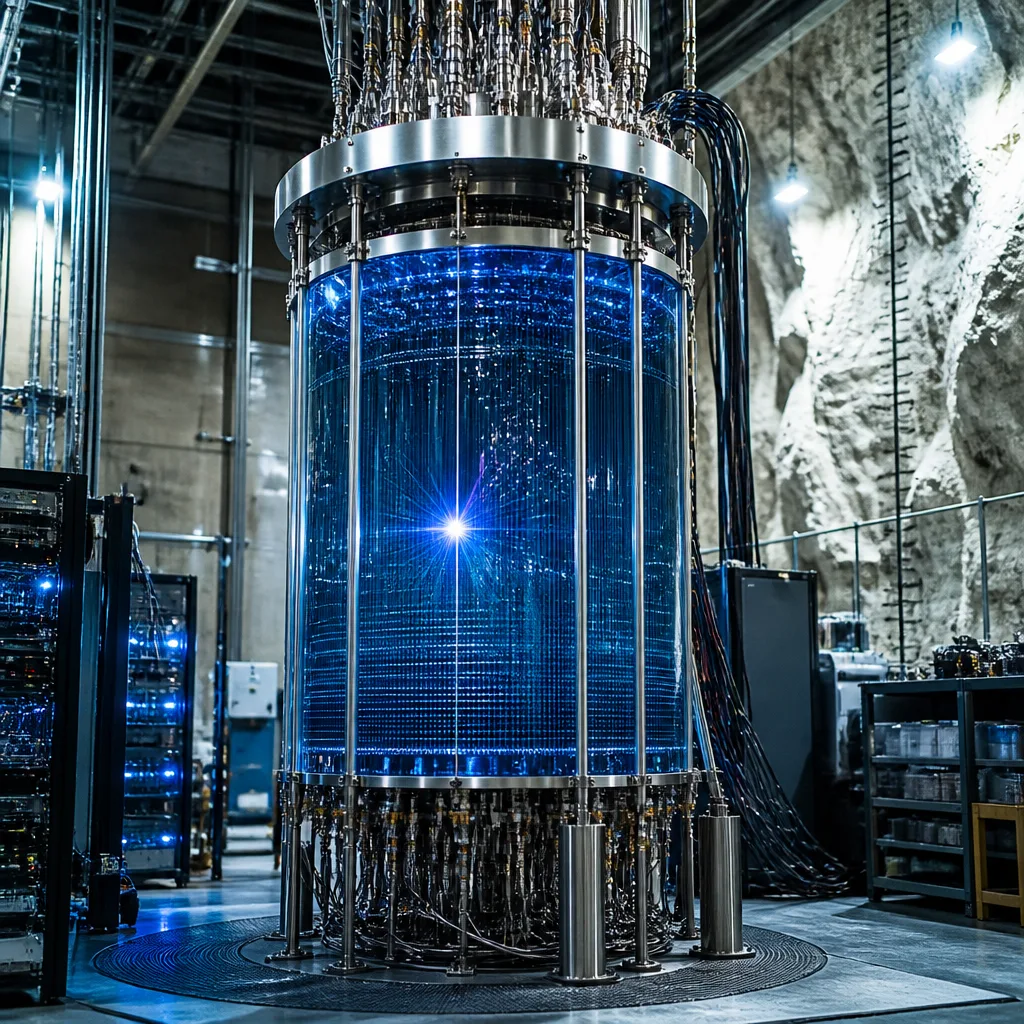
Scientists operating the LUX‑ZEPLIN (LZ) direct‑detection experiment at the Sanford Underground Research Facility (SURF) in South Dakota have reported a single event that may be consistent with a dark matter particle known as a weakly interacting massive particle (WIMP). The result was presented at the TeV Particle Astrophysics (TeVPA) conference in Tendo, Japan and has been reported by Popular Mechanics.
What was observed
According to the LZ team, the detector — a 10‑tonne tank of liquid xenon located nearly 5,000 feet underground to shield it from cosmic radiation — recorded an interaction in 2023 that produced the signature pattern expected from a WIMP colliding with a xenon nucleus. The experiment measures two distinct signals when such a collision occurs: an immediate flash of light from the xenon recoil and a delayed flash produced when freed electrons reach the top of the detector and are extracted into the gas phase.
“Absolutely fascinating,” said LZ spokesperson Rick Gaitskell when describing the event at the conference, according to reporting.
The team analysed the data from a running period that spanned roughly 220 days and identified this solitary candidate event among the dataset. The characteristics of the event are reported to be in line with theoretical expectations for certain WIMP models, but it remains a single occurrence.
Why one event is not enough
Direct detection of dark matter requires overwhelming statistical evidence because backgrounds — rare but known processes that can mimic the expected signal — can produce similar recorded flashes. The LZ collaboration has been designed to reduce and characterise such backgrounds, but a lone event cannot meet the usual threshold for discovery in particle physics.
- Event rate expectation: WIMPs are hypothesised to interact extremely rarely with ordinary matter, which is why multi‑year exposures and tonne‑scale targets are used.
- Detector signature: LZ looks for a prompt scintillation pulse and a delayed ionisation signal — the two‑signal pattern helps discriminate signal from background.
- Statistical standard: A claim of discovery typically requires a signal well above background fluctuations; a single event cannot establish that.
Context and next steps
Dark matter is inferred indirectly through its gravitational effects on galaxies and cosmic structure, but it has never been captured directly in a laboratory. WIMPs have been one of the leading candidates for decades; they would interact with ordinary matter through the weak nuclear force or gravity, producing rare nuclear recoils that experiments like LZ seek to detect.
The LZ team’s description makes clear this is an intriguing but preliminary result. The collaboration will continue to scrutinise the event, refine background estimates and collect further data. Independent experiments and additional LZ exposure will be necessary to confirm whether the interaction truly originates from a dark matter particle.
| Item | Detail |
|---|---|
| Detector | LUX‑ZEPLIN (LZ) — 10 tonnes of liquid xenon |
| Location | Sanford Underground Research Facility, ~5,000 feet underground |
| Data period referenced | About 220 days |
| Event timing | Occurred in 2023 |
| Reported at | TeV Particle Astrophysics conference, Tendo, Japan |
For South Africa, the result is important for its symbolic and practical connections to global particle physics. While the LZ detector is not located here, South African scientists and students have long engaged in international collaborations in particle astrophysics and cosmology; credible progress anywhere helps shape research priorities and funding conversations domestically.
In short, the LZ observation is a noteworthy hint, not a discovery. It underlines the sensitivity of modern direct‑detection searches and the need for continued data, independent verification and careful background control before the physics community can say whether dark matter has finally been caught in a detector.


