
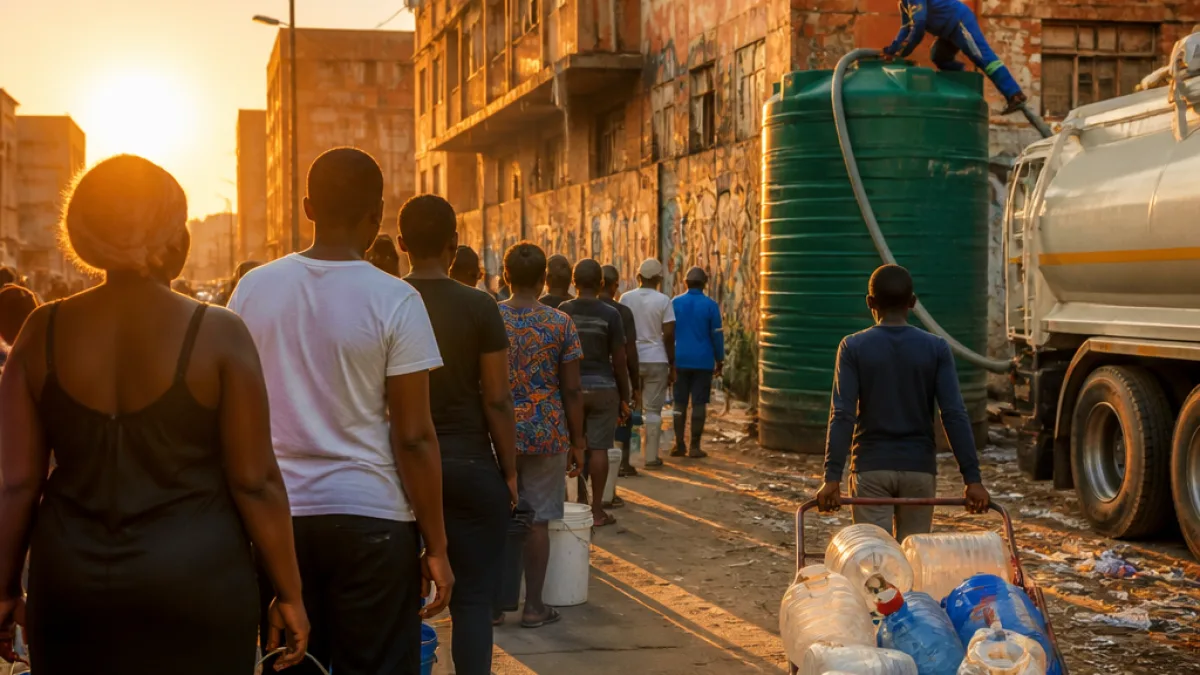
Daily searches for water in Hillbrow and Olievenhoutbosch
Johannesburg residents are once again confronting a reality of dry taps and long waits at communal filling points as the city struggles with ageing infrastructure and widespread pipe bursts.
Reuters reported that the metro is losing more than a third of its water supply — an estimated 655 million litres a day — through burst pipes. The loss has translated into chronic shortages for many households in inner-city neighbourhoods and outlying townships, with some blocks cut off from piped water for extended periods.
In Hillbrow a 17-year-old student, Thandani Masangu, described spending three hours wheeling empty containers on a trolley through the peeling, trash-strewn neighbourhood in search of water. His block, he said, has had no supply for more than three years. He and a friend found a tank being refilled by a municipal water truck but were told by a security guard that the supply was reserved for residents of an adjacent tower block.
- City-wide water loss: 655 million litres daily (reported)
- Long-term outages reported in inner-city blocks, including Hillbrow
- Residents resort to filling stations and municipal tanker deliveries
“I feel really broken,” the student said after searching for water in Hillbrow.
How residents are coping
Across the city, residents are carrying buckets and containers to communal filling stations and lining up when municipal tankers arrive. In the township of Olievenhoutbosch, people were seen collecting water from a nearby filling point, a scene Reuters captured during reporting on 7 August.
For households without reliable backup — such as rooftop tanks, boreholes or privately arranged deliveries — days with no municipal supply mean disrupted routines, challenges with hygiene, and extra expense. Older buildings in the inner city, where multiple households share limited facilities, are particularly vulnerable when supply is interrupted for extended periods.
Numbers and local impact
The scale of the reported losses is significant and has direct consequences:
| Item | Figure |
|---|---|
| Estimated daily water lost through burst pipes | 655 million litres |
That volume — equivalent to thousands of household days of supply — reflects both visible bursts and underlying network leakages. For residents who already contend with intermittent supply, the losses translate into more frequent and longer outages.
Questions for city managers and residents
The reported situation raises immediate questions about maintenance priorities, targeted repairs and the pace of infrastructure upgrades. Residents facing repeated outages will be looking to the metro for a clear plan that includes:
- Targeted repairs to reduce pipe bursts in high-loss areas
- Transparent reporting on where tankers are sent and why certain blocks are prioritised
- Support measures for households enduring prolonged outages
At a local level, community leaders and residents say they need reliable information about scheduled repairs and equitable access to emergency supplies. The images from Olievenhoutbosch and the testimony from Hillbrow underline how the crisis plays out on the ground: not as an abstract statistic but as daily hardship for families, learners and the elderly.
For now, many residents continue to improvise: queuing at filling stations, sharing scarce tanker deliveries and rationing water where it arrives. The challenge for the city is to turn the headline figure of lost water into a focused repair-and-response strategy that restores reliable taps for neighbourhoods that have been without for years.














