
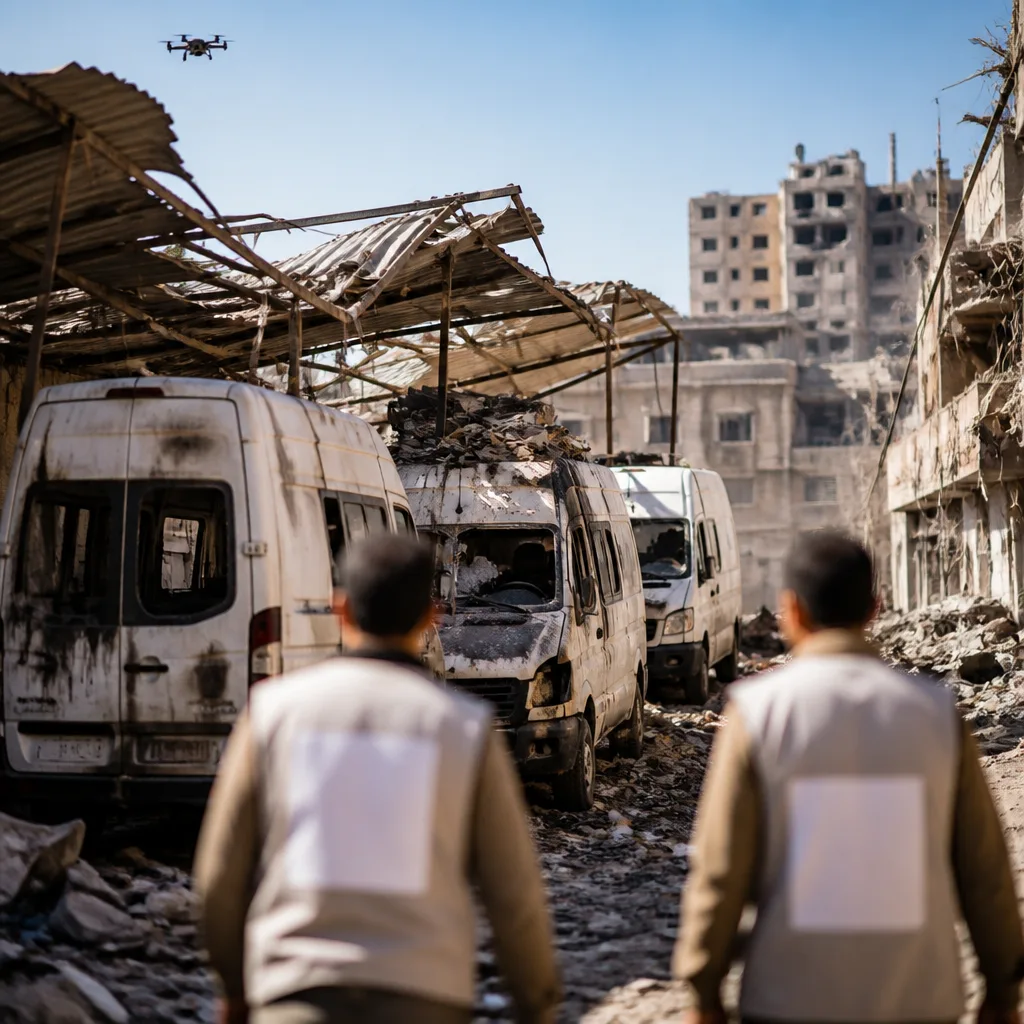
Seven humanitarian workers were killed when Israeli drones struck three clearly marked World Central Kitchen (WCK) vehicles in Gaza after a food delivery in April 2024, a Guardian investigation reports, and the incident was shaped by a military practice that treats proximity to armed people as grounds for targeting.
What the investigation found
The report says Israel Defence Forces (IDF) personnel applied a mode of assessment that effectively established “guilt by association”, marking the aid convoy as a potential target after a brief encounter between WCK staff and armed men. The encounter lasted only minutes and, according to the account, the armed men were assumed to be from Hamas — an assumption that subsequent information showed to be groundless.
Israeli military prosecutors later announced they would not pursue criminal charges over the strike. The official IDF explanation attributed the deaths to a series of errors by a small number of officers and criticised the convoy for deviating from its agreed route and for hiring armed guards. But interviews cited in the Guardian suggest the internal inquiry did not fully address the wider targeting practice that can place aid workers and civilians at risk.
“They were not innocent because they were connected to Hamas,” said reserve colonel Nochi Mendel, who ordered the strike, describing the brief contact between WCK staff and armed men as having caused them to be seen as “mixed together”.
The seven victims included three British nationals, an Australian, a Palestinian, a Pole and a dual US–Canadian national.
Human cost and wider context
The strike is set against the broader toll of the Gaza conflict. The report cites IDF figures indicating that in the three years of the war more than 70,000 Palestinians have been killed, and that the army’s own data suggests more than three-quarters of those fatalities were civilians.
Humanitarian agencies and legal experts have long warned that the safety of aid workers depends on clear rules of engagement and strict distinction between combatants and civilians. The Guardian’s reporting highlights how operational doctrines that allow personnel to be targeted because of proximity to armed individuals can undermine those protections.
- Event: Drone strikes on three marked WCK vehicles, April 2024.
- Casualties: Seven international aid workers killed.
- Official response: Military prosecutors declined to press charges; IDF cited mistakes and alleged route deviation and armed guards.
Implications for humanitarian operations
The incident underscores operational hazards for organisations delivering aid in active conflict zones. When militaries apply broad criteria for identifying legitimate targets, civilian relief efforts can be imperilled — complicating efforts to reach populations in dire need and heightening the legal and moral scrutiny on armed forces’ targeting practices.
For South Africa, which has been a consistent voice in international fora on civilian protection and adherence to international humanitarian law, the case adds to debates over accountability in modern urban and asymmetric conflicts. It also reiterates concerns raised by aid groups about the security of international staff and the conditions under which convoys operate.
| Item | Detail |
|---|---|
| Number killed | 7 |
| Nationalities | Three British; one Australian; one Palestinian; one Polish; one dual US–Canadian |
| IDF stance | Blamed officer mistakes; cited armed guards and deviation from route; prosecutors did not pursue charges |
The Guardian investigation presents testimony from senior Israeli officers and documents that challenge the official narrative. It asserts that the concept of being “mixed together” with armed men — described in operational terms as being “near them, talking, playing, hanging out and so on” — was used to justify target selection in this instance.
Whether this approach will prompt renewed calls for independent inquiries, changes to military targeting doctrine, or shifts in how humanitarian organisations operate in Gaza remains to be seen. For now, the episode is a stark reminder of the lethal consequences that follow when the lines between fighters and civilians are blurred in practice.