
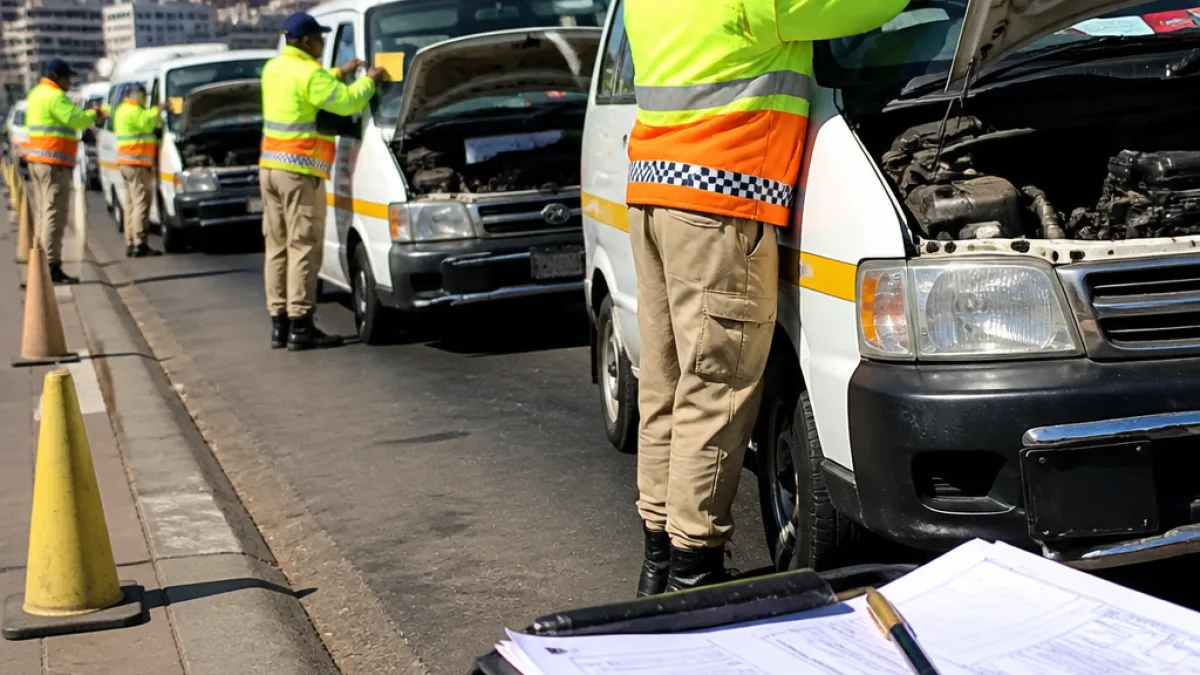
Gauteng traffic officers have taken 14 unroadworthy minibus taxis off the province’s roads and issued hundreds of fines after a week-long operation aimed at cleaning up high-risk public transport corridors.
Operation targets taxis and dangerous vehicles
The Gauteng Traffic Inspectorate (GTI), in partnership with the Road Traffic Management Corporation (RTMC), ran the stop-and-search actions across major metropolitan municipalities between 3 and 9 August as part of the #RemoveSkorokoro campaign, the provincial roads department said.
Inspectors focused on vehicles with serious mechanical defects and on people operating without proper documentation. The department said discontinuations and fines were intended to reduce crashes, deter criminality and bolster compliance with road traffic laws.
What the week produced
- 14 minibuses discontinued for serious mechanical defects, including faulty brakes, worn tyres and defective lighting.
- 20 discontinue notices issued to noncompliant motorists: 2 in Tshwane, 13 in Johannesburg and 5 in Ekurhuleni.
- 48 minibus drivers found driving without valid licences.
- 43 vehicles operating without valid licence discs.
- More than 500 manual AARTO infringement notices issued and an additional 647 electronic notices processed via e-Force devices.
| Area | Electronic notices processed | Discontinue notices |
|---|---|---|
| Tshwane | 252 | 2 |
| Johannesburg | 254 | 13 |
| Ekurhuleni | 64 | 5 |
| Mogale City | 49 | — |
| Sebokeng | 26 | — |
“A public transport vehicle that is mechanically unsafe has no place on Gauteng’s roads,” Gauteng Roads and Transport MEC Kedibone Diale-Tlabela said, applauding the inspectorate’s work.
The department said the electronic notices were processed using the inspectorate’s e-Force devices and provided a breakdown by municipality: 252 in Tshwane, 254 in Johannesburg, 64 in Ekurhuleni, 49 in Mogale City and 26 in Sebokeng.
What this means for commuters and taxi associations
The findings are likely to unsettle commuters who depend on minibus taxis for daily travel. Vehicles with faulty brakes, worn tyres and lighting pose immediate risks in high-speed and high-density corridors. The discovery that dozens of drivers lacked valid licences raises questions about operator screening and training.
MEC Diale-Tlabela urged taxi associations to act against unlicensed drivers, according to the department. The appeal places responsibility on industry structures to police themselves and remove dangerous operators before law-enforcement steps in.
For passengers, simple precautions remain important: check that a taxi displays a licence disc, look for a valid operator vehicle permit where visible, and avoid travelling in a vehicle with obvious mechanical problems.
Enforcement and accountability
Inspectors handed out more than 500 manual AARTO infringement notices in addition to the 647 electronic notices, signalling a broad enforcement push beyond vehicle discontinuations. The department framed the operation as both punitive and preventative.
While the week-long operation produced tangible results, sustained compliance will hinge on regular inspections, better maintenance practices among operators and active enforcement of licensing rules. The department’s intervention highlights the ongoing tension between keeping transport services running and ensuring they meet minimum safety standards.
The GTI and RTMC did not provide further detail on follow-up inspections, prosecutions or whether discontinued vehicles were impounded or given timelines for repairs. It also remains unclear how many of the unlicensed drivers will face criminal charges or administrative penalties after cases are opened at relevant police stations.
Gauteng’s roads remain busy and, during peak periods, dominated by public transport. The province’s move to target high-risk routes is likely to continue as authorities seek to reduce crashes and restore confidence in regulated transport systems.
Local commuters and operators can expect further high-impact operations, the department indicated, as it prioritises road safety ahead of the festive season and other high-traffic periods.














