
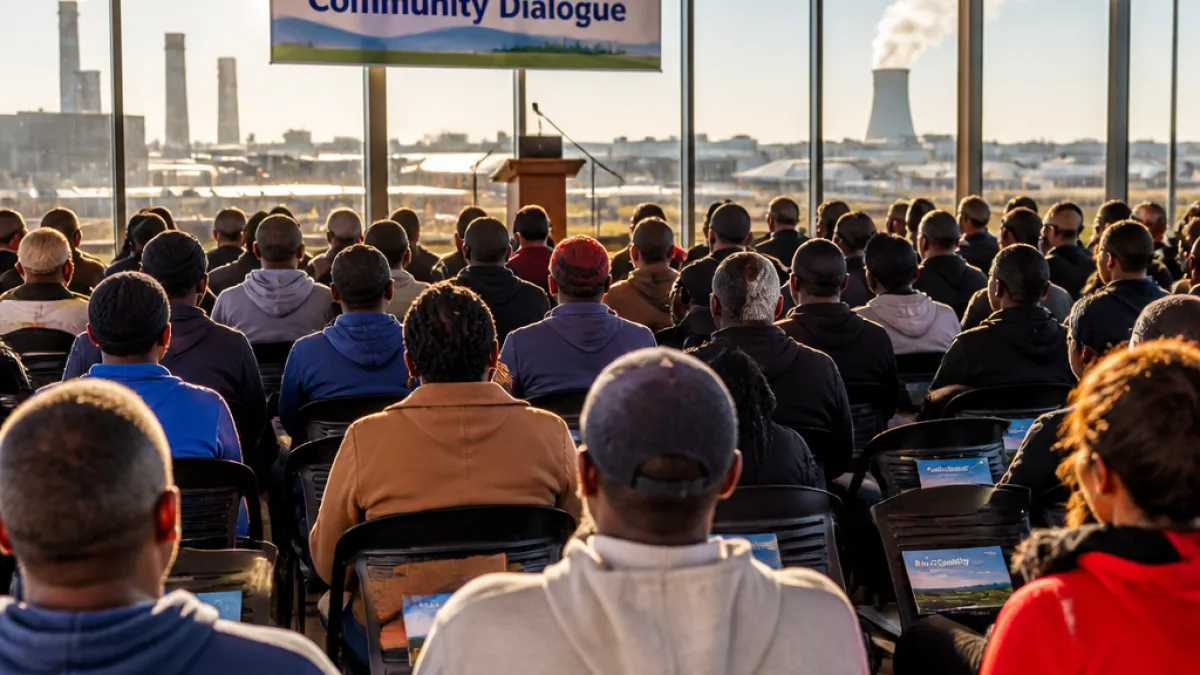
Call for industrial responsibility as Secunda communities face air‑quality pressures
The Deputy Minister for Forestry, Fisheries and the Environment, Bernice Swart, has urged industries operating in and around Secunda to step up interventions to reduce air pollution and protect local communities. Swart spoke at a Clean Air Community Dialogue at the Lillian Ngoyi Centre on 3 August, which brought together government, air‑quality experts, business representatives and residents.
Swart framed the meeting as part of the department’s Clean Air Conversations Programme and emphasised the links between clean air, public health and the local economy.
“We are here because clean air is essential to human health, environmental sustainability and economic prosperity,”she said, adding that air quality affects the health of children and the elderly, worker productivity and long‑term competitiveness.
She acknowledged Secunda’s economic role through energy, petrochemical, mining and manufacturing activities, but warned that these sectors also exert significant pressure on local air quality. According to the dialogue summary, the main contributors discussed included industrial emissions, mining operations, transport, domestic fuel burning, dust and open burning of waste.
- Strengthen monitoring: Swart said the department is committed to improving air‑quality monitoring and compliance systems but called on industry to deploy technologies and share data.
- Improve enforcement: Government indicated it will focus on compliance and enforcement where standards are breached, while urging cooperative approaches to reduce emissions.
- Protect vulnerable communities: The Deputy Minister stressed that communities close to industrial zones should not carry a disproportionate burden of pollution and related health impacts.
Participants at the dialogue included air‑quality experts who outlined technical and practical interventions for reducing emissions and exposure. The meeting emphasised collaborative planning between government, industry and communities to develop pragmatic responses that address both immediate health concerns and longer‑term sustainability.
| Issue | Concern raised at dialogue |
|---|---|
| Industrial emissions | Major contributor to local pollution burden; need for tech upgrades and reporting |
| Domestic fuel burning & open burning | Elevates particulate matter exposure for communities |
| Transport & dust | Localised hotspots requiring mitigation and road maintenance |
The Deputy Minister urged industries in the Highveld Priority Area to strengthen commitments to reduce emissions, saying clean air is essential for “the quality of life of communities”. While government described its role as enhancing monitoring, compliance and enforcement, Swart was clear that industry must provide resources and technology to improve outcomes.
Local residents who attended the session raised concerns about health impacts, smell episodes and visible smoke. The dialogue sought to move beyond complaints to identify practical, collaborative steps that could improve conditions in the short and medium term.
From a regional perspective, Secunda’s air‑quality challenges intersect with economic activity that supports jobs and services. Any measures to reduce pollution will therefore need to balance public‑health protections with the realities of local employment and energy supply. The Clean Air Conversations Programme, as described at the dialogue, aims to create that space for joint planning and technical exchange.
For Secunda residents, the next steps to watch include increased monitoring data being shared publicly, follow‑up meetings to track commitments made by industry and government, and targeted interventions in neighbourhoods where exposure is highest. The dialogue underlined that while government can set standards and enforce compliance, industries have the expertise and capital needed to implement many practical solutions.
As the Highveld Priority Area continues to draw national attention, Secunda’s experience will be important for shaping how policymakers, firms and communities co‑operate to reduce air pollution without undermining the local economy.












